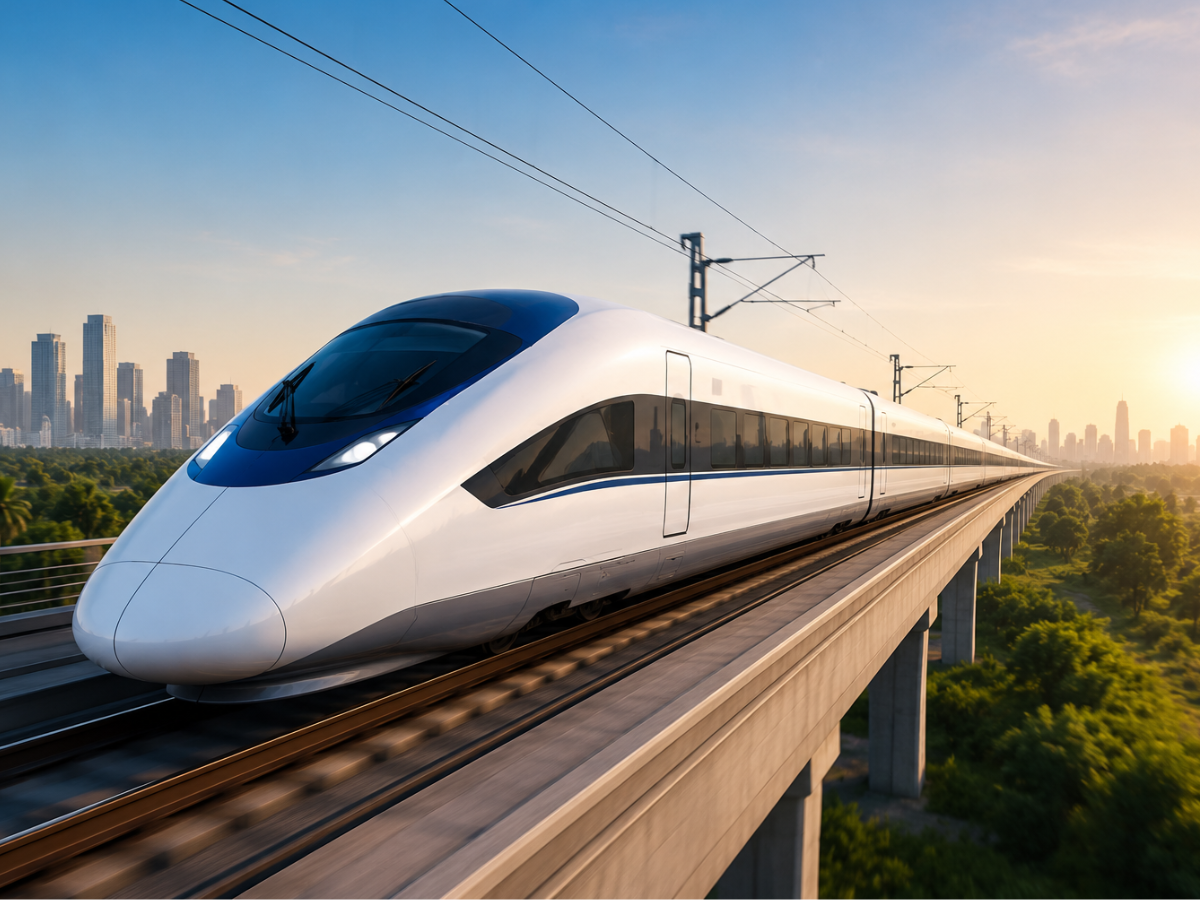
India’s high-speed rail ambitions have taken a significant leap forward with reports indicating that the Detailed Project Report (DPR) for the proposed Hyderabad-Mumbai Bullet Train Corridor has been finalized. The ambitious project aims to connect Hyderabad and Mumbai through a 761-kilometre high-speed rail network capable of reducing travel time between the two cities to just three hours. Estimated to cost around ₹2 lakh crore, the corridor is expected to pass through Telangana, Karnataka and Maharashtra, connecting major economic and industrial hubs along the route. If approved by the Centre, construction could begin between 2027 and 2028, further strengthening India’s growing transportation infrastructure and boosting regional economic development.
The finalisation of the DPR marks an important step in India’s efforts to expand its bullet train network beyond the under-construction Mumbai-Ahmedabad High-Speed Rail Corridor.
The Hyderabad-Mumbai route is being viewed as one of the country’s most strategically important high-speed rail projects because it will connect two major metropolitan regions that play a crucial role in India’s economy. Hyderabad has emerged as a leading technology and pharmaceutical hub, while Mumbai remains the country’s financial capital.
By linking the two cities through a modern bullet train system, authorities aim to create faster mobility, encourage business travel and stimulate investment across multiple regions.
According to the proposed alignment, the high-speed corridor will span approximately 761 kilometres and include stations across three states.
The inclusion of multiple intermediate stations is expected to improve connectivity not only between Hyderabad and Mumbai but also among several rapidly developing urban centres and industrial zones.
One of the biggest advantages of the proposed corridor is the significant reduction in travel time.
Currently, train journeys between Hyderabad and Mumbai can take anywhere from 12 to 16 hours depending on the service. Even air travel often involves additional time spent on airport transfers, security checks and boarding procedures.
The proposed bullet train would reduce end-to-end travel time to approximately three hours, making same-day business travel between the two cities far more practical and efficient.
This improvement could transform travel patterns for business executives, students, tourists and professionals who frequently move between the two metropolitan centres.
Experts believe the Hyderabad-Mumbai Bullet Train Corridor could become a major economic catalyst for the regions it serves.
Improved transportation infrastructure often attracts new industries, logistics hubs and commercial investments. Cities such as Solapur, Kalaburagi and Baramati could witness increased economic activity as they become part of a high-speed transportation network.
The project is also expected to generate thousands of jobs during the construction phase, including opportunities in civil engineering, manufacturing, transportation and related sectors.
In the long term, the corridor could contribute to regional development by encouraging urban expansion and creating new business opportunities along the route.
The estimated project cost of around ₹2 lakh crore highlights the scale and complexity of the undertaking.
The investment will cover land acquisition, track construction, station development, signaling systems, rolling stock and supporting infrastructure.
Funding mechanisms are yet to be finalized, but officials are expected to explore a mix of government funding, international partnerships and institutional financing similar to other major infrastructure projects.
The final cost could vary depending on land acquisition requirements and engineering challenges encountered during implementation.
If the project receives the necessary approvals from the central government and relevant authorities, construction is expected to commence between 2027 and 2028.
Large-scale high-speed rail projects typically require several years for land acquisition, environmental clearances and detailed engineering work before full-scale construction begins.
Industry experts believe the project could take close to a decade to complete once construction starts, depending on funding availability and execution efficiency.
The Hyderabad-Mumbai Bullet Train Corridor represents a broader shift toward modern transportation systems in India.
As urban populations continue to grow and demand for faster travel increases, high-speed rail is increasingly being viewed as a sustainable alternative to congested highways and crowded airports.
The proposed corridor could eventually become part of a larger national high-speed rail network connecting major cities across India, helping improve mobility while reducing travel times significantly.
The finalisation of the DPR for the Hyderabad-Mumbai Bullet Train Corridor marks a major step toward realizing one of India’s most ambitious transportation projects. With a proposed length of 761 kilometres, a travel time of just three hours and an estimated investment of ₹2 lakh crore, the corridor has the potential to transform connectivity between Telangana, Karnataka and Maharashtra. While several approvals and clearances still lie ahead, the project underscores India’s commitment to building world-class transportation infrastructure capable of supporting future economic growth and regional development.
Also Read: Pawan Singh Enters Bihar Politics: BJP Fields Bhojpuri Star For Legislative Council Polls
I am a seasoned writer with 2.5 years of experience who presently works at ITV Digital. I specializes in entertainment journalism, reporting on the newest Bollywood news as well as compelling healthy lifestyle pieces. I am master at creating material around popular issues and internet buzz, bringing unique, reader-friendly viewpoints to every item i write
Srinagar Protesters Seek Global Action Over PoK Violence
Social activist Javid Beig led a protest outside the UN office in Srinagar against alleged…
TMC MP Kalyan Banerjee Heckled At Kolkata Airport. Crowd Raises Chor Chor Slogans
TMC MP Kalyan Banerjee was heckled at Kolkata airport by a group chanting 'Chor Chor'…
XLRI Welcomes the Incoming Batch of 2026–28 with Prayer Service and Induction Ceremony
Jamshedpur (Jharkhand) [India], June 9: XLRI – Xavier School of Management, Jamshedpur, formally welcomed the…
