

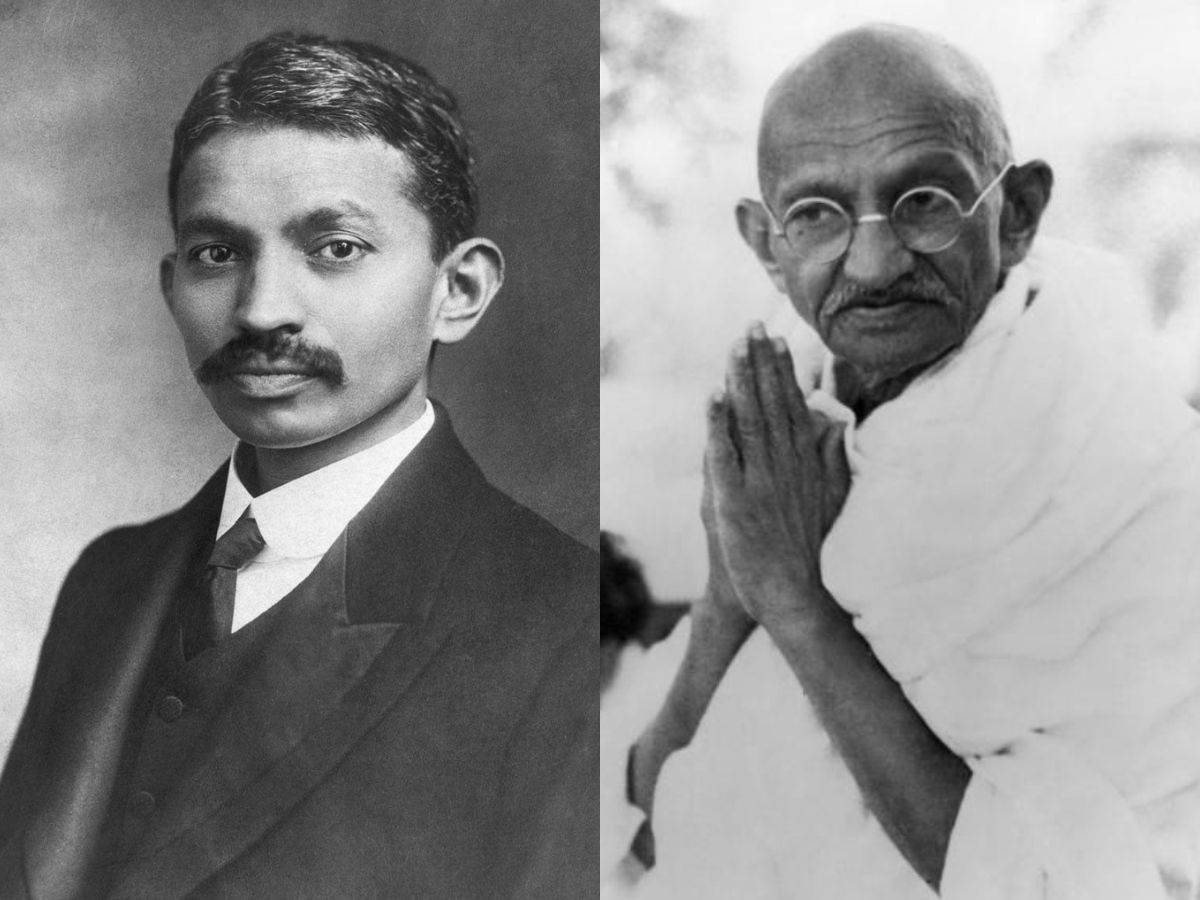
Whenever there is a discussion about India’s Freedom Movement, one name that has placed itself as the face of India’s non-violent freedom struggle is Mahatma Gandhi. But the journey to become Mahatma from Mohandas was not easy. Before establishing himself as the leader of a mass movement, Gandhi was trying to find his place in the world as a young lawyer.
His journey to become Mahatma began way before joining India’s freedom movement. A major part of it unfolded thousands of kilometres away in South Africa. He spent 21 years there, although he was supposed to be part of a short legal assignment in 1893. His life experiences in South Africa changed his career, politics and approach to fighting injustice.
Gandhi Before South Africa: From London Law Student To Struggling Lawyer
Born in Porbandar in 1869 as Mohandas Karamchand Gandhi. He was 18 years old when he travelled to London to study law. He joined the Inner Temple and was called to the Bar in June 1891. After completing his education there, he returned to India and tried to establish himself as a lawyer.
Things did not go as planned. His early legal practice in Bombay was unsuccessful. Gandhi was also known for being extremely shy. He found it difficult to speak confidently in court. He later returned to Rajkot, where he worked on legal drafting and petitions. Then came an offer that would change his life.
Why Did Gandhi Go To South Africa?
In 1893, an Indian merchant, Dada Abdullah, needed legal assistance in a commercial dispute in South Africa. Gandhi was offered a one-year assignment to assist the firm. He travelled to South Africa as a young London-trained barrister, not as a political leader.
The High Commission of India in Pretoria says Gandhi arrived in South Africa on May 24, 1893, to handle the legal matter involving Dada Abdullah Jhaveri. His job was initially straightforward. He was expected to help with the case and legal correspondence. But within weeks, his life took a dramatic turn.
The Train Incident That Changed Gandhi’s Life
While travelling to Pretoria, Gandhi was in a first-class train compartment. He had a valid first-class ticket. At Pietermaritzburg, railway officials ordered him out of the compartment because of his race. He was thrown off the train on June 7, 1893.
Gandhi spent the night in the station’s waiting room. The incident forced him to confront racial discrimination directly. Instead of simply completing his legal assignment and returning to India, he decided to stay and fight discrimination against Indians in South Africa.
The High Commission of India describes the incident as a turning point in Gandhi’s life. Gandhi later wrote, “My active non-violence began from that date.” That night in a railway station would eventually become one of the most important moments in Gandhi’s transformation.
Gandhi Becomes A Leader In South Africa
Gandhi gradually moved beyond his legal work. In 1894, he helped establish the Natal Indian Congress. The organisation worked on issues affecting the Indian community, including political rights and discrimination.
He also began using petitions, public meetings, negotiations and organised campaigns to challenge discriminatory policies. His activism did not always protect him from violence.
When Gandhi returned to South Africa with his family in 1896, a white mob attacked him after he arrived in Durban. He survived the assault and continued his work.
Gandhi Was Also A Lawyer, Writer And Community Organiser
Gandhi’s South African years were not limited to protests. He established a legal practice in Johannesburg in 1903. Much of his time, however, was increasingly spent on community and political work.
He also founded the Phoenix Settlement near Durban in 1904. It became a centre for community living and later supported his campaigns.
Gandhi also became involved with the newspaper Indian Opinion. The publication helped him communicate with and organise the Indian community. His work was slowly expanding from courtroom arguments to public campaigns and community mobilisation.
When Did Gandhi First Use Satyagraha?
South Africa was where Gandhi developed and first used Satyagraha, his method of non-violent resistance. In 1906, he organised a major protest in Johannesburg against rules requiring Indians to register and carry passes. More than 3,000 people attended a meeting at the Empire Theatre.
Gandhi refused to accept the discriminatory registration system. He was arrested and imprisoned several times during his South African campaigns. In 1908, he was imprisoned for refusing to obey an order to leave Transvaal. Later that year, he organised a large public burning of registration passes.
Tolstoy Farm: Gandhi’s Experiment In Simple Living
In 1910, Gandhi founded Tolstoy Farm near Johannesburg with the support of his close friend Hermann Kallenbach. The settlement became a training centre for people involved in Satyagraha. Residents followed a simple lifestyle and took part in education and manual work.
The High Commission of India says the farm covered about 1,100 acres and had around 85 permanent residents. It became an important centre of Gandhi’s political work in South Africa.
Gandhi Returns To India After 21 Years
As early as 1913, Gandhi started yet another fight against the discriminatory laws affecting Indians. Many women, including Kasturba Gandhi, joined in the effort and were imprisoned. The movement finally led to the passing of the Indian Relief Act of 1914, which did away with some of the discriminatory laws.
Gandhi returned from South Africa in July 1914 and reached Mumbai on January 9, 1915. At that time, Gandhi was 45 years old. No longer the young lawyer who had left India for a one-year stint was now back.
In South Africa, Gandhi got his first lesson in organised opposition. South Africa was where Gandhi formulated Satyagraha and experimented with nonviolent methods of protest, which he would employ on an even bigger scale in India. The most famous phase of Gandhi’s life was yet to come, but the making of Gandhi had begun in South Africa.
Sudeep Singh Rawat is a Copy Editor at NewsX Digital with over five years of experience in digital journalism. He covers national and international news, with a focus on politics, crime, technology, public affairs, and trending topics. Before joining NewsX Digital, he worked with Business Standard, The Sunday Guardian, and other digital media organisations. His reporting focuses on breaking news, enterprise stories, and explainers that inform readers through accurate, balanced, and context-driven journalism.