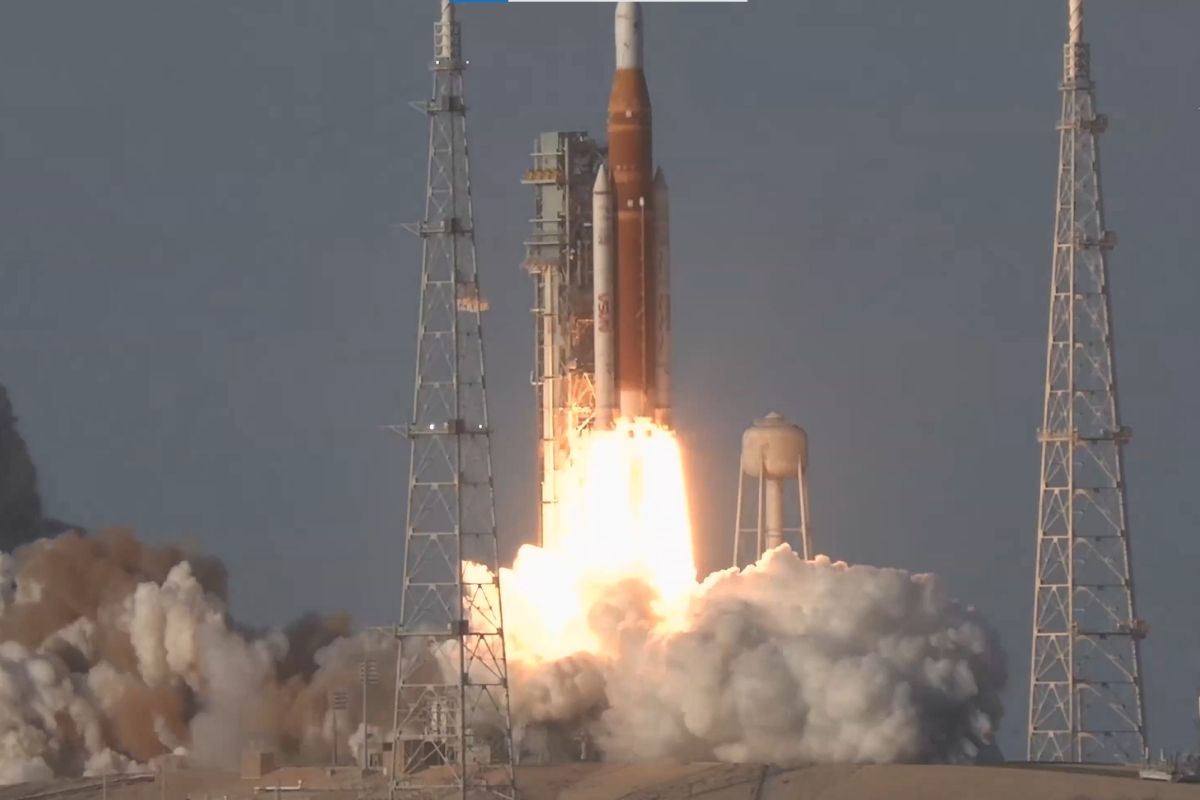
Artemis 2 launched, credit: NASA
The National Aeronautics and Space Administration (NASA) agency has launched its historical mission, Artemis II, on 2nd April 2026 from Kennedy Space Centre in Florida from launch Pad 39B. Artemis II is marked as the biggest space project in 50 years.
The space agency has launched the project with four crew members who will be landing near the moon for the first time. The rocket liftoff at 6:24 PM EDT (3:54 AM IST).
The four crew member on the space craft are Americans named Reid Wiseman, Christina Koch, Victor Glover, and Canadian Jeremy Hansen.
The Artemis II mission uses the Space Launch System (SLS) rocket and the crew capsule named Orion. The SLS will propel Orion into a free return trajectory around the far side of the moon, reaching around 7,500km from the moon’s surface before the earth’s gravity pulls them back to splash down in the Pacific Ocean in a little over a week.
When the astronauts return from the Moon, their spacecraft slams back into Earth’s atmosphere at around 40,000 km per hour which is enough speed to heat up the outer surface of the spacecraft up to the temperatures hotter than the surface of the sun.
The only thing standing between the crew and that inferno is what is called a heat shield which is a thick protective layer at the base of the capsule designed to absorb and shed that heat.
While uncrewed Artemis I test flight in 2022, engineers discovered the Orion capsule’s heat shield suffered unexpected damage during its high-speed return from the Moon. They had expected the heat, and the surface to get charred by it, but the material as a whole was supposed to stay intact and provide insulation. It didn’t.
Instead, the material from the shield broke off unevenly, causing heat to build up inside the outer layer, trapping gases, and raising the internal pressure. Which then caused cracking and uneven shedding as the spacecraft dipped in and out of the atmosphere on its return to Earth.
In Artemis 2, NASA is not replacing the heat shield. The agency is changing the re-entry path to minimise the intensity of heating. Re-entering the Earth without a redesigned heat shield is a risk NASA has decided to take willingly.
Inside the Orion capsule, a life support system continuously monitors and maintains oxygen, temperature, and cabin pressure. Basically, it monitors everything that keeps the crew alive.
The previous mission of Artemis I carried no astronauts, but Artemis II will consist of a fully operational environmental control and life-support system letting astronauts live and work aboard Orion throughout the mission.
The engineers and scientists are still working on issues related to life support systems as well as electrical system batteries during abort operations.
NASA claims that sufficient progress has been made to proceed. However, the system will only truly be proven once the mission is completed
Syed Ziyauddin is a media and international relations enthusiast with a strong academic and professional foundation. He holds a Bachelor’s degree in Mass Media from Jamia Millia Islamia and a Master’s in International Relations (West Asia) from the same institution.
He has work with organizations like ANN Media, TV9 Bharatvarsh, NDTV and Centre for Discourse, Fusion, and Analysis (CDFA) his core interest includes Tech, Auto and global affairs.
Tweets @ZiyaIbnHameed
US President Donald Trump warned that the United States could strike every electric generating plant…
Faisal bin Farhan and Antonio Guterres discussed efforts to ease rising tensions in West Asia…
Kamal Kharazi, a senior adviser to Iran’s supreme leader, was injured in a US-Israeli strike…
