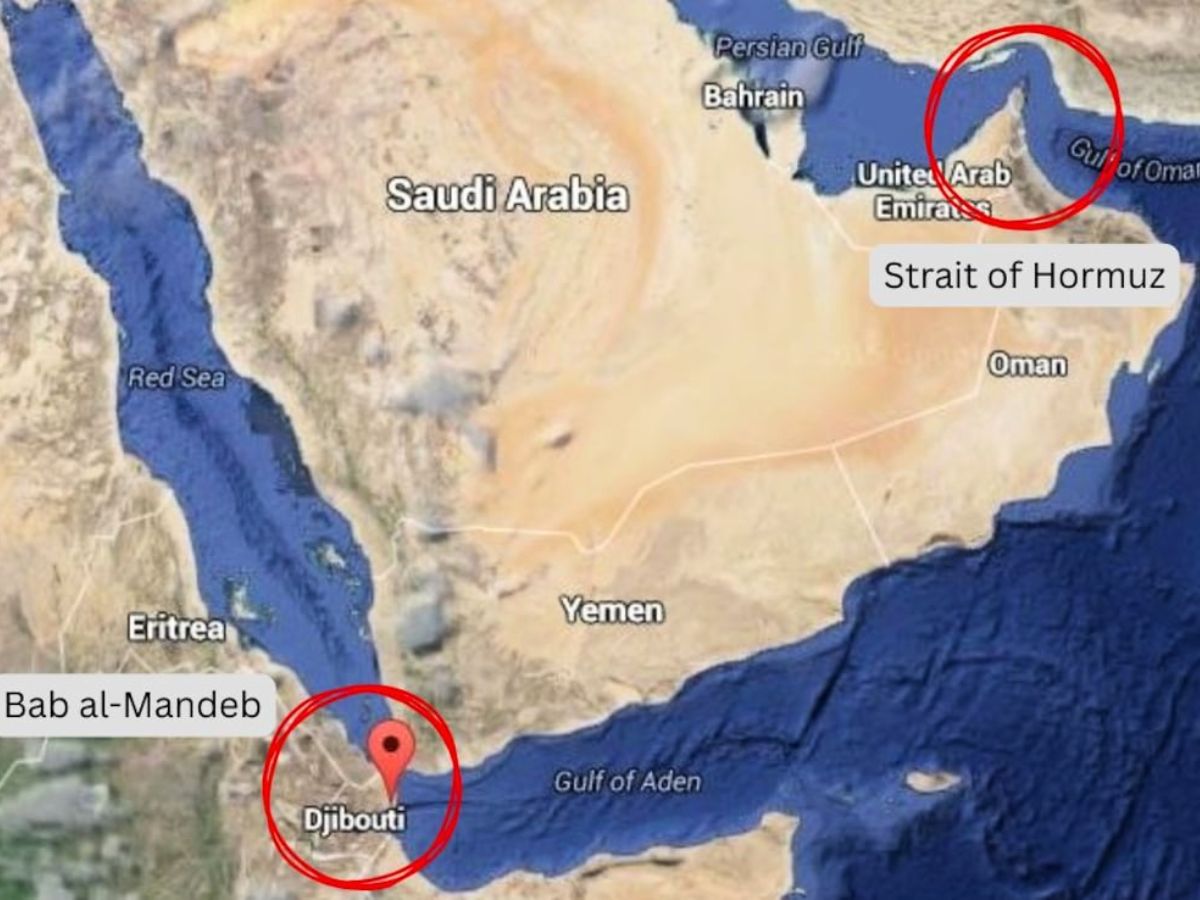
After Hormuz tensions, Bab al-Mandab faces IRGC-backed threats. (Photo: X)
As tensions escalate in the ongoing US-Iran conflict, global attention is shifting from the Strait of Hormuz to another critical maritime route, the Bab al-Mandab Strait.
Often referred to as the “Gate of Tears,” this narrow passage connecting the Red Sea to the Gulf of Aden is now emerging as a potential second flashpoint.
The concern comes at a time when the Strait of Hormuz through which nearly 20% of the world’s oil passes remains under severe strain following weeks of drone and missile exchanges between Iran and US-Israeli forces.
The Bab al-Mandab Strait may not match Hormuz in sheer oil volume, but its strategic importance is undeniable. Roughly 12–14% of global trade passes through this corridor, making it a lifeline for shipments between Europe, Asia, and the Middle East.
The strait allows ships to cut travel distance significantly. For instance, oil tankers moving from Saudi Arabia to Europe can save thousands of kilometres by passing through the Red Sea instead of navigating around Africa.
According to estimates, around 4.2 million barrels of oil per day transit through this route, a figure that underscores its growing importance, especially as disruptions hit other supply lines.
The crisis in the Strait of Hormuz has already rattled global energy markets. Iran’s geographic advantage controlling the northern coastline allows it to monitor and potentially target vessels with precision.
This has effectively turned the strait into a high-risk zone, forcing some shipping companies to reconsider routes and raising fears of supply disruptions.
With Hormuz under pressure, Bab al-Mandab has become even more crucial as an alternative pathway for oil exports, particularly for Gulf countries trying to bypass conflict zones.
A key factor driving fears around Bab al-Mandab is the involvement of Yemen’s Houthi rebels, widely seen as aligned with Iran and backed by the Islamic Revolutionary Guard Corps.
The Houthis have a track record of targeting commercial vessels in the Red Sea using drones, missiles, and explosive boats. Since late 2023, such attacks have already disrupted shipping lanes, forcing rerouting and raising costs.
Their recent missile strike on Israel signals a widening conflict one that could easily spill into maritime trade routes.
Unlike the Strait of Hormuz, Bab al-Mandab cannot be completely shut down due to multiple access points. However, experts warn that even partial disruption is enough to trigger global ripple effects.
A sustained threat could:
Force ships to reroute around the Cape of Good Hope
Increase shipping time and fuel costs
Push global oil prices sharply higher
Past incidents show just how vulnerable the route is. Shipping volumes through Bab al-Mandab dropped by over 50% during earlier Houthi attacks.
The situation is further complicated by the so-called “Axis of Resistance” , a network of Iran-backed groups including Hezbollah, Hamas, Iraqi militias, and the Houthis.
With multiple actors now active across the region, analysts warn of a “layering of conflict” where disruptions in one zone quickly spill over into another.
If Bab al-Mandab becomes active in the conflict, it would mean Iran and its allies effectively influencing two of the world’s most critical maritime chokepoints.
The biggest fear is a dual chokepoint crisis with both Hormuz and Bab al-Mandab under threat.
Such a scenario could: Disrupt up to 30–35% of global seaborne oil trade. Send oil prices soaring to $150–$200 per barrel, according to analysts. Trigger inflation and economic shocks worldwide. Countries and companies dependent on stable oil flows would be among the hardest hit.
As of now, there is no official blockade of Bab al-Mandab. Ships including American and Israeli-linked vessels continue to pass through.
However, the warning signs are unmistakable. Iran has hinted at opening new fronts, and the Houthis have demonstrated both capability and intent.
The Bab al-Mandab Strait is no longer just a secondary route it is rapidly becoming central to the unfolding geopolitical crisis.
With the Strait of Hormuz already under pressure, any escalation here could deepen the global energy crisis and disrupt trade on an unprecedented scale.
For now, the “Gate of Tears” remains open but the question is for how long.
Sofia Babu Chacko is a journalist with over five years of experience reporting on Indian politics, crime, human rights, gender issues, and stories about marginalized communities. She believes journalism plays a crucial role in amplifying unheard voices and bringing attention to issues that truly matter. Sofia has contributed articles to The New Indian Express, Youth Ki Awaaz, and Maktoob Media. She is also a recipient of the 2025 Laadli Media Awards for gender sensitivity. Beyond the newsroom, she is a music enthusiast who enjoys singing. Connect with Sofia on X: https://x.com/SBCism
IndiGo raises domestic, international fuel charges from April 2 amid jet fuel surge; fares now…
Lucknow Super Giants' (LSG) captain Rishabh Pant endured an extremely unlucky way to be dismissed…
US President Donald Trump has indicated that the United States could withdraw its forces from…
