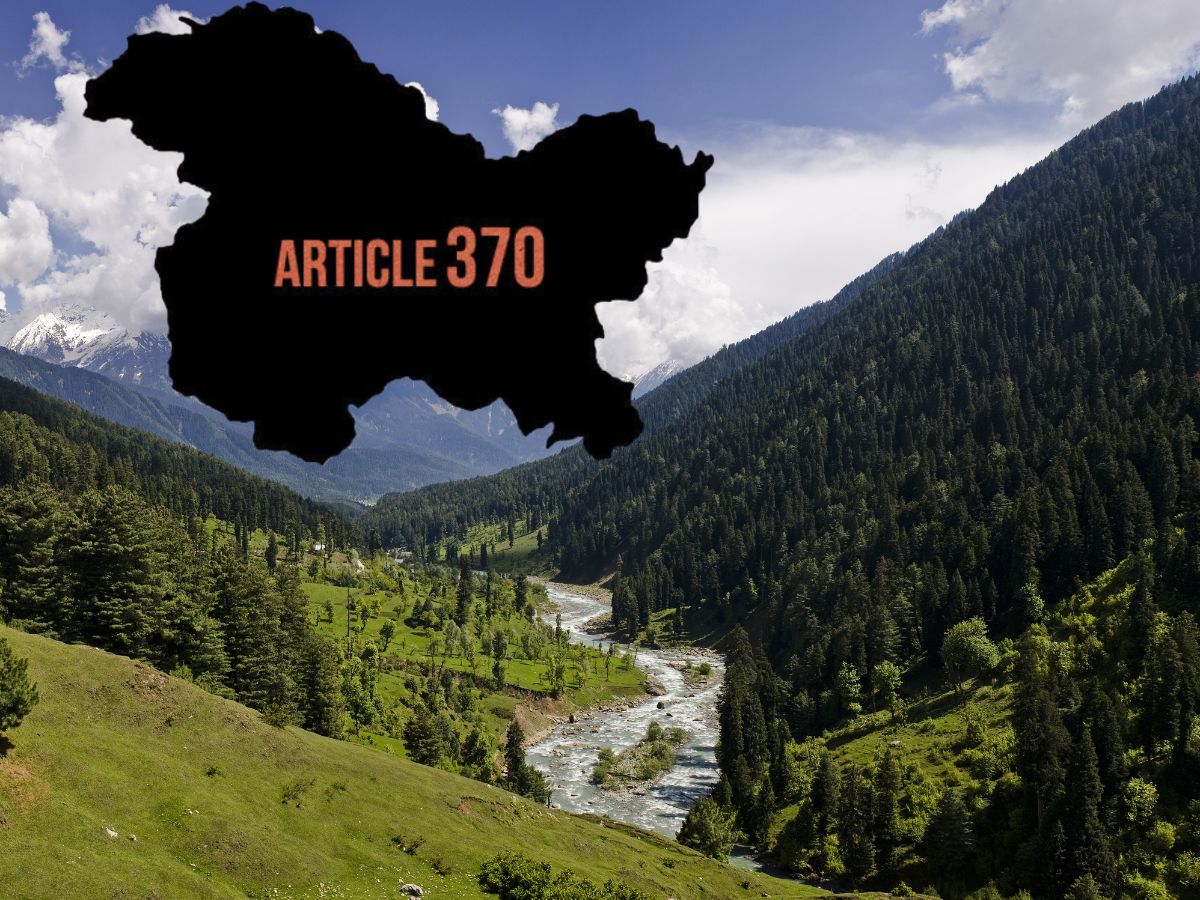
From Article 370 to Reorganisation 2025: Kashmir’s constitutional journey continues.
The Prime Minister Narendra Modi government is preparing to bring the Jammu and Kashmir Reorganisation (Amendment) Bill, 2025 in the Lok Sabha on August 20. The Union Home Minister, Amit Shah will bring the Bill. This comes years after the then-prime minister Modi, in August 2019 abrogated the constitutional provision of Article 370 making a tectonic shift of the political and constitutional history of Jammu and Kashmir.
Article 370 of the Constitution of India gave special provision to Jammu and Kashmir only after Maharaja Hari Singh signed the Instrument Accession to join India in 1947. Under this arrangement, the Indian Parliament could only legislate on defence, external affairs, and communications for the State. Everything else was under the State of Jammu and Kashmir and it even had different constitution. Furthermore, Indians from outside the State could not purchase land or property.
This article was brought in as a “temporary provision” to ease Jammu and Kashmir’s joining India without offending its special political situation. The Constituent Assembly of the State, formed in 1951 and dissolved in 1957, alone had the right to suggest amendments to Article 370. As it never suggested abrogation, the provision went on for decades.
The Bharatiya Janata Party (BJP) was already talking about making Article 370 of the Indian Constitution a thing of the past since 1989 calling it an obstacle to fully integrating Jammu and Kashmir with the rest of India. The BJP has referred to repealing Article 370 in its election manifestos; 2009, 2014 and 2019.
The Modi government revoked Article 370 on 5 August 2019 by using President’s Orders CO 272 and CO 273. The government changed the definition of “Constituent Assembly” to a “Legislative Assembly” and substituted Article 367. As Jammu and Kashmir was under President’s Rule, Parliament had acted as the State Assembly, which gives the Union Government a constitutional basis for claiming repeal.
The setting of the story occurred in 2019 when the Indian parliament had enacted the Jammu and Kashmir Reorganisation Act. To understand deeper, the act has bifurcated the State into two Union Territories Jammu and Kashmir (with legislative assembly) and Ladakh (without legislative assembly). The Jammu and Kashmir Reorganisation Act law reversed decades of ‘special status’ for Jammu and Kashmir and brought the Union Territories within the whole purview of the Indian Constitution bestowing on Parliament the power to enact laws in the territory.
The abrogation of Article 370 was received by the BJP and its allies as a bold decision for national integration and development in Jammu and Kashmir. The decision, though, was met with opposition from opposition parties such as present INDIA bloc leaders who argued that it was unconstitutional and contrary to the spirit of federalism. They also organized protests in different regions and areas of the country.
Sofia Babu Chacko is a journalist with over five years of experience reporting on Indian politics, crime, human rights, gender issues, and stories about marginalized communities. She believes journalism plays a crucial role in amplifying unheard voices and bringing attention to issues that truly matter. Sofia has contributed articles to The New Indian Express, Youth Ki Awaaz, and Maktoob Media. She is also a recipient of the 2025 Laadli Media Awards for gender sensitivity. Beyond the newsroom, she is a music enthusiast who enjoys singing. Connect with Sofia on X: https://x.com/SBCism
US intelligence chief Tulsi Gabbard says Iran’s regime remains intact but weakened after weeks of…
The killing of Ali Larijani in a targeted strike near Tehran marks a major escalation…
Hardik Pandya recalls a hilarious rookie-season prank by Ricky Ponting during IPL 2015 that gave…
