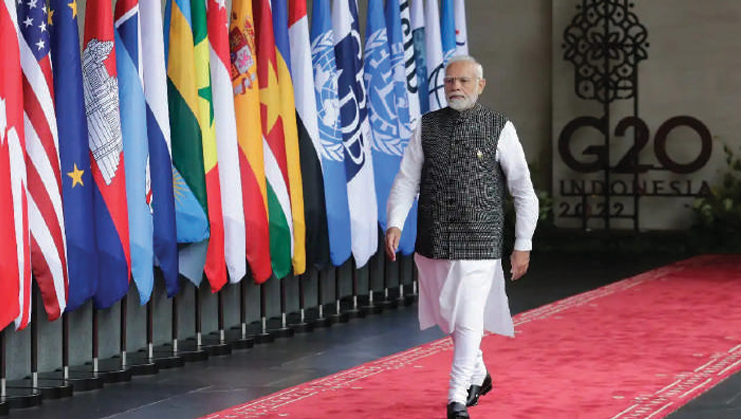
Prime Minister Narendra Modi, whose rise from grassroots activism to the pinnacle of power reflects India’s democratic vibrancy, today commands recognition as one of the most consequential leaders of the 21st century. His leadership has not only reshaped India’s internal governance trajectory but has fundamentally redefined the nation’s standing in global affairs. Modi’s statesmanship represents a confluence of visionary policymaking, assertive diplomacy, and strategic foresight. Under his stewardship, India has moved beyond the hesitations of the past to position itself as a solution-oriented power—actively contributing to global debates on technology, security, sustainability, and inclusive growth. Through the fusion of pragmatic statecraft and India’s civilizational ethos, Modi has ensured that the country stands not as a marginal voice in world forums but as a central architect of the evolving global order.
Champion of Global Diplomacy
Among Modi’s most notable achievements is his redefinition of India’s diplomatic posture. Once seen as cautious in multilateral forums, India now plays a proactive role. From launching the International Solar Alliance to successfully hosting the G20 Summit in New Delhi, Modi has consistently projected India as a responsible and constructive power. His emphasis on institutionalized dialogues, regional coalitions, and cultural exchanges reflects diplomacy that is not ceremonial but strategic, ensuring India shapes global agendas on climate, economics, and security with credibility and authority.
India as the Voice of the Global South
Modi has reinvigorated India’s traditional role as a natural leader of the developing world. By advocating for debt relief, equitable climate financing, and inclusive growth, he has championed the interests of nations often sidelined in decision-making. His call for “One Earth, One Family, One Future” during the G20 Presidency symbolized India’s ethos while offering a unifying vision to bridge divides. This leadership has deepened partnerships with Africa, Latin America, and small island states, where concerns about food security, vaccine equity, and sustainable development remain urgent. By advancing these issues internationally, Modi has positioned India as the conscience of the Global South, blending moral authority with tangible policy initiatives.
Comparative Statesmanship in a Shifting World
What sets Modi apart is how his leadership style contrasts with other global contemporaries. While Xi Jinping projects centralized authority through China’s state-led model, and Joe Biden emphasizes alliance-driven cooperation rooted in Western traditions, Modi has charted an independent course—anchored in democratic legitimacy, civilizational ethos, and pragmatic strategy. Leaders such as Brazil’s Lula da Silva have invoked Global South solidarity, but Modi has institutionalized it by giving developing nations a consistent and credible platform at the G20 and beyond. This blend of democracy, tradition, and strategy gives his leadership a unique resonance across both developed and developing worlds.
Strategic Partnerships with Global Powers
A defining hallmark of Modi’s foreign policy is his ability to cultivate diverse partnerships simultaneously. With the United States, ties have expanded into a comprehensive strategic partnership covering defense, technology, and space exploration. With Russia, India has preserved historic ties, particularly in energy and defense. In the Gulf, Modi’s outreach has translated into deeper investments and opportunities for Indian expatriates. In the Indo-Pacific, India’s active role within the QUAD underscores its centrality to regional stability. This strategy of multi-alignment ensures India avoids overdependence on any single bloc while maximizing strategic autonomy. Modi’s partnerships are pragmatic, forward-looking, and mutually beneficial, reflecting India’s ability to safeguard its interests while contributing to the global order.
Climate Leadership and Sustainability
In the sphere of climate action, Modi has given India a transformative voice. His Panchamrit pledge at COP26, including the ambitious goal of net-zero emissions by 2070, balanced vision with realism. The International Solar Alliance positioned India as a leader in renewable energy collaboration. Unlike many world leaders, Modi has consistently emphasized climate justice, urging that developed nations assume greater responsibility for historical emissions. By integrating green technologies with indigenous innovation, India has projected a model of sustainable yet equitable growth. Modi’s environmental statesmanship has repositioned India as not a reluctant participant but a proactive provider of solutions.
This future-oriented approach positions India not just as a beneficiary of globalization, but as a rule shaper capable of bridging divides between developed and developing worlds.
Expanded Soft Power Diplomacy
Beyond geopolitics, Modi has harnessed India’s cultural and civilizational wealth as a formidable tool of influence. The global observance of International Yoga Day, championed at the United Nations, has become a defining symbol of India’s spiritual diplomacy. His promotion of Ayurveda, the Digital India initiative, and the vibrancy of democratic traditions have further extended India’s global footprint. India’s creative industries—especially Bollywood—continue to shape cultural imaginations across continents, while digital public goods such as UPI, Aadhaar, and the CoWIN vaccine platform are now being exported as global models of inclusive innovation. Above all, as the world’s largest democracy engaging simultaneously with authoritarian regimes and liberal democracies, India under Modi commands moral authority that few others can claim.
Balancing Challenges and Criticism
Despite global recognition, Modi’s leadership has not been without criticism. Analysts often highlight India’s cautious stance during the Russia–Ukraine conflict and human rights concerns raised by some Western observers. Yet his neutral but principled position underscores India’s commitment to strategic autonomy. Domestically, the challenge remains to balance rapid economic expansion with social inclusivity. Nevertheless, Modi’s ability to navigate crises—from the COVID-19 pandemic to border tensions and global economic shocks—reflects adaptability and resilience. Far from diminishing India’s image, these challenges illustrate the complexity of managing a large, diverse democracy while asserting an independent course in global affairs.
A Forward-Looking Global Vision
As India approaches the centenary of its independence in 2047, Modi’s vision of a Viksit Bharat emphasizes technological leadership, economic strength, and global responsibility. Looking ahead, India is poised to play a defining role in:
AI governance: shaping ethical and inclusive frameworks for emerging technologies.
Climate justice: ensuring equitable transitions where developing nations are not penalized for the West’s historical emissions.
Global South development agenda: leading debt restructuring conversations and fostering South–South cooperation.
Narendra Modi’s global stature reflects not merely his individual statesmanship but also India’s transformation into a confident and responsible power. His diplomacy artfully combines hard strategy with cultural outreach, balancing national imperatives with international expectations. Under his leadership, India has moved beyond post-colonial hesitations to embrace global centrality. His enduring legacy lies in demonstrating that India’s civilizational ethos, when fused with pragmatic governance, can inspire collective progress.
This stature was further amplified during the SEO Summit in China, where Modi positioned India as an indispensable partner in addressing regional and global challenges. His interventions underscored India’s role not as a peripheral participant but as a decisive voice shaping the strategic, economic, and security agenda of Asia. By anchoring India’s position amidst competing power blocs, he ensured that New Delhi’s vision of inclusive growth and cooperative security received global recognition.
At the heart of this diplomacy is Modi’s remarkable willpower and resolve. Unlike many leaders who bend under international pressure, Modi has consistently chosen to negotiate with the world on India’s terms, never compromising national interest for external appeasement. Whether in trade, climate, or security dialogues, he has projected India as a nation that engages constructively but refuses to bow down. This firmness has compelled even the most powerful nations to acknowledge India’s red lines and respect its sovereignty.
In history’s reckoning, Modi may well be remembered as the leader who turned India from the world’s largest democracy into one of its defining democracies—an architect not only of national resurgence but also of a more balanced and multipolar world order. He has reshaped the contours of diplomacy, altered the momentum of global politics, compelling major powers to seek stronger ties with India as an indispensable partner in shaping the twenty-first century.
If the 20th century was defined by Western power and China’s rise marked the early 21st, Modi’s India has positioned itself as the democratic fulcrum of a multipolar world—neither a follower nor a challenger, but a builder of consensus and a shaper of destiny.
Donald Trump backs Joe Kent’s resignation over the Iran threat dispute, calling it beneficial. He…
An armed man triggered a security alert at a VA clinic in Jasper, Georgia, leading…
Joe Kent resigned as tensions with Iran escalated, triggering political turmoil in Washington. Opposing prolonged…
