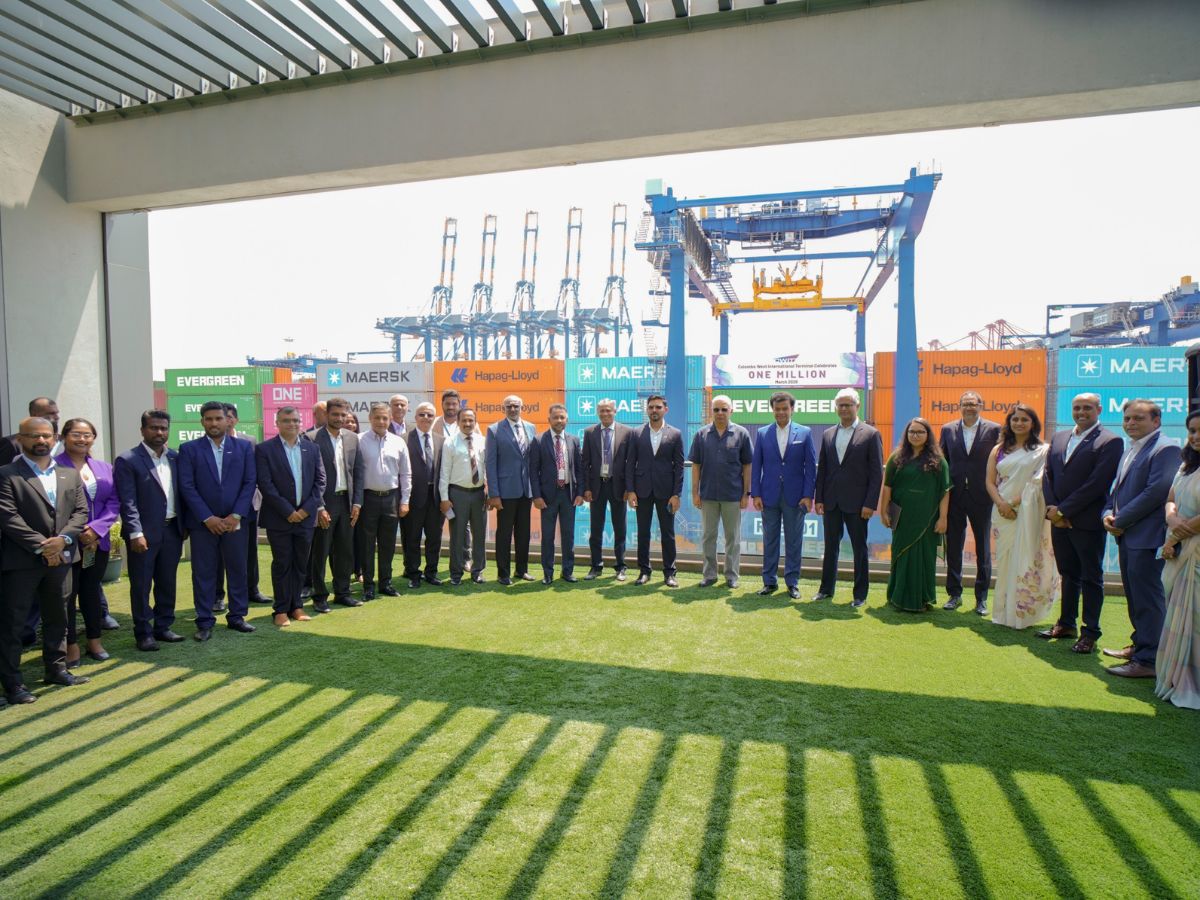
APSEZ’s Colombo terminal crosses 1 million TEUs in its first year. (Photo: NewsX)
A rapid first-year ramp-up at the Port of Colombo in Sri Lanka underscores the expanding global footprint of Adani Ports and Special Economic Zone Ltd (APSEZ), highlighting both the growing importance of the Indian Ocean Region (IOR) in global trade flows and its emerging role in the blue economy.
In a milestone that signals both operational discipline and strategic intent, the Colombo West International Terminal (CWIT) in Sri Lanka, which commenced operations in April 2025, has crossed one million TEUs (Twenty-foot Equivalent Units) in its first year. The achievement marks the fastest ramp-up recorded at the Port of Colombo, placing the CWIT among a select group of global facilities to reach such scale in its inaugural year.
The Colombo West International Terminal is a partnership between Adani Ports and Special Economic Zone Ltd (APSEZ), which handles nearly 45 per cent of India’s container cargo, John Keells Holdings PLC, one of the most respected conglomerates in Sri Lanka, and the Sri Lanka Ports Authority. With an investment of about $800 million, it represents one of the most significant port infrastructure commitments in Sri Lanka in recent years.
The milestone comes in the backdrop of Colombo strengthening its role as a key transshipment hub, linking cargo flows across Asia, the Middle East and Europe. Its location, close to the world’s major east-west shipping route, has long made it a preferred stop for mainline vessels and feeder networks.
Container terminals typically take several years to stabilise operations and build throughput. CWIT’s performance reflects strong early alignment with shipping lines, efficient berth productivity and the advantage of operating within an established transshipment ecosystem. Large ports operate at far greater scale, but their expansions have historically ramped up in phases. Even newer automated terminals in Europe and East Asia have taken longer to reach comparable utilisation levels.
CWIT is the first fully automated deep-water terminal at the Port of Colombo, built to handle the latest generation of ultra-large container vessels. Its 1,400-metre quay and water depth of around 20 metres allow it to berth some of the largest ships operating on the Asia–Europe trade route.
With an annual capacity of about 3.2 million TEUs, the terminal significantly expands Colombo’s handling capability. Digitally integrated systems, modern cranes and electrified yard equipment are designed to reduce turnaround times and improve operational efficiency.
This aligns with broader global trends, where ports are investing in automation and energy-efficient systems to enhance productivity while managing environmental impact.
The terminal’s early success reinforces Colombo’s importance in global shipping networks. A significant share of its volumes continues to be transshipment cargo, much of it linked to India, making efficiency and connectivity critical to sustaining growth.
For APSEZ, which operates a portfolio of 15 ports in India and four overseas, the project marks a notable step in expanding its international footprint, reinforcing its position as India’s largest private port network. The partnership with John Keells Holdings PLC and the Sri Lanka Ports Authority combines global operational expertise with local institutional alignment.
Sofia Babu Chacko is a journalist with over five years of experience reporting on Indian politics, crime, human rights, gender issues, and stories about marginalized communities. She believes journalism plays a crucial role in amplifying unheard voices and bringing attention to issues that truly matter. Sofia has contributed articles to The New Indian Express, Youth Ki Awaaz, and Maktoob Media. She is also a recipient of the 2025 Laadli Media Awards for gender sensitivity. Beyond the newsroom, she is a music enthusiast who enjoys singing. Connect with Sofia on X: https://x.com/SBCism
Saudi Arabia has confirmed Eid-ul-Fitr 2026 will be celebrated on March 20 after the Shawwal…
US intelligence chief Tulsi Gabbard says Iran’s regime remains intact but weakened after weeks of…
The killing of Ali Larijani in a targeted strike near Tehran marks a major escalation…
