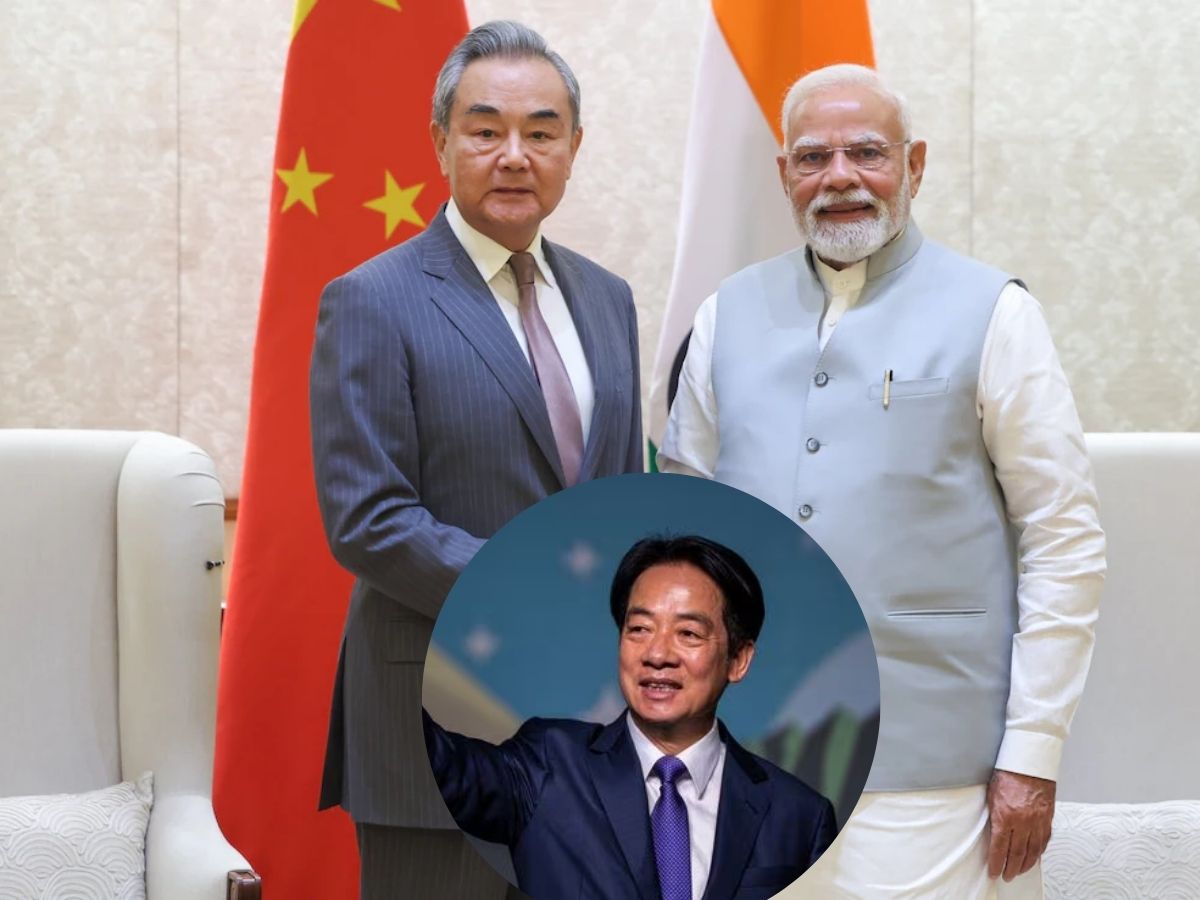
India rejects China’s claim on Taiwan stance, clarifies no policy change after Jaishankar-Wang Yi meeting. Photos/X.
A Chinese readout following a recent meeting between India’s External Affairs Minister S. Jaishankar and Chinese Foreign Minister Wang Yi claimed that India acknowledges that Taiwan is a part of China.
However, the Indian government, though not through an official statement but through reports, has dismissed these claims that it altered its position on Taiwan.
Beijing’s official statement on Monday quoted Jaishankar saying, “the relationship between India and China remains stable, cooperative and forward-looking, which is in line with the interests of both countries. Taiwan is a part of China.”
However, New Delhi has firmly rejected the interpretation of EAM’s statement.
“There is no change in our position on Taiwan. We stressed that, like the rest of the world, India has a relationship with Taiwan that focuses on economic, technology and cultural ties. We intend to continue it,” various reports quoted government sources, including The Hindu and The Print.
While India has historically acknowledged the ‘One-China Policy’ – which asserts that Taiwan is part of China – it has, in recent years, maintained active economic linkages with the self-ruled island, which has remained outside Beijing’s control since the end of the Chinese civil war in 1949.
In June 2024, Taiwan President Lai Ching-te congratulated Prime Minister Narendra Modi on his electoral victory. Modi responded by expressing hope for closer ties with Taiwan, drawing a strong protest from Beijing.
At the time, Chinese Foreign Ministry spokesperson Mao Ning rejected Lai Ching-te’s status as “President” of Taiwan and urged India to resist what Beijing described as Taipei’s “political calculations.”
When Modi became President in 2014, Taiwan Ambassador Chung-Kwang Tien and Central Tibetan Administration President Lobsang Sangay graced his swearing-in ceremony.
India has an office in Taipei, the India-Taipei Association (ITA), and it is managed by a senior diplomat. Taipei, on the other hand, has the Taipei Economic and Cultural Center (TECC) in New Delhi. Both offices were established in 1995 to manage diplomatic, commercial, and cultural activities.
Though the relations have increased gradually over three decades, India has maintained the relations low-keyed because of Chinese sensitivities. For example, parliamentary delegations and legislature-level exchanges have not occurred since 2017, around the time of the Doklam border standoff between India and China.
Taiwan-India Relations After Galwan
New Delhi-Taipei relations have witnessed renewed focus in recent times following India’s tensions with China which intensified after the 2020 Galwan conflict. During that year, India appointed diplomat Gourangalal Das, who was Joint Secretary (Americas) in the Ministry of External Affairs at the time, as its representative to Taipei.
Two BJP lawmakers, Meenakshi Lekhi and Rahul Kaswan, participated virtually in the swearing-in of Taiwan President Tsai Ing-wen on May 20, 2020.
Subsequently, in August 2020, India mourned the passing of former Taiwan President Lee Teng-hui as “Mr Democracy.” The message was seen by many as a symbolic one aimed at Beijing, considering India’s own customary restraint in making politically charged statements regarding Taiwan.
The current Chinese President has publicly, at various times, said that the country will occupy and reunify Taiwan with mainland China. Its army, PLA, has in recent years increased its activities around Taiwan and on the larger island. China has held various military exercises on the island, increasing pressure on the Taiwan government.
Currently, there are only 12 countries in the world that have official diplomatic relations with Taiwan. Even the largest supporter, the US, does not formally recognize the island but pursues a policy of “strategic ambiguity” in which it states its opposition to any “forceful” effort to change the status quo of Taiwan.
Zubair Amin is a Senior Journalist at NewsX with over seven years of experience in reporting and editorial work. He has written for leading national and international publications, including Foreign Policy Magazine, Al Jazeera, The Economic Times, The Indian Express, The Wire, Article 14, Mongabay, News9, among others. His primary focus is on international affairs, with a strong interest in US politics and policy. He also writes on West Asia, Indian polity, and constitutional issues. Zubair tweets at zubaiyr.amin
Important Conference on Rights and Social Security of Unorganised Workers Held in Bishnupur
New Delhi [India], March 17: With the aim of raising awareness about the rights, dignity…
IPL 2026: Riyan Parag on Sanju Samson’s Absence — ‘Like Virat Kohli, He Can’t Be Replaced’
Riyan Parag emphasised that while Samson is "irreplaceable," the team has addressed last season's shortcomings…
Reports suggest that JioHotstar has acquired the film’s digital rights for around ₹150 crore, though…
