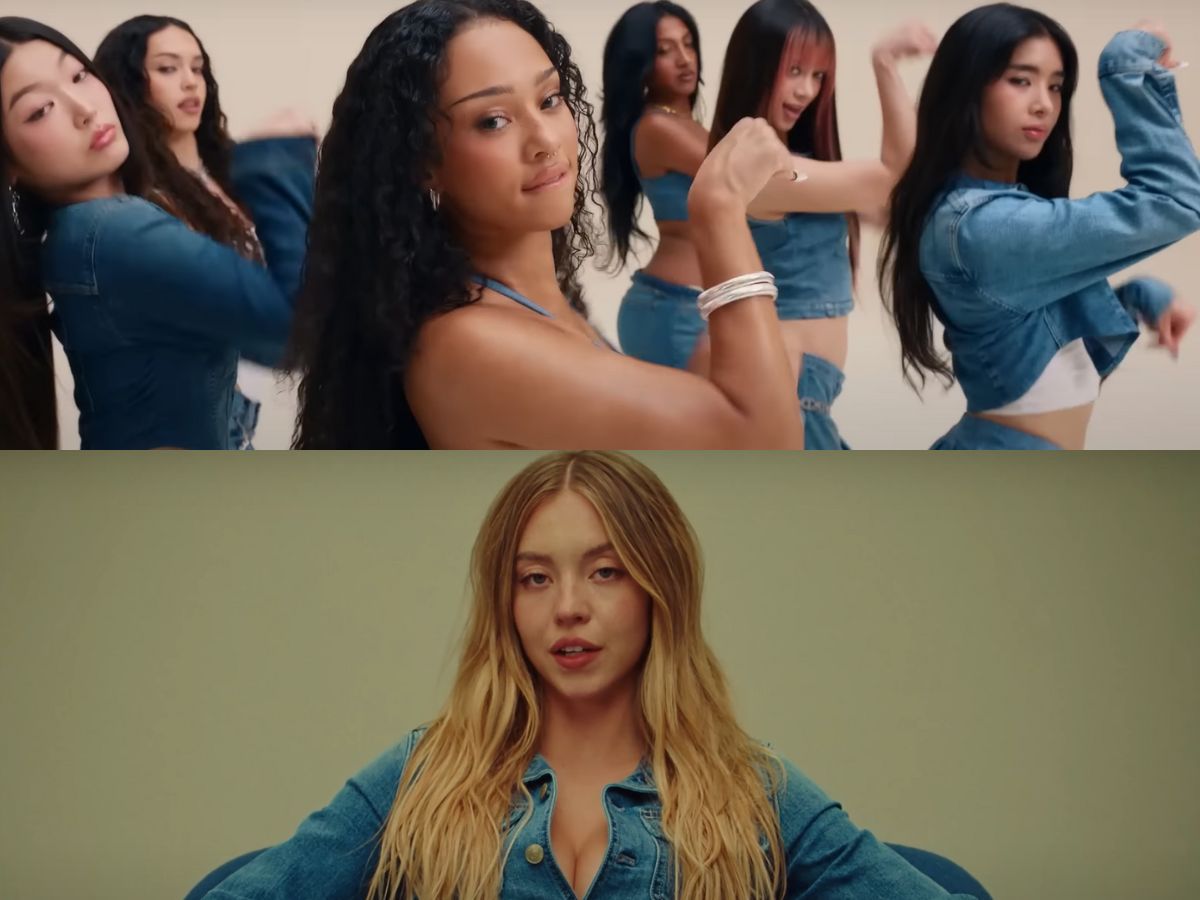
The two advertisements highlight the growing contrast in fashion advertising between realistic imagery and shock value that breaks taboos. (Image Credit: American Eagle and GAP YouTube)
On July 23, 2025, American Eagle launched an edgy advertisement featuring actress Sydney Sweeney, the tagline of which is the pun Sydney Sweeney has great genes/jeans. In one she corrects a sign reading genes to jeans and in another she states, ‘Gene’s all determine traits such as hair and eye color.’ The campaign was talked about instantly and all over the internet, the stock of American Eagle rose by 10% adding to the company hundreds of millions in value, a clear example of how shock driven marketing continues to pay off. These accusations mount, but backlash also increases.
Although the campaign started on an apolitical positive note, the campaign was hit by a lot of criticism towards the end of July. It was criticized as propagating eugenics and white supremacy, and its sexualized looks, due to Sweeney having blond hair and blue eyes. The complaints ran the gamut, including a slight undercurrent of racial prejudice, the repeated refrain of Nazi propaganda. The screaming came in the form of academics like Sayantani DasGupta pointing out that the campaign was full of eugenics messages, paralleled by major news sources making a case about whiteness and beauty ideals.
Very soon, the controversy was turned into a political one. President Trump were among those who defended the ad, saying their opponents were being overdramatic about so called cancel culture. The praise, which Trump gave to American Eagle, caused another 23 percent rise in stocks. Meanwhile, right wing media also accused lefties of being too dramatic, with left wing critiques replying that what they were outraged about was only given so much airtime and attention because right wing personalities picked it up. Consequence, an emergence of competing narratives around whether it was an offensive or anti woke campaign.
The campaign was deemed to be promoting the male gaze by some feminists, since it makes a woman all about her body and subsequently it is used to market jeans. Critics complain that it appeals to retrogressively idealized beauty under the guise of innocence. This is a heightening of already contentious arguments in feminism on whether the given misogyny can be addressed by sexualizing women through imagery or not. A charitable aspect, such as the proceeds of a butterfly themed Sydney jean going to domestic violence awareness were a token inclusion which served to do little towards curbing the negative reception. Besides, the campaign attracted a wider discussion about the left Is wokeness too hasty with its condemnations, or is it necessary to make a judgment call on subtle, but harmful biases? Sheffield sociologist Dr. Amelie Burgess commented that the polarizing visuals and puns of the ad both herald and bore the mark of the sociopolitical climate of the day, leading to different interpretations on the visuals and puns according to the ideological leanings of the person reading them.
GAP, and their own iteration of this trend the Better in Denim campaign with KATSEYE, a girl group whose members represent 7 nationalities and are sporting a range of Y2K fashion with Kelis playing in the background with her Milkshake song. It was posted August 19 and has gained more than 20 million views on Instagram and has been hailed on its positive portrayal and inclusiveness. The GAP campaign was a sharp contrast to the controversial American Eagle, bright, culturally oriented and tactful. Fans dubbed it ‘how to do a jean advert’ because of its emotional appeal one viewer was quoted as saying that an Indian mother was telling her daughter about the importance of seeing someone of Indian descent Lara Raj of KATSEYE in an advert.
The split between American Eagle and GAP does not only represent the popular market in terms of fashion marketing, but also describes the ideological polarites taking place in America today
Woke/feminist critiques are not just questioning what is presented but how images and text could be construed in a biased way and possibly without intent. The right stances induce indignation as performative or hyperextended, weaponizing woke to counter content they think of as traditional. Learning their lesson, brands are shifting to more inclusive campaigns that do not stray into the danger zone of controversy, as GAP did.
This was originally a play on words denim commercial but turned out to be yet another cultural hot spot. It revealed how the combination of the powerful forces of marketing, identity, race, feminism, and political activism manufactures and shakes up the cultural fabric of America.
The American Eagle campaign strengthened the critiques of self proclaimed feminists to the left that all was not well with the concept of pretentious empowerment with the underlying currents of oppressing norms under the disguise of empowering terminology. In the case of brands, the lesson is evident, authenticity and representation has weight over being provocative. The empowering, inclusive vibe of GAP KATSEYE ad is maybe an indication of a smarter and more inclusive realization of the part of fashion in the cultural conversation.
Also Read: Why Sydney Sweeney’s ‘Great Jeans’ Ad Sparked Eugenics Accusations And What Eugenics Really Means
Ahmed Shehzad accused the board of prioritizing the "branding" of 6–8 specific players for the…
NHIDCL Recruitment 2026 Open For Multiple Roles, Check Key Details Here
The National Highways & Infrastructure Development Corporation Limited (NHIDCL), under the Ministry of Road Transport…
A U.S. court sentenced Indian-origin Sital Singh to four years in prison for his role…
