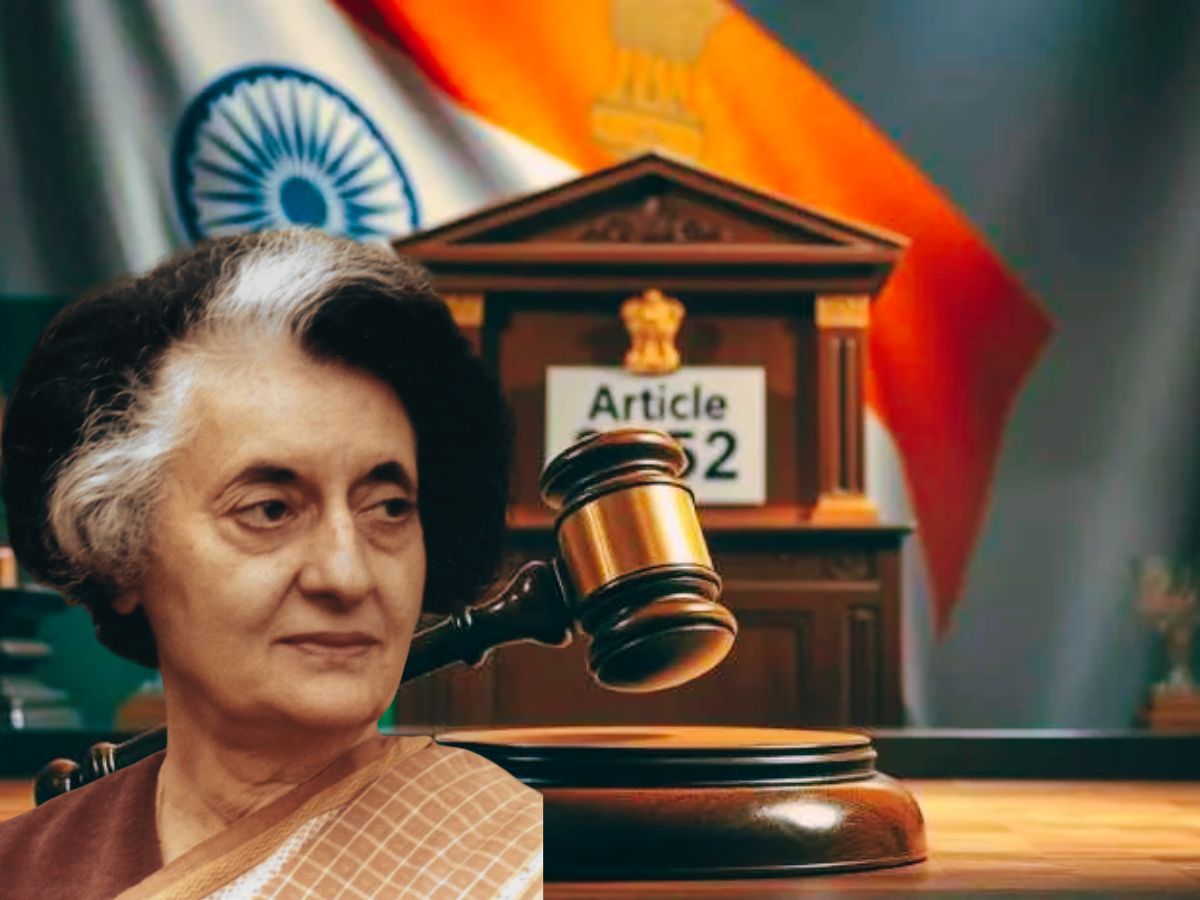
Article 352 empowers the President to declare a National Emergency during war, external aggression, or armed rebellion, significantly expanding central authority and restricting fundamental rights.
India is commemorating 50 years of national emergency. At this moment it is crucial to look Article 352 of the Indian Constitution, which some believe is the constitutional pillar. This powerful provision allows the central government the prime authority to undertake measures in circumstances of national danger.
Article 352, forms a constituent of the Constitution’s Part XVIII which says about Provisions dealing with Emergency. It gives the President of India the power to issue a National Emergency in case if the security of the nation or any part of it is threatened by war, armed rebellion or external aggression.
Through the 44th Constitutional Amendment Act of 1978, the original inclusion of the phrase “internal disturbance” as a reason for emergency was substituted by “armed rebellion”, due to its abuse during the Emergency of 1975.
The powers of the central government will enormously increase, it can also diminish the authority of state governments. In fact, the basic rights, specifically under Article 19 (freedom of speech and expression), can be suspended.
The Union government can legislate on topics in the State List. The finances and money can be centralised under Article 354.For avoiding the misuse, various constitutional safeguards were introduced after 1975 emergency.
A National Emergency has to be officially confirmed by both Houses of Parliament Rajya sabha and Lok sabha within one month. After it gets approved, it is valid for six months and can be extended time and again with parliamentary approval after every six months.The President can declare an end to the national emergency whenever he likes without Parliament’s sanction.
But if 1/10th of Lok Sabha members insist, a special session of Lok Sabha has to be held to pass a vote on whether to bring an end to the Emergency or not.If Lok Sabha passes a resolution disapproving the Emergency, the President is obligated to withdraw it.
Depending on the intense of threat, a National Emergency can either be of the following two types:
An External Emergency will proclaim in case of war or foreign aggression where as an Internal Emergency will proclaim when there is armed rebellion against the country. In fact, both have far-reaching implications for governance, civil rights, and the federal balance.
Meanwhile, the legacy of the 1975–77 Emergency much condemned so far after many years for its excesses of authoritarianism continues to influence India’s democratic protections. The 44th Amendment, enacted after the Emergency, made it more difficult to invoke Article 352 by imposing tighter conditions, thus making it more difficult to abuse.
ALSO READ: What Does ‘Samvidhaan Hatya Diwas’ Mean? Here’s The History Behind It
Sofia Babu Chacko is a journalist with over five years of experience reporting on Indian politics, crime, human rights, gender issues, and stories about marginalized communities. She believes journalism plays a crucial role in amplifying unheard voices and bringing attention to issues that truly matter. Sofia has contributed articles to The New Indian Express, Youth Ki Awaaz, and Maktoob Media. She is also a recipient of the 2025 Laadli Media Awards for gender sensitivity. Beyond the newsroom, she is a music enthusiast who enjoys singing. Connect with Sofia on X: https://x.com/SBCism
The Trump administration has shared a 15-point peace plan with Iran through intermediaries, including Pakistan,…
Alan Ritchson, star of Reacher and War Machine, is under investigation after a physical altercation…
Iran says the US and Israel struck targets near the Bushehr Nuclear Power Plant, raising…
