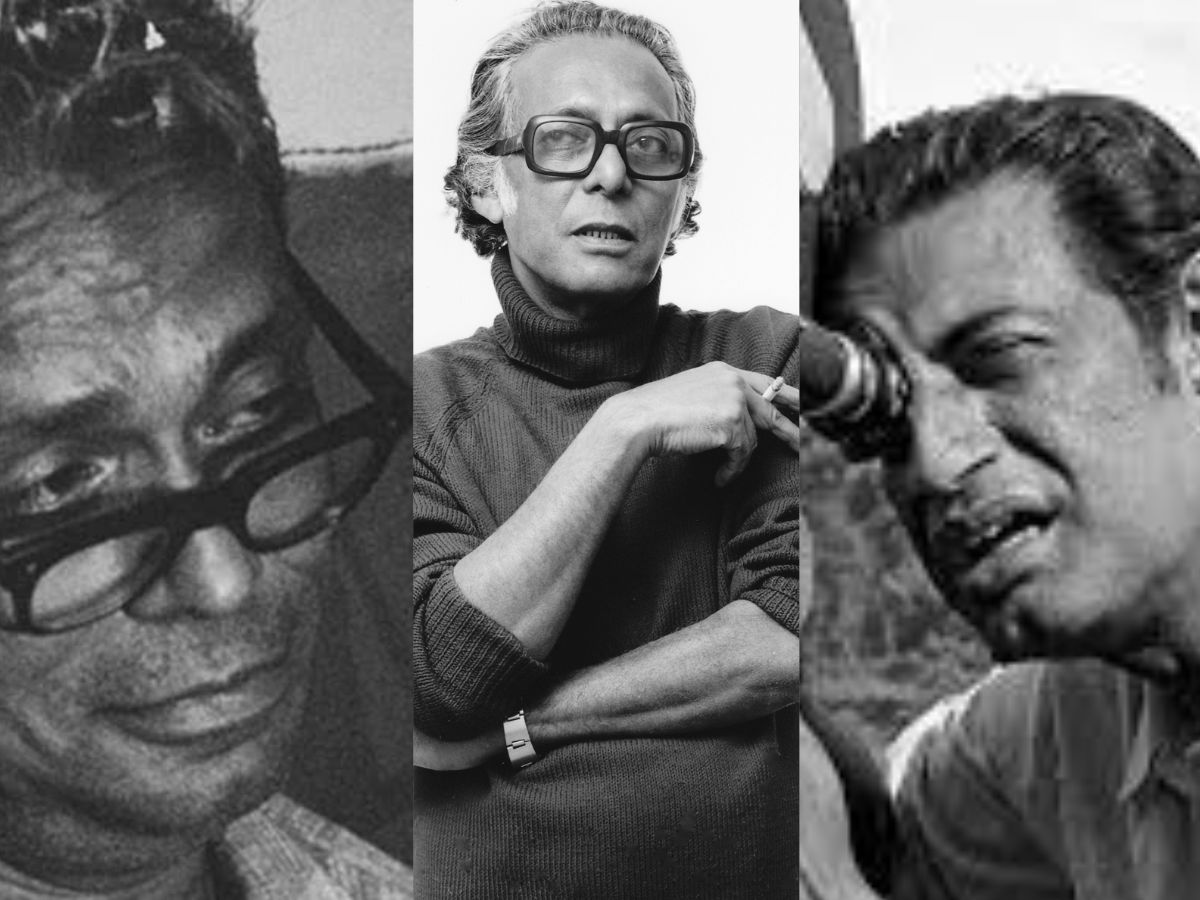
Satyajit Ray's ancestral home demolition halted after protests; spotlight on Ritwik Ghatak and Mrinal Sen homes too. Photos/X.
After reports came in that Bangladesh is plaaning to demolish the ancestral home of legendary filmmaker Satyajit Ray, people across the South Asia have poured on their outrage pushing the authorities to halt the move for now. The Indian government also appealed to the Bangladeshi authorities and offered help to renovate and repair the ancestral house of celebrated filmmaker.
Ray was born in Calcutta in India but had an ancestral house in n Mashua village, Katiyadi, Kishoreganj, Bangladesh. Just 115 kilometers northeast of Dhaka, the house holds deep cultural and emotional value for his family and admireers. Ray visited the house a few times before the Partition of India in 1947 and often recalled the scenic beauty of the Padma River viewed from the estate.
“That hope kept receding, particularly after the Partition,” Ray had once said, describing his longing to return to the family home after India’s division.
According to the Bangladesh Department of Archaeology, the house was constructed more than a century ago by a local zamindar named Ray Chowdhury from Masua in Katiyadi Upazila of Kishoreganj. After the 1947 Partition, the property came under government ownership.
The estate spans 36 acres and features several grand structures, including a residential palace, a prayer hall, a large kitchen, and the traditional workspace known as ‘Kachari Bari’. The grounds also include a garden house, an elephant pond, a playground, and two water bodies, a small pond at the back and a large front pond with a concrete ghat and multiple steps.
Today, the property is in a dilapidated condition. Film activists in Dhaka have urged the government through the District Administration to renovate and preserve the house. However, no official action has been taken yet.
The incident has renewed attention to an earlier initiative taken by the Federation of Film Societies of India (FFSI), the apex body of film societies across India. The FFSI, which was founded by Satyajit Ray in 1959, had decided in a Central Executive Committee meeting on January 30, 2020, to launch an international campaign for the restoration of the ancestral houses of Satyajit Ray, Ritwik Ghatak, and Mrinal Sen.
Ritwik Ghatak’s Ancestral Home
The issue is not limited to Ray’s residence. The ancestral house of Ritwik Ghatak, another towering figure of Indian cinema, is also under threat.
Located in Rajshahi, about 245 kilometers northwest of Dhaka, Ghatak’s family home was where he spent his childhood and youth, studying at Rajshahi College. His family left East Pakistan in 1948. The Padma River at Rajshahi was a favorite place for Ghatak and featured prominently in his memories and creative work.
In 1987-88, the then military government under Md. Ershad leased the property to a private homeopathic college, which demolished most of the original structures to erect a poorly constructed college building. Recently, another room from Ghatak’s ancestral house was torn down to make space for a bicycle garage.
The demolition triggered mass protests from the cultural and film community in Rajshahi, Dhaka, and Toronto. In the last week of December, human chains were formed and demonstrations were held to oppose the move.
Mrinal Sen’s House Also in Danger
The ancestral home of Mrinal Sen, another celebrated filmmaker, is located at Jhiltuli in Faridpur, about 130 kilometers west of Dhaka. The house is currently under private ownership, and most of the property has been demolished for new construction.
However, parts of the original house still remain. Film activists in Dhaka have called for its renovation and preservation.
This is not the first time Indian officials have intervened over heritage preservation in Bangladesh.
Chief Minister Mamata Banerjee urged Prime Minister Narendra Modi to intervene after a mob vandalised the ancestral home of Nobel laureate Rabindranath Tagore, the Kachharibari in Sirajganj district.
According to Bangladeshi officials, the incident occurred due to a dispute between a visitor and museum staff over a motorcycle parking fee.
The Shahzadpur house was originally purchased in 1840 by Dwarkanath Tagore, Rabindranath’s grandfather, for Rs 13 and 10 annas at an auction. Rabindranath Tagore spent several summers there overseeing his family estate and interacting with local farmers. The place inspired many of his writings.”
The house was declared a protected archaeological site in 1969 and later converted into the Rabindra Memorial Museum.
Also Read: Satyajit Ray Ancestral Home Demolition In Bangladesh: How Was It Stopped And What Happens Next?
Zubair Amin is a Senior Journalist at NewsX with over seven years of experience in reporting and editorial work. He has written for leading national and international publications, including Foreign Policy Magazine, Al Jazeera, The Economic Times, The Indian Express, The Wire, Article 14, Mongabay, News9, among others. His primary focus is on international affairs, with a strong interest in US politics and policy. He also writes on West Asia, Indian polity, and constitutional issues. Zubair tweets at zubaiyr.amin
Retired Navy officer Ashok Kharat was arrested by Nashik police for sexual exploitation after 58…
Ranveer Singh is set to make a big-screen comeback with Dhurandhar 2, officially titled Dhurandhar:…
Officials from the Afghanistan Cricket Board (ACB), along with members of the national team, have…
