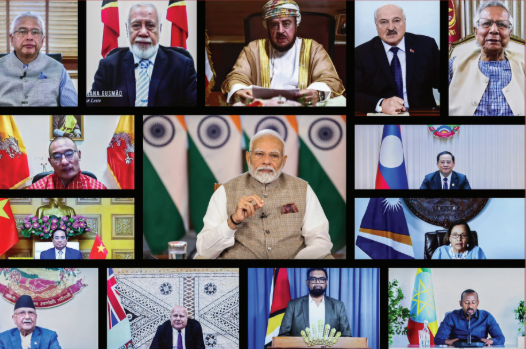
In the middle of 2010, during my academic sabbatical in South East Asia, I came across an interesting pattern. Every critical discussion, in think tanks, universities and in industrial forums, would always end with a mention of India. Out of sheer anxiety, I once asked a lawmaker as to why the India angle is often brought in. To my surprise, he was ecstatic in his response about how important India is as a balance between the Western Powerhouses and China, and how much the developing countries would want India to show a new path.
During those days, India was not what it is today. Mired in internal turmoil, policy paralysis and a pacifist approach, India was not even a shadow of what the Global South was expecting it to be. It was neck-deep its own problems, exacerbated by a fractured polity that was self-serving and had no time to unleash India’s true potential. In 2013, India was mentioned in the ‘Fragile Five’ list by Morgan Stanley. Soon after that phase, Narendra Modi arrived as Prime Minister of India after a historic mandate for BJP led NDA in 2014 Lok Sabha elections.
In fact, one of the most profound aspects of PM Modi’s era has been the simultaneous focus on economic growth, addressing socio-economic imbalances, as well as reconnecting India’s present generations with Bharat’s timeless culture, ethos, traditions, heritage, and philosophies.
Rarely one witnesses the head of state of any major economy focusing more on addressing socio-economic anomalies, and structural reforms, after donning the mantle than anything else. When PM Modi prioritised policies like Jan Dhan Yojana, Mudra Yojana, Swachh Bharat Abhiyan, Ayushman Bharat, Start-up India, Stand-up India, followed by demonetisation, and then ushering the era of GST and Digital India, little did many realise that PM Modi was laying the ground for a long-haul game whereby addressing the grassroot issues would itself pave way for sustained economic growth in times to come. PM Modi knew, that if India has to be torchbearer of the Global South, it would have to set its own house in order first.
In a country where more than 50 percent population did not have access to formal banking, Jan Dhan Yojana ensured opening of more than 56 crore Jan Dhan bank accounts, with a cumulative deposit of Rs 2.68 lakh crore. As a result, more than 99% of Indian households now have a bank account. Mudra Yojana, along with Jan Dhan bank accounts, ensured access to formal capital that was hitherto inaccessible to India’s tens of millions of micro enterprises. In ten years, the micro enterprise sector, consisting of nearly 6 crore enterprises were provided with loans with Rs 35 lakh crore through nearly 54 crore loans. The combination of Pradhan Mantri Mudra Yojana (PMMY) and Pradhan Mantri Jan Dhan Yojana (PMJDY) empowered the grassroots section of India like never before. It created livelihood in tens of millions which are never reflected in conventional EPFO numbers.
Further, the combination of Swachh Bharat Abhiyan and Ayushman Bharat schemes, ensured convenient access to better sanitation and healthcare facilities, through central government funded construction of 12 crore toilets, 2.53 lakh community sanitation complexes, and provision of Rs 5 lakh of free health insurance for nearly 50 crore people. A combination of all the above-mentioned schemes, and many more, ensured that now India’s Bottom-of-the-Pyramid, was ready to emerge as a major economic contributor to India’s future.
The combination of Jan Dhan-Aadhar-Mobile or JAM Trinity, created a foolproof mechanism for Direct Benefit Transfer (DBT) of funds to beneficiaries of social welfare schemes. Over the last one decade, Modi Government has transferred more than Rs 44 lakh crore through DBT, bypassing middlemen and plugging leakages worth Rs 3.48 lakh crore. Modi Government’s Digital India scheme, proliferation of smartphones, massive reduction in prices of mobile data, and UPI initiatives, truly bridged the rural-urban, privileged-underprivileged divides and worked as a great enabler for small businesses. With 18 billion monthly transactions recorded in June 2025, worth Rs 24 lakh crore, UPI has now reached to more than 49 crore individuals and 6.5 crore merchants, resulting in an unprecedented economic revolution. GST reforms, meanwhile has truly made Indian market an integrated one. A combination of GST reforms and digitisation, has formalised almost 80% of the Indian economy. As per reports, in FY 2024-25, the gross GST collection was a whopping Rs 22 lakh crore. It has made even the staunchest political critics of GST silent, as even the opposition run states too have benefitted by increased revenue generation as a result of this massive indirect tax reform.
In early 2019, cross border air strikes by Indian Air Force, into the heart of Pakistan’s terror training epicentre, in the aftermath of horrendous Pulwama terror attack, announced to the world how Modi Government has transformed the doctrine of India’s counter terror response mechanism. It would no more seek support or validation from West, but would directly do what is necessary for India’s security. Operation Sindoor in 2025 further exemplified it.
After Modi Government was brought back to power with a resounding mandate in the 2019 Lok Sabha Elections, through abrogation of Article 370 and construction of Ram Temple, Modi Government fulfilled two of the major commitments of BJP, that strengthened the nation and further imbibed essence of nationalism in young generations.
When Covid pandemic struck, many had started writing off the India story. However, PM Modi’s grit, determination and conviction, galvanised the nation and ensured that India not only administered domestically produced free vaccines to more than 100 crore eligible Indian citizens, but also gave additional free rations to more than 80 crore people so that no one would have problems with basic sustenance even during the peak phases of the pandemic.
Further, India having taken care of its own population, provided more than 30 crore Covid vaccines to over 99 countries and two UN Bodies, including 1.5 crore free vaccines given to over 50 countries from Global South. This happened at a time when the Global West was accused of vaccine hoarding. This was the kind of leadership from India, the Global South had been waiting for. Interestingly, even as most countries, including India were barely recovering in the post Covid scenario, a massive socio-political and economic crisis engulfed Sri Lanka, which resulted in the nation being on the brink of a total collapse. It was India that went ahead to provide Sri Lanka with food, essential commodities, medicines, and fuel, worth more than $4 billion, that exemplified PM Modi’s ‘neighbourhood first’ policy.
Leveraging the economic challenges posed by the Covid pandemic, Modi Government went in for major economic reforms. The Atmanirbhar Bharat Abhiyaan has been a game changer in terms of India striving for reducing its import dependence for critical manufactured and intermediary products. As part of it, there was also a major push towards developing self-reliance in domestic manufacturing of defence items. The Production Linked Incentive (PLI) scheme, defined as ‘A Transformational Push for Manufacturing, Employment and Global Competitiveness’ through financial incentives to entities setting up manufacturing facilities in India, attracted investments worth Rs 1.76 lakh crore across 14 sectors, while the cumulative sales figures of the PLI beneficiaries have crossed Rs 16.5 lakh crore by middle of 2025.
The upward revision of MSME definition, extending the turnover limit for Micro enterprises to Rs 10 crore, Small and Medium Enterprises to Rs 100 crore and Rs 500 crore respectively, has been yet another landmark decision to give institutional support to industry, which, along with the PLI scheme, reduction of corporate tax rates, major reforms in GST rates through reduction of slabs, massive overhaul in income tax rates, simplification of labour laws by converting 29 labour laws into 4 labour codes, a more liberal FDI policy, and impetus to infrastructure built-up through Rs 100 lakh crore investments under PM Gatishakti, have all played critical roles in catapulting Indian economy in post Covid phase of global turmoil. The Startup India Policy meanwhile, ensured that India is now the third largest ecosystem for startups in the world with 1.59 lakh registered startups.
Further, under PM Modi’s vision India has been a pioneer in enhancing the landscape for renewable energy development pivoted around National Solar Mission, National Hydrogen Mission, Ujala Scheme, and many more. Additionally, the Anusandhan National Research Foundation, formed to streamline and providing a strategic direction to research work across universities, colleges and research centres, followed by Research, Development and Innovation (RDI) Scheme, National Semiconductor Mission, National Deep-Tech Startup Policy and National Deep Ocean Mission, are all aimed at building the foundation of India’s quantum leap into the future.
The cumulative outcome of the tireless efforts of Modi Government in the last 11 years, catapulted India to the $4 trillion club. To be among the ‘Major Four’ economies by 2025, from ‘Fragile Five’ list in 2013, is an accomplishment hardly been achieved by any other country. During this phase, India also brought nearly 27 crore people out of multidimensional poverty as well.
Yet, the most critical aspect of India’s resurgent journey in Modi era has been that economic growth was achieved even without giving up on strategic autonomy and sovereign decision-making right. Against all odds, and extreme pressures, India refused to take sides in the Ukraine-Russia war, and advocated for an era of ‘No War’. It remained steadfast in maintaining its independence of foreign policy, and even advised Europe through Dr. Jaishankar’s iconic statement that ‘Europe has to grow out of the mindset that Europe’s problems are the world’s problems but the world’s problems are not Europe’s problems’. India, under PM Modi, universalised the idea of Vasudhaiva Kutumbakam, stressed on the need for reforms in multilateral institutions to address the concerns of Global South, and vehemently opposed the culture of unilateral sanctions by West.
Through inclusion of African Union in G20 grouping, pioneering the Voice of Global South Summit, and refusing to bow to Western dictums while buying oil from Russia or protecting the interest of 15 crore marginal and small farmers involved in dairy, poultry, fisheries and agri-sector, while negotiating trade deals with Global West, India, under PM Modi’s leadership, has charted a new path of national progress rooted in economic development, technological advancement, philosophy of universal brotherhood and integral humanism, that has emerged as a beacon for the Global South.
By being a strong advocate of BRICS even while maintaining strong relationship with the West, and yet being defiant when it comes to protecting the interest of 1.5 billion Indians, PM Modi’s leadership has been an inspiration for Global South to unshackle from the binary and chart their own destiny of development. India’s journey, especially in the last one decade exemplifies that in times to come Global South led by India would be the pitstop for global initiatives.
Pathikrit Payne is a Senior Research Fellow with Dr. Syama Prasad Mookerjee Research Foundation
Shubhi is a seasoned content writer with 6 years of experience in digital media. Specializing in news, lifestyle, health, sports, space, optical illusions, and trending topics, she crafts engaging, SEO-friendly content that informs and captivates readers. Passionate about storytelling, Shubhi blends accuracy with creativity to deliver impactful articles across diverse domains.
International opera star Rainelle Krause has died unexpectedly after a brief hospital stay. The Metropolitan…
The IMD has issued a yellow alert for Delhi-NCR as a western disturbance triggers three…
Invincible Season 4 Arrives: How to Watch Episodes 1–3 Globally, Release Times, and What to Expect
Invincible Season 4 premieres March 18, 2026, on Amazon Prime Video with three episodes. Mark…
