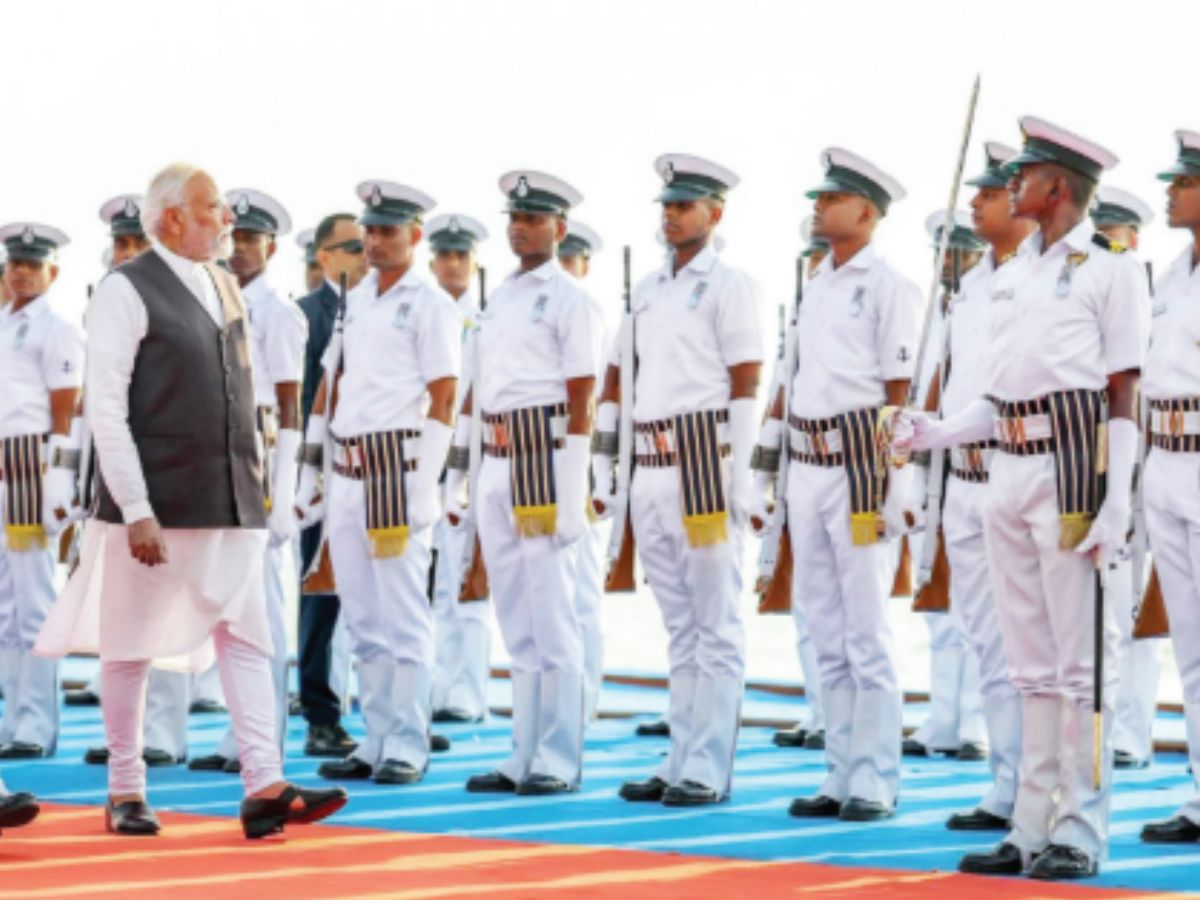
In the 21st century, the seas have reemerged not merely as conduits of commerce, but as crucibles of geopolitical contestation. The Indian Ocean Region (IOR) has long been central to India’s civilizational journey, shaped by culture, commerce, and connectivity. Today, the IOR and the broader Indo-Pacific theatre represent the pulse and rhythm of global trade, energy flow, and digital infrastructure.
With 11,098.81 km of coastline and a pivotal geographic location bridging the eastern and western maritime chokepoints, India’s maritime domain is no longer a peripheral theatre of defence. It stands as the strategic spine of India’s global engagement, anchoring both its security and outreach in an increasingly interconnected world.
Historically, India’s defence posture has been heavily framed by the two-front threat construct across the northern and western continental borders. Yet, this land-centric obsession has often obscured a critical truth: India’s prolonged colonial subjugation was enabled not by defeat on land, but by maritime vulnerability. Strategic blindness at sea allowed successive incursions through ports and coastlines. The narrative of the “Great Game” may have dominated modern strategic thinking, but it overshadowed the substantial maritime legacy of ancient and medieval India—a legacy now being consciously reclaimed.
In this context, the growth of India’s Navy and maritime institutions is not a reactive maneuver to neighbours’ provocations. Rather, it is part of a capability-based, future-ready vision, where maritime power is integral to economic resilience, regional leadership, humanitarian response, and credible deterrence. This transformation aligns with India’s evolving strategic doctrine, from the foundational philosophy of SAGAR (Security and Growth for All in the Region) to the more expansive Mahasagar (Mutual and Holistic Advancement for Security and Growth Across Regions).
Despite recurrent narratives suggesting that India’s naval expansion is a reaction to China-Pakistan maritime alignments, this is an oversimplification. While such factors may shape tactical considerations, they are not the primary strategic drivers. India’s maritime vision was outlined decades ago, born from the recognition that control of the seas is central to sovereignty and stability in the modern world. The 21st-century battlespace includes digital seabeds, critical chokepoints, and dispersed threats, requiring not just response, but anticipation and reach.
Thus, the Indian Navy’s growth is rooted in a capability-centric doctrine—one that emphasises blue-water presence, indigenous shipbuilding, island infrastructure, and regional cooperation. This doctrine is not about confrontation, but about establishing India as a responsible maritime stakeholder, committed to rules-based order and collective security. The Navy’s strength lies not only in hard power or deterrence but in building regional trust. India now conducts over 30 bilateral and multilateral naval exercises, reflecting its transition from a regional responder to a regional shaper. In the maritime domain, geography yields to connectivity. In this era of global shipping lanes and cross-border maritime concerns, any nation across the seas can become a strategic neighbour. Consequently, India’s maritime neighbourhood today stretches from Jakarta to Mombasa, from Fremantle to Muscat—a span that underscores the importance of interoperability, maritime domain awareness, and strategic foresight.
While capability is the bedrock, readiness for conflict remains essential. The Indian Navy ensures comprehensive maritime security across the western and eastern seaboards through constant vigilance against two distinct categories of challenges. State-based threats primarily include conventional military risks posed by regional adversaries such as Pakistan and China, ranging from naval incursions and undersea warfare to grey-zone operations. These are deliberate, organized threats emanating from sovereign military forces. Non-traditional disruptions encompass asymmetric and transnational risks such as piracy, maritime terrorism, trafficking of arms and narcotics, illegal fishing, and cyber threats to critical offshore infrastructure. These challenges, though less overtly combative, erode regional stability and require persistent maritime domain awareness. A key facet of state-based threat management is Pakistan’s procurement of Hangor-class submarines from China, aiming to shift the undersea power balance in South Asia. India’s response, however, has been layered and assured. With 12 P-8I Poseidon maritime patrol aircraft, MH-60R Seahawks, and Scorpene-class submarines armed with the indigenous Varunastra torpedoes, India’s anti-submarine warfare capabilities are both deep and resilient.
The commissioning of Project 15B guided missile destroyers and the advancement of Project 75 Alpha nuclear submarines underscore India’s long-term focus on indigenous development and comprehensive sea control, including robust sea denial capabilities. As for China, its growing presence in the Indian Ocean, via bases and port access agreements from Djibouti to Gwadar, is no longer a matter of speculation. Yet India’s approach is not to mirror but to outmanoeuvre. Strategic depth is being enhanced through island infrastructure upgrades in the Andaman & Nicobar and Lakshadweep, forward basing arrangements, and increased operational reach from the African coast to Southeast Asia. In parallel, India deepens its strategic anchorage through active roles in QUAD, the Indo-Pacific Oceans Initiative (IPOI), and cooperative surveillance and information-sharing mechanisms with like-minded navies, building a lattice of trust that reinforces regional security beyond sheer naval tonnage.
India’s maritime posture today is not defined by isolated assertions of power but by a shared architecture of peace, stability, and regional development. The transition from the doctrine of SAGAR to the broader Mahasagar Vision reflects this shift. More than semantics, Mahasagar represents India’s strategic aspiration to be a maritime leader, first responder, and trusted partner across a vast, interconnected oceanic space. Within this vision, the Indian Navy performs four distinct yet interlinked roles:
Military role – Anchors traditional defence and deterrence operations, ensuring India’s maritime borders are secure and sea lanes remain open.
Diplomatic role – Executed through goodwill visits, naval diplomacy, and participation in multilateral groupings, enhancing India’s global maritime footprint.
Constabulary role – Involves enforcing laws at sea, combating piracy, illegal trafficking, and upholding international norms such as UNCLOS (United Nations Convention on the Law of the Sea).
Benign role – Reflects the Navy’s humanitarian heart, delivering Humanitarian Assistance and Disaster Relief (HADR), supporting climate resilience, and extending logistics and medical aid to smaller regional partners.
Rather than isolated acts, these roles operate in a synergistic framework, reflecting a holistic maritime outlook that underpins India’s regional credibility. Naval exercises exemplify this ethos. Large-scale engagements like MILAN, Varuna, Malabar, and SLINEX go beyond tactical interoperability. They showcase maritime friendships built on trust, transparency, and shared responsibility. These exercises help standardise operating procedures, deepen mutual understanding, and reinforce the message that India stands not as a lone actor, but as a collaborative power committed to regional prosperity and maritime order.
India’s march towards maritime strength is mirrored by its investments in domestic shipbuilding and defence production. From the INS Vikrant, India’s first indigenously built aircraft carrier, to modern destroyers, frigates, and auxiliary ships, the aim is strategic autonomy without insulation. Programs like Make in India – Defence, along with private sector involvement, are key to making the naval ecosystem sustainable. Coastal radar chains, satellite-enabled surveillance, and GAGAN and RISAT systems ensure real-time domain awareness. India is not just defending its waters—it is digitally mapping the Mahasagar.
Unlike many powers where military projection overshadows national purpose, India’s Navy remains a quiet enabler, offering strength without provocation and presence without posturing. It is the arm of statecraft that signals resolve without rhetoric and extends compassion without compromise. Whether during Operation Samudra Setu in the COVID-19 pandemic, or in the aftermath of Cyclone Mocha, or through fuel and currency support to Sri Lanka, the Indian Navy has repeatedly shown that maritime power is as much about credibility and care as it is about capability. From ocean mapping for the Maldives to medical and humanitarian missions across the region, India’s seaborne outreach exemplifies soft power with strategic depth.
Yet, a truly future-ready strategic culture must transcend the cycles of defence procurement and weapon platforms. It must foster a maritime consciousness among citizens, embed a sense of continuity and institutional memory in policy-making, promote serious investment in maritime research and scholarship, and prioritise resilient logistics chains and sustainable coastal economies. These are not ancillary aspects; they are the scaffolding on which long-term maritime strength rests.
India’s maritime future will not be written in reaction, but in reclamation of its civilisational oceanic identity, its strategic foresight, and its unshakable resolve. The Indian Ocean is not a theatre of contestation alone; it is a vast canvas where the waves of trade, diplomacy, and defence intersect. In Mahasagar, India does not seek domination; it seeks direction. Direction born of clarity, courage, and confidence. A direction where capability means choice, not confrontation. Where ships are not just platforms of deterrence, but symbols of partnership, presence, and peace. Today, the Indian Navy does more than secure seas; it builds trust, fuels regional resilience, and steers a collaborative future. It is India’s vanguard in shaping a maritime world order grounded in rules, respect, and responsibility.
In this expansive blue frontier, India is not just a resident power, it is an anchoring power. And as it sails into the Mahasagar of the future, it does so with quiet confidence and open arms, charting a course of strategic autonomy, collective security, and global leadership.
Commodore (Dr.) Johnson Odakkal is a maritime scholar, strategic affairs analyst, and Indian Navy veteran. He serves as Faculty of Global Politics and Theory of Knowledge at Aditya Birla World Academy, Mumbai, and Adjunct Faculty of Maritime and Strategic Studies at Naval War College, Goa.
Manisha Chauhan is a passionate journalist with 3 years of experience in the media industry, covering everything from trending entertainment buzz and celebrity spotlights to thought-provoking book reviews and practical health tips. Known for blending fresh perspectives with reader-friendly writing, she creates content that informs, entertains, and inspires. When she’s not chasing the next viral story, you’ll find her diving into a good book or exploring new wellness trends.
An airstrike in Kabul killed hundreds at a rehab centre. Afghanistan blamed Pakistan, which denied…
Business Energy Plans Built For Cost Efficiency
Online businesses run on more than servers and marketing: they run on energy. Business gas is part…
Ranveer Singh’s Dhurandhar 2: The Revenge faces bans across several Gulf countries, but reports suggest…

