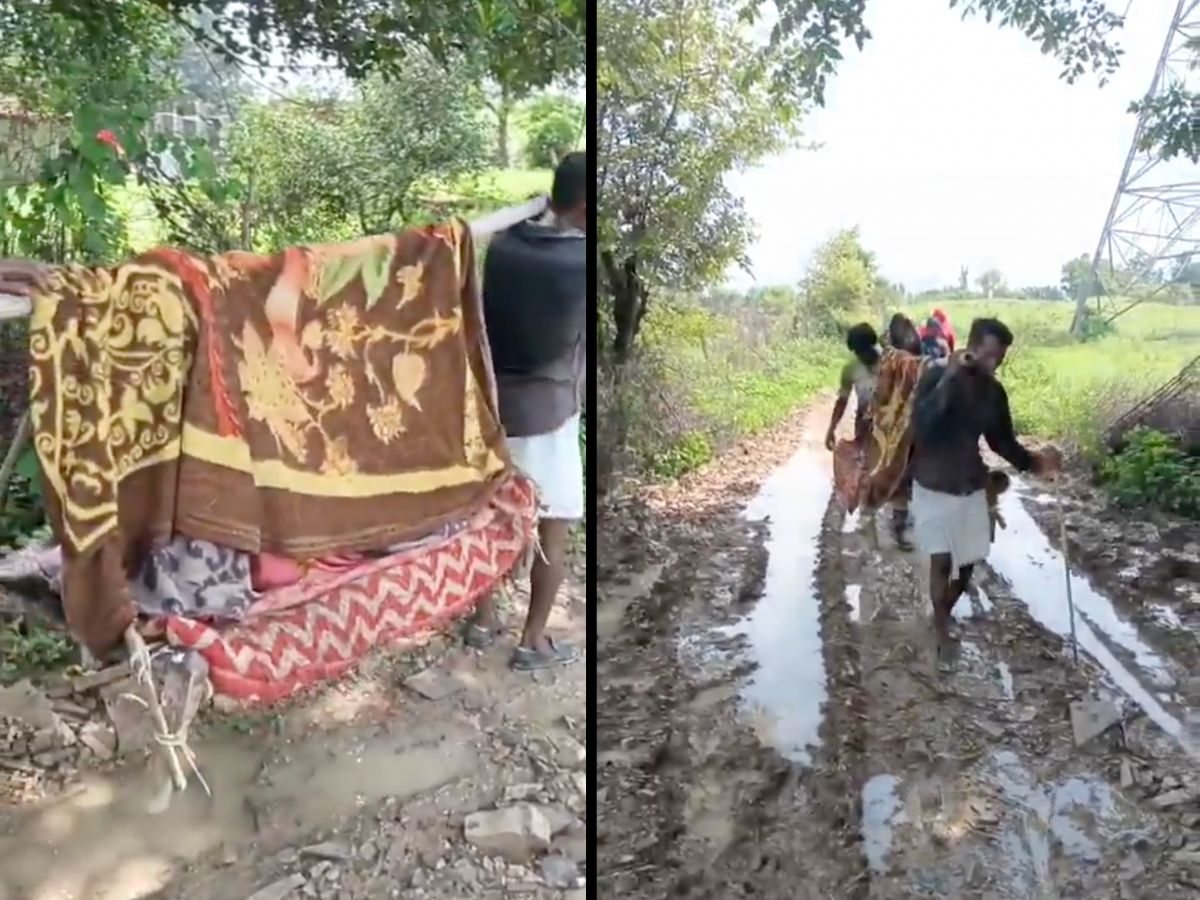
No ambulance or road access in Singrauli, Madhya Pradesh, forced a woman to deliver twins at home. Tragically, one newborn died. (Photo: X/@akanshathakur7)
Gallu Devi, a woman, had to give birth to twin girls in her home because there was no ambulance and there was no good connectivity of roads to her village. Unfortunately, one of the infants died in a short while after birth. This brutal case from Chitrangi region of Singrauli district, Madhya Pradesh has again brought into focus the absence of basic healthcare facilities in rural India.
When Gallu Devi had labor, the family struggled to organize a vehicle to the nearest hospital but could find no motorable road or ambulance service at hand. Having no other choice, the family delivered her at home. When her condition deteriorated the following day, villagers carried Gallu Devi on a stretcher made from a cot for almost two kilometres along bumpy, muddy roads to get to the nearest road. Thereafter, an auto-rickshaw brought her to the community health centre in Korsar town.
A clip of Gallu Devi being transported on a cot has gone viral on social media. The locals hold the absence of a good road and prompt medical attention responsible for the baby’s death. Block Medical Officer assured that a medical team made a checkup on the family and both the mother and the newborn child, cautioning that the surviving infant is still at risk from low birth weight and lack of proper medical attention.
The accident happened in the hometown of State Minister for Panchayat and Rural Development, Radha Singh. The state government has come under fire on social media for asking how development could be expected elsewhere when even the minister’s own village is not provided with basic infrastructure.
Similar incidents of ‘no ambulance’ available cases occured earlier too. Another incident happened in Uttarakhand on January 2025, when a family found themselves stranded at Sushila Tiwari Hospital in Haldwani after no ambulance was available to take the body of their late relative to their village. Hema Devi, 45, of Paithana village in Almora district, died of her injuries in the meantime. In December last year, the body of an 80-year-old tribal woman in Kerala’s Wayanad was transported to a burial site in an auto-rickshaw when an ambulance did not come.
In another unfortunate incident, a 21-12 months- mother and her newborn baby lost their lives in an ambulance accident just days following childbirth in Narmadapuram district of Madhya Pradesh on June 30, as the family turned into their way domestic from the medical institution after a successful transport.
Anjali Rajput, a resident of Sarra Kishore village, had welcomed a baby boy at the authorities’ sanatorium in Narmadapuram. She turned into being transported back home in a central authority-operated ambulance service, followed using her new child, husband, and girl spouse and children. This carrier is a part of a central authority initiative designed to provide unfastened and safe transportation for moms and babies post-transport.
ALSO READ: Why Doctors Warn Against The ‘Romanticisation’ Of Home Births—Kerala Mother’s Death A Wake-Up Call
Sofia Babu Chacko is a journalist with over five years of experience reporting on Indian politics, crime, human rights, gender issues, and stories about marginalized communities. She believes journalism plays a crucial role in amplifying unheard voices and bringing attention to issues that truly matter. Sofia has contributed articles to The New Indian Express, Youth Ki Awaaz, and Maktoob Media. She is also a recipient of the 2025 Laadli Media Awards for gender sensitivity. Beyond the newsroom, she is a music enthusiast who enjoys singing. Connect with Sofia on X: https://x.com/SBCism
President Trump said the U.S. cannot negotiate with Iran, as “nobody to talk to” remains…
Crown Princess Mette-Marit of Norway revealed her past connection with Jeffrey Epstein, calling it “manipulation.”…
Raj Arjun rose from theatre to acclaim with films like Secret Superstar. Father of Sara…
