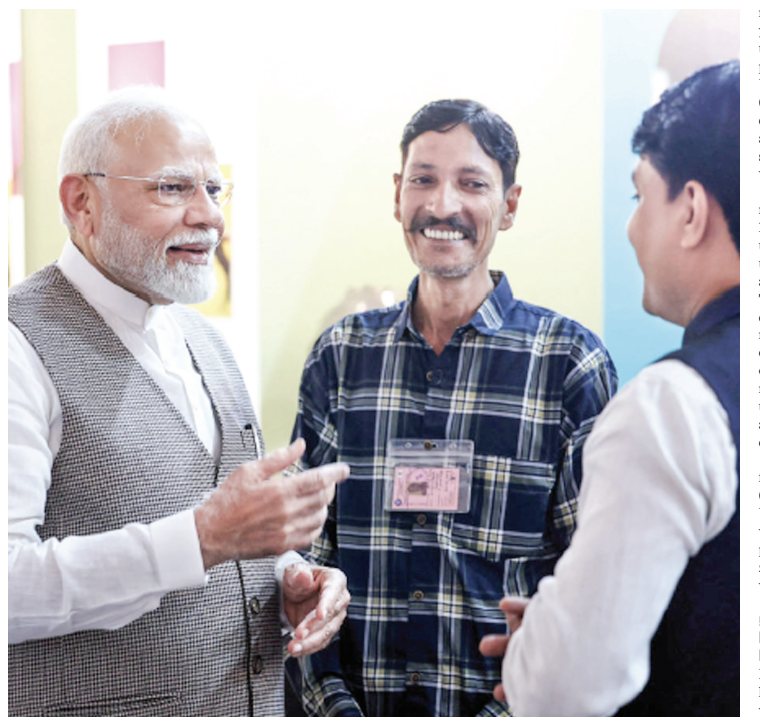
For any nation aspiring to rise as a global power, the comfort and aspirations of its mid- dle class serve as the back- bone of its progress. In In- dia, the last 11 years under Prime Minister Narendra Modi have been marked by a deliberate push to im- prove the ease of living, particularly for the bur- geoning middle class. From enabling affordable hous- ing to digital revolutions, the government’s approach has sought to balance eco- nomic opportunity with everyday convenience.
Affordable Housing: Realising the Dream of Homeownership Owning a home has long been considered the ultimate marker of stabil- ity for middle-class families. The Pradhan Mantri Awas Yojana (PMAY) has been instrumental in turning this aspiration into reality. With more than 4 crore urban and rural houses constructed, the scheme has delivered not just walls and roofs but dignity and security. The government’s Credit Linked Subsidy Scheme (CLSS) under PMAY has allowed lakhs of families to access loans at lower in- terest rates, making own- ership affordable. Importantly, the Real Estate Regulatory Au- thority (RERA) Act of 2016 has safeguarded middle-class investments in real estate. For de- cades, buyers struggled against delayed projects and stalled developments. With RERA, over 1 lakh cases have been disposed of, and accountability has been introduced into a sector notorious for opac- ity. Complementing this is the SWAMIH fund, which has unlocked more than Rs 37,000 crore for stuck projects, ensuring that families receive their long-awaited homes. The Svamitva Scheme has further provided clear property rights in rural India through drone- based mapping and issu- ance of ownership cards, thus securing property for future generations.
Tax Reforms: Relieving the Burden For the middle class, few issues are as central as income tax. The Modi government’s tax reforms have substantially eased this burden. Under the new tax regime, incomes up to Rs 12.75 lakh receive a full rebate, expanding disposable incomes and enabling greater con- sumption. The tax system has be- come simpler and more transparent—from e-fil- ing of returns and face- less assessments to quick refunds, harassment has significantly reduced. The expansion of the tax base—from 3.3 crore re- turns in FY 2013-14 to over 8 crore in FY 2023- 24—indicates both com- pliance and trust in gov- ernance. Meanwhile, the introduction of the Goods and Services Tax (GST) has rationalised indirect taxes, bringing down the costs of everyday goods and services.
UDAN: Taking Air Travel to Tier-II and Tier-III India Air travel, once considered a luxury, is now within reach of the middle class. The Ude Desh Ka Aam Nagrik (UDAN) scheme, launched in 2016, has made affordable flights possible by connecting underserved and unserved airports. Over 1.5 crore passengers have availed affordable air travel under UDAN, with 86 new airports operation- alised in the past decade. This connectivity has not only saved time but also created economic oppor- tunities for smaller towns, allowing families and pro- fessionals to access the ben- efits of mobility.
Metro Expansion: Easing Urban Commutes Urban transportation has undergone a dramatic transformation with the ex- pansion of metro networks. From only 5 cities in 2014, metro services now operate in 23 cities with over 1,013 km of track length. This ex- pansion has reshaped the way middle-class Indians commute. Families are sav- ing both time and money, while cities benefit from reduced pollution and con- gestion. The shift from private vehicles to comfortable, ef- ficient public transport has brought about a tangible change in quality of life. It has also added a layer of safety, convenience, and predictability to urban liv- ing—essentials for the mid- dle class balancing work and family responsibilities.
Digital Payments: The UPI Revolution One of the most visible revolutions of the last 11 years has been India’s transformation into a digital payments powerhouse. The Unified Payments Interface (UPI) has become the default mode of transaction across households, kirana shops, and even street vendors. By March 2025, India recorded an astounding 1830 crore UPI transactions monthly, with close to 46 crore individual users and 6.5 crore merchants. This digital ecosystem has enabled micropayments, making even a Rs 5 tea pur- chase cashless. The ease of transactions has elimi- nated leakages, expanded transparency, and created a trusted, inclusive digital economy. Beyond payments, plat- forms like DigiLocker (52 crore users) and the UMANG app (2,297+ services) have further reduced paperwork, enabling citizens to access essential services with a tap.
5G Rollout: Powering the Next Leap India’s leap into the future has been cemented with the world’s fastest 5G rollout, covering 99.6% of districts in just 22 months. This ex- pansion has unlocked un- precedented opportunities in healthcare, education, agriculture, industry, and governance. For middle-class families, this means high-speed in- ternet for children’s online learning, remote working opportunities, telemedicine consultations, and seamless entertainment. For profes- sionals and entrepreneurs, it opens doors to innovation in sectors like AI, robotics, and smart cities. Affordable data costsdown by 97% since 2014 have made India the global leader in internet af- fordability and penetration.
Everyday Convenience: From Electricity to Internet The government’s holistic approach has ensured that improvements go beyond headline projects. Access to reliable electricity, reduction in car loan interest rates, and near-universal sanitation and tap-water facilities have created a seamless lifestyle for families. In many ways, these basic provisions form the bedrock upon which larger aspirations—like travel, education, and entrepreneurship—are built.
Middle-Class Empowerment The government’s vision of “Sabka Saath, Sabka Vikas, Sabka Vishwas, Sabka Prayas” resonates strongly in the story of the middle class. Affordable homes, regulated real es- tate, tax reliefs, efficient public transport, access to air travel, digital payments, and lightning-fast internet are no longer privileges of a few but rights accessible to millions. This empowerment has had a multiplier effect: high- er disposable incomes, in- creased consumption, great- er mobility, and the creation of a digitally savvy, globally competitive citizenry. The middle class today stands not just as beneficiaries but as active participants in India’s growth story.
KVS Admission 2026 Notification To Be Out At kvsangathan.nic.in, Check Key Details Here
KV Admission 2026-27: The Kendriya Vidyalaya Sangathan (KVS) admission 2026 notification is expected to be…
KL Rahul Unhappy at Delhi Capitals? Ex-CSK Star Hints at Dressing Room Tension Before IPL 2026
KL Rahul’s role at Delhi Capitals is under scrutiny ahead of IPL 2026, with S…
WATCH: King Kohli Returns! Virat Kohli Lands in Bengaluru Ahead of RCB vs SRH Opener in IPL 2026
Virat Kohli is gearing up for the upcoming edition of the Indian Premier League (IPL).…

