
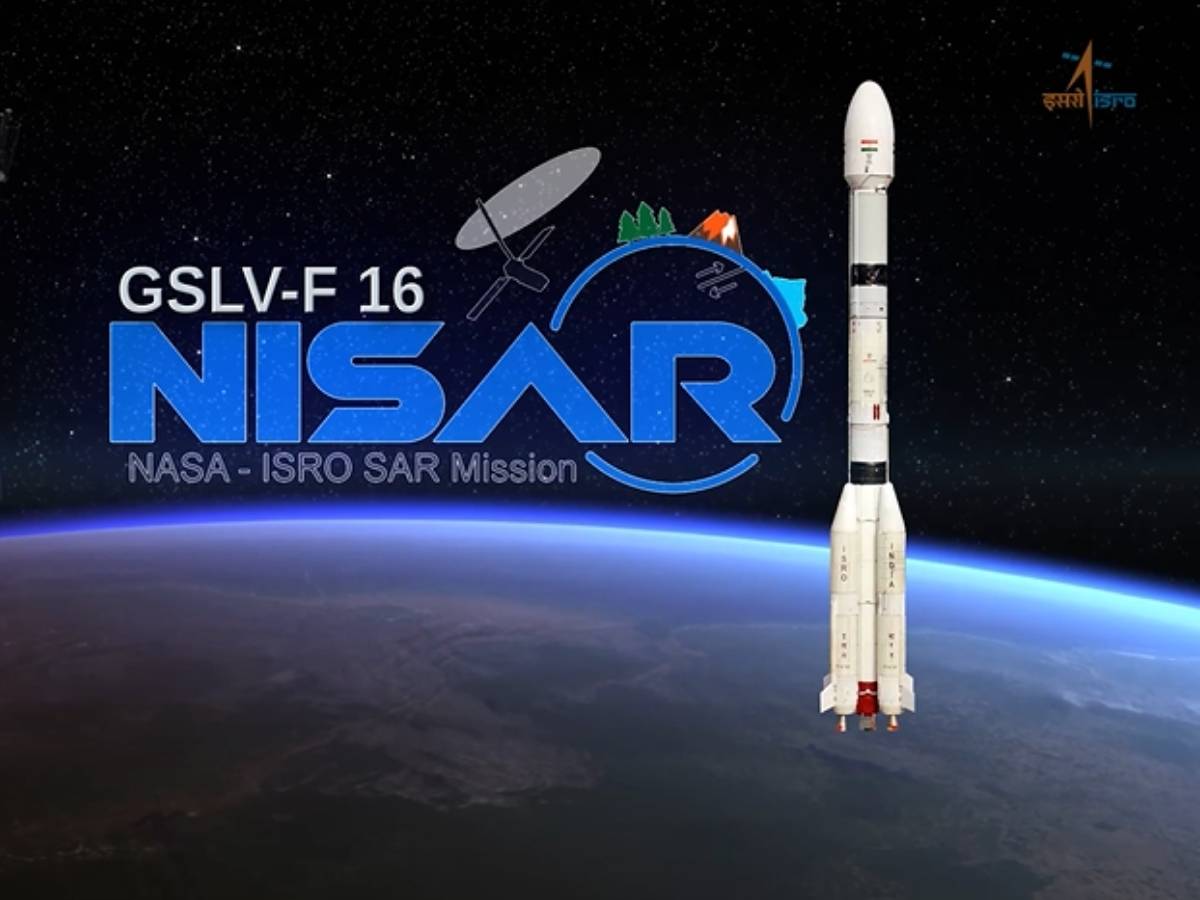
In a major step towards advancing Earth observation and climate monitoring, India and the United States jointly launched the NASA-ISRO Synthetic Aperture Radar (NISAR) satellite on Wednesday from the Satish Dhawan Space Centre in Sriharikota. The high-tech satellite aims to closely monitor changes in the Earth’s surface, including glacier melt, groundwater shifts, and seismic activity.
Launched aboard ISRO’s GSLV-F16 rocket at 5:40 pm IST, the satellite was successfully placed into orbit by 5:58 pm. Weighing 2,393 kg and roughly the size of a large SUV, NISAR will soon begin deploying its 30-foot boom and its 39-foot gold-plated reflector to commence scientific operations, expected to start by the end of October.
NISAR is the world’s first Earth observation satellite equipped with dual-band radar technology the S-band radar developed by ISRO and the L-band radar built by NASA. This combination allows scientists to monitor even the smallest movements on Earth’s surface as small as one centimetre from an altitude of 743 km.
The $1.5 billion mission will map almost all land surfaces of the planet every 12 days over five years. It is designed to detect early signs of natural disasters like earthquakes and landslides, while also providing critical data on glacier movement, polar ice melting, forest degradationDelhi Breaks 10-Year Record With Cleanest July Air, Despite Heavy Rains, and methane emissions.
Union Minister Jitendra Singh hailed the joint launch as a “scientific handshake with the world,” emphasizing its importance to sectors like aviation and shipping due to its ability to penetrate fog, clouds, and ice.
NASA’s Deputy Associate Administrator Casey Swails, present at the launch, reflected on the decade-long collaboration that built the mission: “It’s been an incredible journey across continents and cultures, making this moment possible.”
ISRO Chairman V. Narayanan confirmed that the satellite is performing as expected. “All vehicle systems behaved normally, and the satellite was placed in orbit within a 3 km margin well within the 20 km allowance,” he said.
Data from the L-band radar will be accessible via the Alaska Satellite Facility, while the S-band radar data will be hosted on Bhoonidhi at India’s National Remote Sensing Centre in Hyderabad.
This landmark partnership between NASA and ISRO marks a new era in Earth science, combining resources, talent, and technology to better understand and protect the planet.
ALSO READ: Delhi Breaks 10-Year Record With Cleanest July Air, Despite Heavy Rains