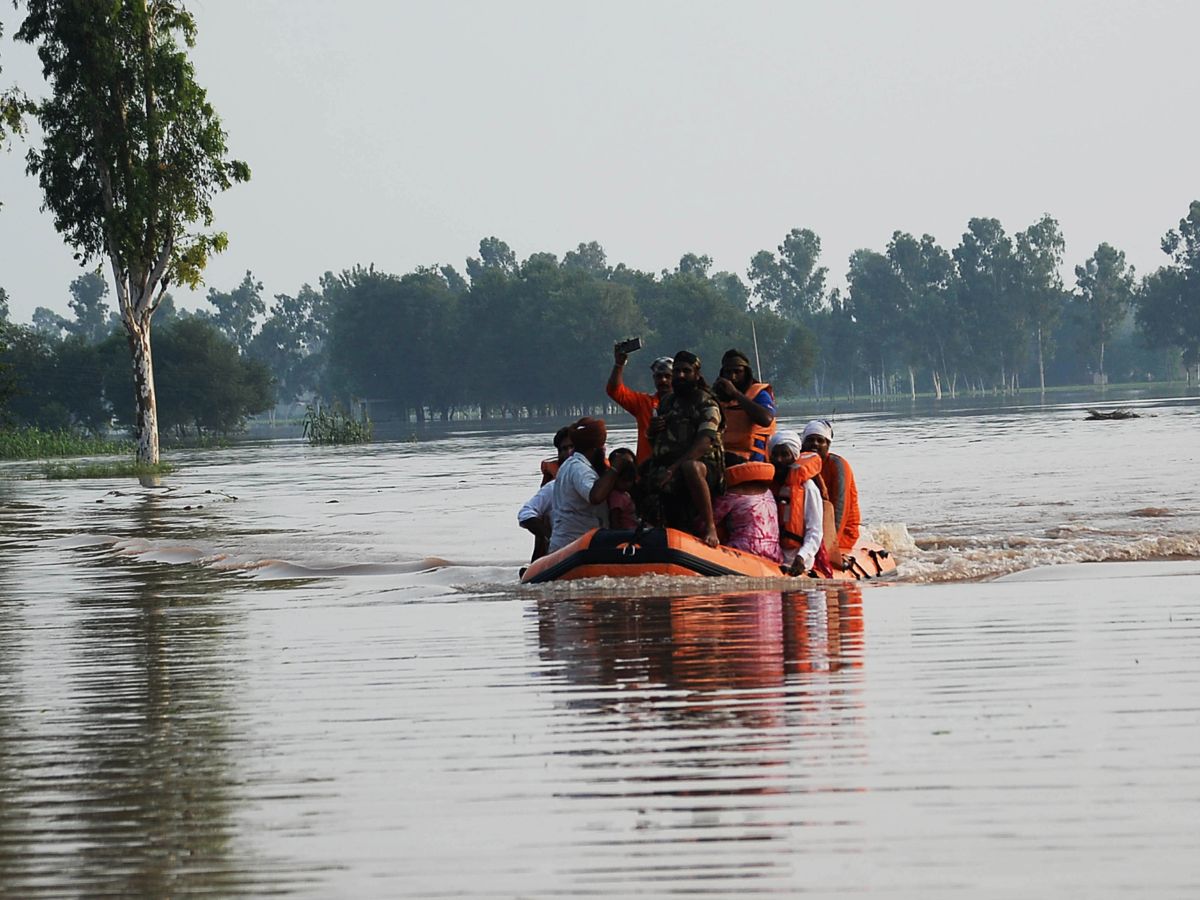
Flood-hit Punjab braces for relief as IMD predicts rainfall to subside from September 4 (Photo: ANI)
After several days of fast and nonstop rain that soaked large parts of Punjab, the Indian Meteorological Department (IMD) said that rain-bearing activity will sharply lessen in the area beginning Thursday, September 4.
“The intensity of rain will substantially decrease from Thursday, and this trend is expected to continue for a minimum of the next three to four days,” Surender Paul, Director, IMD-Chandigarh, said. “There is no alertness for heavy rain, at least until September 9, which would be some relief for flood-affected areas. The rain activity is also expected to decrease in Chandigarh, Haryana, and Himachal Pradesh apart from Punjab.
Punjab has been struggling with excess rainfall, and due to this reason, there is waterlogging in rural and urban areas severely. In the past 24 hours, 19 districts had rainfall of more than 60% above normal including Sangrur, Gurdaspur, Ludhiana, Pathankot, Jalandhar, and Barnala. IMD data has shown that Punjab has received 30 mm of rainfall versus 4.6 mm as the normal value which is observed for the past couple of weeks.
This monsoon year has already recorded 575 mm of rainfall between June 1 and September 3, which is 54% more than the Long Period Average (LPA). As much as 253.7 mm rainfall was recorded in August alone, which is the highest for a month in 25 years for the state. Punjab received 22% lower rainfall during the corresponding period last year.
Experts believe Punjab’s urban flooding is indicative of a larger trend for cities all over India. The gap between the intensity of rainfall and drainage capacity is increasing flooding. Wetlands filled with rubbish, water channels taken over by slums, blocked stormwater drains, and the development of non-permeable surfaces such as roads and pavements have reduced the amount of natural percolation that can occur.
This trend is not only in Punjab or the north of India. There have been extreme flooding events in Hyderabad (2020, 2021), Chennai (2021), Bengaluru and Ahmedabad (2022), Delhi and Nagpur (2023) over the past few years and the authorities have been unable to determine whether or not to implement flood prevention plans. Even hill towns like Dehradun and Shimla do not feel safe anymore, flash floods and landslides becoming more common place. The disastrous Sikkim flash floods of October 2023 are warning of the urban-like exposures increasing in the hills.
Himachal Pradesh serves as a crucial reminder of the effects of unscientific development practices. The Supreme Court of India has in recent times and categorically associated anthropogenic processes like hydro electric developments, four-lane of highways, indiscriminate deforestation and unrestricted construction of multistoreyed buildings with the ecological degradation of the state. “No amount of revenue collection”, the country’s highest court cautioned, “can be harvested at the expense of the environment and ecology”.
ALSO READ: Is Over-Urbanisation Pushing The Himalayas To The Brink Of Collapse?
Sofia Babu Chacko is a journalist with over five years of experience reporting on Indian politics, crime, human rights, gender issues, and stories about marginalized communities. She believes journalism plays a crucial role in amplifying unheard voices and bringing attention to issues that truly matter. Sofia has contributed articles to The New Indian Express, Youth Ki Awaaz, and Maktoob Media. She is also a recipient of the 2025 Laadli Media Awards for gender sensitivity. Beyond the newsroom, she is a music enthusiast who enjoys singing. Connect with Sofia on X: https://x.com/SBCism
A strong western disturbance brings a sudden weather shift to Delhi. IMD issues yellow alert…
A gondola at Engelberg-Titlis ski resort crashed, killing a 61-year-old woman. High winds up to…
Chaitra Navratri 2026, starting March 19, honors Maa Durga’s nine divine forms. Sharing heartfelt wishes…
