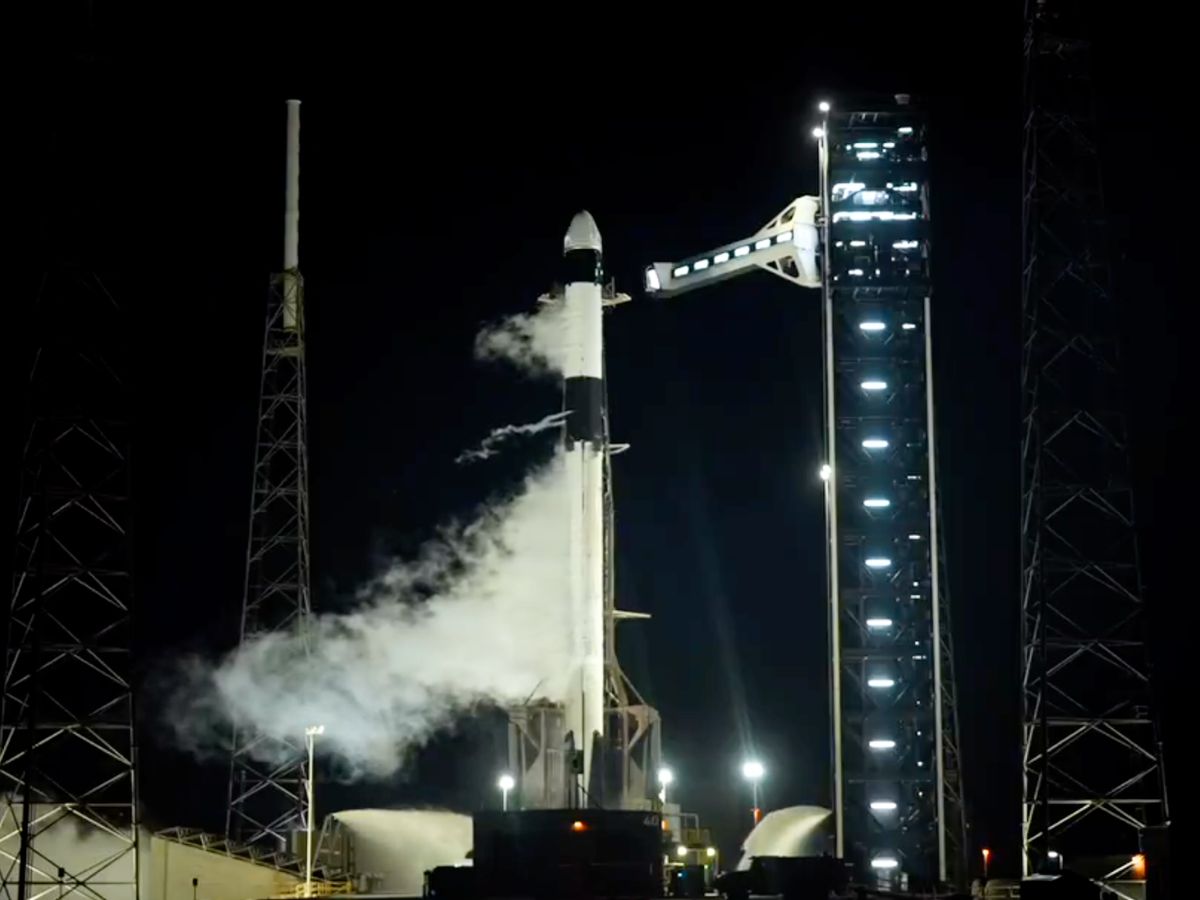
SpaceX and NASA are preparing to launch the Crew-12 mission. (Photo; X/SpaceX)
SpaceX and NASA launched the Crew-12 mission to the International Space Station (ISS), bringing the orbiting laboratory back to full capacity after a month of operating with a skeleton crew.
The SpaceX Dragon capsule is scheduled to lift off no earlier than 5:15 a.m. ET Friday from Cape Canaveral Space Force Station in Florida.
The launch comes after Crew-11, the previous SpaceX mission, made an early return to Earth due to an undisclosed medical issue affecting one astronaut. This early departure left the ISS with only three crew members, well below NASA’s preferred seven-person staffing level for maximum operational efficiency and scientific productivity.
The Crew-12 mission carries four astronauts: NASA’s Jessica Meir and Jack Hathaway, European Space Agency astronaut Sophie Adenot, and Russian cosmonaut Andrey Fedyaev.
Unlike typical ISS operations, this mission will not feature an on-station handover period with Crew-11 due to the early departure. However, the Crew-12 team received a thorough briefing from Crew-11 personnel on the ground before launch.
NASA usually facilitates a direct handover between incoming and outgoing crews to ensure smooth transitions and temporarily boost staffing levels. This overlap helps astronauts quickly acclimate to station systems and ongoing research projects.
Currently, the ISS is staffed by NASA astronaut Chris Williams and Russian cosmonauts Sergey Kud-Sverchkov and Sergei Mikayev. Operating the station with a reduced crew limits ongoing research, maintenance, and scientific experiments. NASA Administrator Jared Isaacman emphasized that a full crew presence is critical for maximizing the $3 billion annual investment in ISS operations.
Jessica Meir noted that prior to regular SpaceX crew rotations, lean staffing and indirect handovers were common, relying heavily on ground communication for continuity.
During their approximately eight-month mission, the Crew-12 astronauts will conduct a variety of experiments. These include ultrasound examinations of blood vessels to study circulation changes, pharmaceutical tests on bacteria responsible for pneumonia, and a simulated lunar landing exercise to evaluate how sudden gravity shifts impact human physiology and cognition.
These projects aim to advance scientific understanding essential for long-duration space missions and future exploration beyond Earth orbit.
NASA continues to support the development of commercial space stations in low Earth orbit as successors to the ISS. Administrator Isaacman envisions multiple private-sector stations, while the remaining lifespan of the ISS will be used to maximize high-impact science.
Maintaining full staffing and productivity aboard the ISS remains a priority, ensuring ongoing research and operational success as NASA prepares for future deep-space exploration missions.
Sofia Babu Chacko is a journalist with over five years of experience reporting on Indian politics, crime, human rights, gender issues, and stories about marginalized communities. She believes journalism plays a crucial role in amplifying unheard voices and bringing attention to issues that truly matter. Sofia has contributed articles to The New Indian Express, Youth Ki Awaaz, and Maktoob Media. She is also a recipient of the 2025 Laadli Media Awards for gender sensitivity. Beyond the newsroom, she is a music enthusiast who enjoys singing. Connect with Sofia on X: https://x.com/SBCism
The viral video of the incident has caused furore on social media, with many people…
The Indian rupee saw a strong jump against the US dollar, rising 1.52% to close…
US intelligence indicates Iran is unlikely to reopen the Strait of Hormuz anytime soon, viewing…
