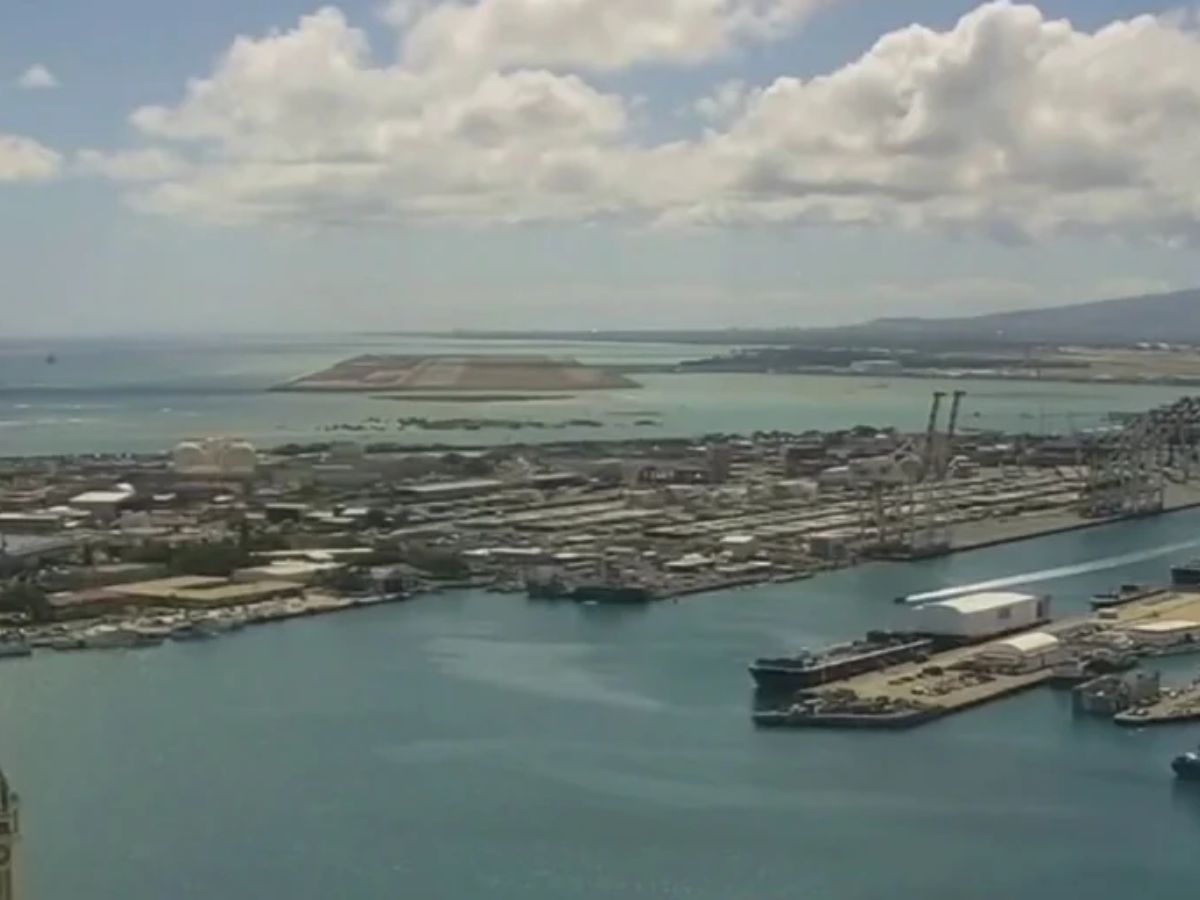
Hawaii under tsunami warning after 8.8 quake in Russia’s Far East; waves hit Maui, evacuations and alerts issued Pacific-wide. Photo/X.
Hawaii continues to be under a tsunami warning after one of the most powerful earthquakes in recent history. Earthquake of magnitude 8.8 struck Russia’s Far East early Wednesday.
The quake triggered tsunami waves across the Pacific, including in Japan and Alaska, and prompted alerts for regions as far as North and Central America and southward to New Zealand.
The Pacific Tsunami Warning Center (PTWC) reported that the estimated arrival time of the first tsunami wave in Hawaii was 7:17 p.m. local time on Tuesday (1:17 a.m. EDT Wednesday). According to CBS affiliate KGMB-TV in Honolulu, initial tsunami waves began coming ashore in parts of Hawaii. Although these early waves were relatively small, they coincided with high tide, raising concerns.
The PTWC confirmed that the tsunami gauge in Kahului, Maui, recorded a wave height of four feet above normal sea levels. In response, authorities urged residents and visitors to move inland. Shelters were opened across multiple locations to accommodate evacuees.
Hawaii Governor Josh Green noted that wave data from Midway Atoll, located between Japan and Hawaii, indicated wave peaks reaching six feet from trough to crest. He cautioned that the waves reaching Hawaii could be either larger or smaller, and their actual impact remained uncertain at this stage.
“This is a longitudinal wave with great force driving through the shoreline and into land,” Green explained during a press briefing.
To support emergency response efforts, Black Hawk helicopters and high-water vehicles were placed on standby in case rescues were needed.
“But please do not put yourself in harm’s way,” the governor urged.
Further north, the Oregon Department of Emergency Management announced on Facebook that small tsunami waves—ranging from one to two feet, were expected to hit the coastline starting at approximately 11:40 p.m. local time. Authorities urged the public to avoid beaches, harbors, and marinas until advisories were lifted.
“This is not a major tsunami, but dangerous currents and strong waves may pose a risk to those near the water,” the department stated.
A tsunami advisory was also in effect for much of the West Coast, including Canada’s British Columbia, as well as Washington state and California.
The powerful earthquake struck at 8:25 a.m. Japan time and initially registered a magnitude of 8.0, according to both Japanese and U.S. seismological agencies. The U.S. Geological Survey later revised the magnitude to 8.8 and reported that the quake occurred at a shallow depth of 13 miles.
The epicenter was located approximately 74 miles east-southeast of Petropavlovsk-Kamchatsky, a city of 180,000 people on Russia’s Kamchatka Peninsula. Several strong aftershocks followed, with magnitudes reaching up to 6.9.
Zubair Amin is a Senior Journalist at NewsX with over seven years of experience in reporting and editorial work. He has written for leading national and international publications, including Foreign Policy Magazine, Al Jazeera, The Economic Times, The Indian Express, The Wire, Article 14, Mongabay, News9, among others. His primary focus is on international affairs, with a strong interest in US politics and policy. He also writes on West Asia, Indian polity, and constitutional issues. Zubair tweets at zubaiyr.amin
GATE 2026 Answer Key Released, How To Check Result And Direct Result Link Here
The Indian Institute of Technology (IIT) Guwahati has released the Graduate Aptitude Test in Engineering…
Gudi Padwa 2026 marks the beginning of the Hindu New Year and is being celebrated…
Lionel Messi's milestone strike came in a tightly contested encounter, as Inter Miami secured progression…
