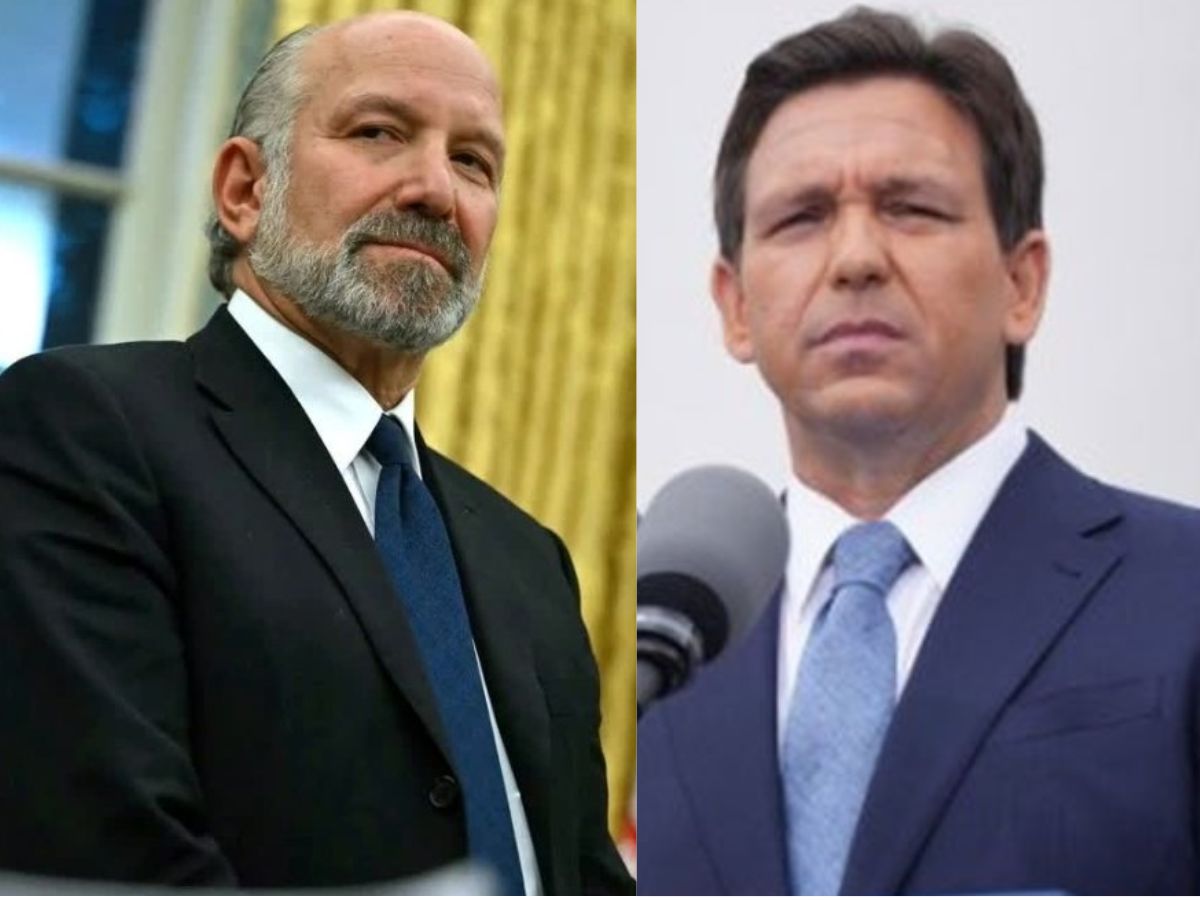
US leaders criticize H-1B visas, favoring India over American workers; reform and Gold Card proposal gain traction. Photos/X,ANI.
The H-1B visa program has come under attack from various US lawmakers, including the likes of US Commerce Secretary Howard Lutnick, Florida Governor Ron DeSantis, and Republican Senator Mike Lee, claiming that the program is favoring India while ignoring the US workers. There have been growing calls among Republicans and MAGA followers to amend the program.
Florida Governor Ron DeSantis has now publicly criticized the H-1B visa program, saying it disadvantages American workers.
“Companies lay off Americans while bringing in new H-1Bs. It’s not the best and brightest from around the world… it’s from just one country, India. It’s a cottage industry, mostly from one country,” DeSantis said, highlighting concerns about the concentration of visa recipients from a single nation.
United States Commerce Secretary Howard Lutnick made similar concerns, calling for significant changes to the H-1B and green card systems.
“I’m involved in changing the H-1B program. We’re going to change that program,” Lutnick told Fox News, describing the current system as “terrible.”
Lutnick also questioned the current allocation of green cards, “we give green cards. The average American makes $75,000 a year, and the average green card recipient $66,000. So we’re taking the bottom quartile. Why are we doing that?”
He announced plans for a new system that would prioritize highly skilled individuals.
“That’s the gold card that’s coming. And that’s we’re gonna start picking the best people to come into this country. It’s time for that to change,” Lutnick said.
US Republican Senator Mike Lee also suggested a possible pause on H-1B visas, many of which are obtained by highly skilled Indian workers.
“Is it time to pause H1B visas?” Lee asked on the social media platform X, responding to claims that a Walmart executive received kickbacks to preferentially hire Indian H-1B tech workers over Americans.
First introduced in 1990, H-1B visas allow US companies to hire foreign workers for specialty occupations. The visas are valid for three years, extendable to a maximum of six. The program currently has an annual cap of 65,000 visas, with an additional 20,000 available to individuals who complete a master’s or PhD in the US. Technology professionals from India have consistently been among the largest beneficiaries.
Earlier this month, the White House Office of Information and Regulatory Affairs adopted a proposed regulation to prioritize H-1B visa applicants based on earnings rather than a random lottery.
Currently, the program issues 85,000 visas annually, selected through a lottery system. The Department of Homeland Security had recommended in 2021 that visas be allocated according to earnings, divided into four categories to prioritize higher-paying positions.
The Trump administration’s proposed “Gold Card” would grant permanent residency to foreigners who invest $5 million in the United States.
According to Lutnick, there is already strong interest, with 250,000 people reportedly in the queue. He has further projected that the program could generate $1.25 trillion in revenue for the US.
Concerns over H-1B visas have grown amid recent layoffs in the tech sector. Vice President JD Vance criticized the practice of hiring foreign-born workers while displacing American employees:
“You see big tech firms laying off 9,000 employees and then applying for thousands of overseas work visas – it just doesn’t add up. That kind of displacement and math concerns me. The President has said we want the best and brightest to make America their home, and that’s good. But I don’t support companies firing thousands of American workers and then claiming they can’t find talent here,” Vance said on a podcast in July.
Also Read: Donald Trump’s Additional 25% Tariff on Indian Goods Takes Effect: All You Need to Know
Zubair Amin is a Senior Journalist at NewsX with over seven years of experience in reporting and editorial work. He has written for leading national and international publications, including Foreign Policy Magazine, Al Jazeera, The Economic Times, The Indian Express, The Wire, Article 14, Mongabay, News9, among others. His primary focus is on international affairs, with a strong interest in US politics and policy. He also writes on West Asia, Indian polity, and constitutional issues. Zubair tweets at zubaiyr.amin
Is Market Open Today: The stock market holiday on March 19, 2026, has left many…
Happy Gudi Padwa 2026: Gudi Padwa, which marks the beginning of the Hindu New Year,…
Karachi Region Whites and Abbottabad Region will lock horns in the final of the Pakistan…
