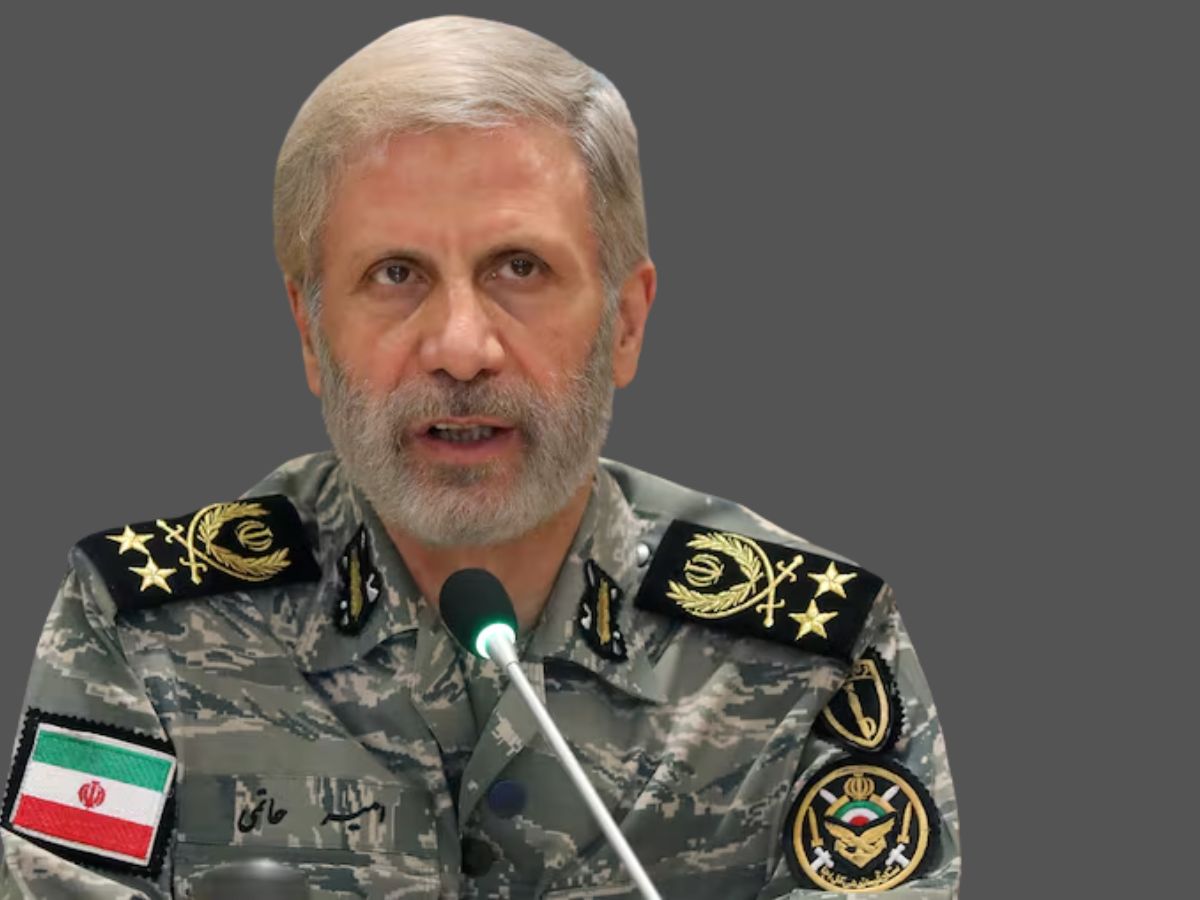
Iran’s Army Chief Amir Hatami. (Photo: Reuters/ Canva)
Iran’s Army Chief Amir Hatami has issued a sharp warning to the United States and Israel, declaring that Iran’s nuclear expertise “cannot be eliminated” even if its scientists are killed, as tensions escalate following a major US naval deployment in the Gulf.
His remarks come after US President Donald Trump announced that a “large armada” of American warships was heading toward Iran, raising fears of a potential military confrontation amid ongoing unrest inside the country and renewed global scrutiny over Tehran’s nuclear and missile programmes.
Speaking to Iran’s official IRNA news agency, Hatami said Iran’s nuclear science and technological capability would survive any military strike.
“The nuclear science and technology of the Islamic Republic of Iran cannot be eliminated, even if scientists and sons of this nation are martyred,” he said.
Hatami stressed that Iran’s armed forces were at “full defensive and military readiness” and warned that any attack would have serious consequences for regional security.
“If the enemy makes a mistake, it will undoubtedly endanger its own security, the security of the region, and the security of the Zionist regime,” he added.
The warning from Tehran follows Trump’s statement that the United States is sending a significantly expanded naval presence toward Iranian waters, led by the aircraft carrier USS Abraham Lincoln.
“We have a large armada, flotilla, call it whatever you want, heading toward Iran right now,” Trump said, adding that he hoped Tehran would choose negotiations over confrontation. “Hopefully we’ll make a deal. If we don’t, we’ll see what happens.”
The deployment has intensified speculation that Washington could be preparing for possible military action if diplomatic efforts fail.
The US naval buildup has heightened fears of a direct clash in the Gulf region. Iran has warned that it would retaliate with missile strikes on US bases, naval assets and allies, including Israel, if attacked.
At the same time, US Central Command (CENTCOM) said Iran’s Islamic Revolutionary Guard Corps (IRGC) would conduct a two-day live-fire naval exercise in the Strait of Hormuz, a crucial global energy transit route. CENTCOM cautioned the IRGC against “unsafe and unprofessional behaviour” near US forces.
The US designated the IRGC a terrorist organisation in 2019, a step the European Union followed this week, drawing strong protests from Tehran.
While tensions rise, Iranian Foreign Minister Abbas Araghchi indicated that Tehran remains open to discussions on its nuclear programme. However, he made it clear that Iran’s missile and defence capabilities would “never be negotiated”.
On Friday, Trump said he expected Iran to seek talks over its nuclear and missile programmes rather than face American military action.
The latest escalation comes months after the US carried out strikes on key Iranian nuclear sites in June during a brief 12-day conflict between Israel and Iran. Israeli attacks also targeted military facilities and killed senior officers and nuclear scientists.
Despite these attacks, Hatami insisted that Iran’s nuclear expertise remains intact.
The military tensions also follow weeks of nationwide protests in Iran that began on December 28 over rising living costs and evolved into broader anti-government demonstrations. Iranian authorities said the unrest turned violent and accused the US and Israel of stoking the protests.
Officials put the death toll at 3,117, while the US-based Human Rights Activists News Agency has claimed that over 6,500 people, including children, were killed.
On Saturday, President Masoud Pezeshkian called for greater engagement with citizens and urged the government to address public grievances, saying justice and fairness were essential for national stability.
With US warships moving closer, Iran conducting naval drills in the Strait of Hormuz, and strong rhetoric from both sides, the situation in the Gulf remains highly volatile.
Even as Washington signals openness to a deal, Tehran’s message is clear: its nuclear knowledge, it says, is irreversible and any military miscalculation could trigger a wider regional crisis.
Sofia Babu Chacko is a journalist with over five years of experience reporting on Indian politics, crime, human rights, gender issues, and stories about marginalized communities. She believes journalism plays a crucial role in amplifying unheard voices and bringing attention to issues that truly matter. Sofia has contributed articles to The New Indian Express, Youth Ki Awaaz, and Maktoob Media. She is also a recipient of the 2025 Laadli Media Awards for gender sensitivity. Beyond the newsroom, she is a music enthusiast who enjoys singing. Connect with Sofia on X: https://x.com/SBCism
Jaipur is experiencing a brief weather shift with cloud cover and chances of light rain,…
IPL 2026: Sanju Samson Falters Again For Chennai Super Kings, Dismissed For 7 vs Punjab Kings
Sanju Samson failed to produce an impactful performance for the Chennai Super Kings for the…
A second case of bat not passing through the umpire's gauge has emerged in IPL…
