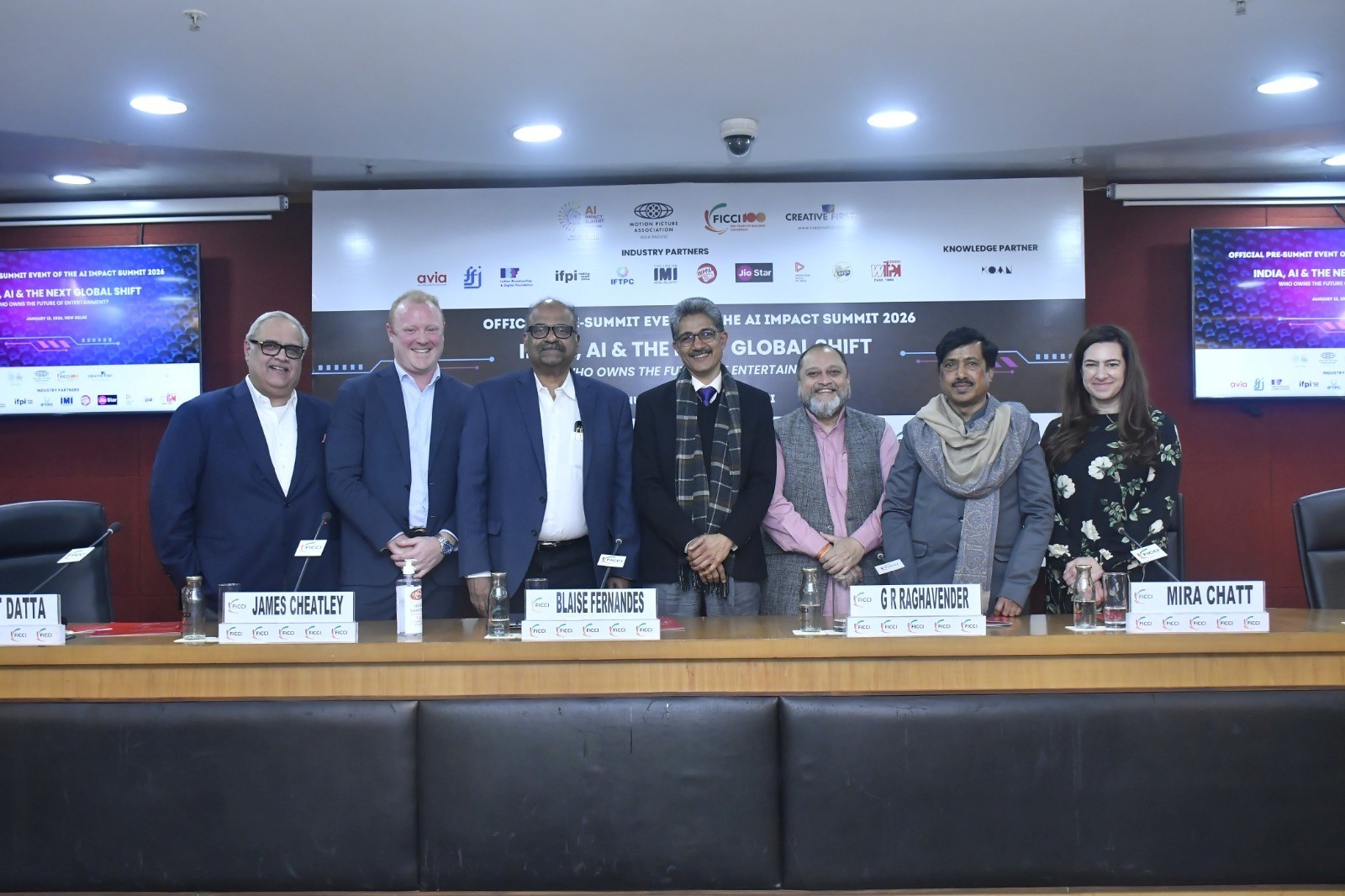
Artificial Intelligence must be harnessed to expand creativity while preserving trust, rights, and value for creators, Prabhat, Additional Secretary, Ministry of Information and Broadcasting, Government of India, said on Tuesday.
He was speaking on January 13 at FICCI in Delhi during an official pre-summit event organised by the Motion Picture Association (MPA) in collaboration with the Federation of Indian Chambers of Commerce and Industry (FICCI), ahead of the India AI Impact Summit 2026.
Titled “Who Owns the Future of Entertainment?: India, AI, and the Next Global Shift,” the one-day seminar examined how India can leverage AI to strengthen its creative economy while safeguarding the rights and livelihoods of creators.
From a public policy perspective, Prabhat outlined three objectives that must be addressed together. AI, he emphasised, must be used to expand creativity, improve competitiveness, and preserve trust and rights, ensuring that innovation remains sustainable rather than fragile.
The event saw strong participation from across the film, television, music, digital platforms, and advisory services sectors. It was supported by industry partners AVIA, FFI, IBDF, IFPI, IFTPC, IMI, IMPAA, JioStar, PGI, TFCC, and WIFPA.
The opening session focused on the policy and regulatory challenges arising from AI’s rapid adoption across creative industries, including issues related to copyright, ownership, training data, attribution, and remuneration. Chaired by James Cheatley, Vice President – VOD, Digital Affairs and Intellectual Property, Motion Picture Association, Asia Pacific, the panel featured Dr. G. R. Raghavender, Senior Consultant, IPR and former Joint Secretary, DPIIT; Ameet Datta, Co-Chair, FICCI IP Committee and Founder, ADP Law Offices; and Blaise Fernandes, President, IMI, among other senior experts.
Highlighting the importance of copyright-led growth, Blaise Fernandes said, “At WAVES 2025, our Prime Minister, Shri Narendra Modi, set the benchmark for India’s creative sector to power the Orange Economy to global heights. Any AI policy must ensure that the copyright sector is given the opportunity to unlock the value of copyright through voluntary licensing models. This is very important to reach global heights.”
Emphasising what is at stake, James Cheatley said, “AI is transforming every stage of the creative lifecycle. The policy decisions made now will shape how creators, companies, and markets evolve. India has a real opportunity to work in dialogue with industry to establish frameworks that support creativity, investment, and responsible technological growth.”
Mira Chatt, IFPI Regional Director (Asia), noted, “The creative industries have stepped up to shape future opportunities for music and AI by pursuing voluntary licensing opportunities. Governments should support this by enforcing, not undermining, existing copyright laws to ensure a level playing field for creators, right holders, and AI companies. It’s a basic question of fairness. Right holders in India should be able to negotiate a license for the use of their music. This benefits the whole creative ecosystem and its future.”
The second session shifted focus to real-world applications, examining how AI is already being deployed across scripting, music, animation, visual effects, and distribution. Chaired by Vivan Sharan, Partner at Koan Advisory, the panel included Andrew Ure, Vice President, Global Affairs, Asia Pacific, Netflix; Akash Saxena, Chief Technology Officer, JioStar; Vikram Malhotra, Founder and CEO, Abundantia Entertainment; and Pankaj Kumar Mishra, Head – Enterprise Technology Group, Sony Pictures Networks India, among other industry leaders.
Pankaj Kumar Mishra said, “AI in media and entertainment is not a single debate; it is a strategic set of choices across capability, economics, creativity, competitive advantage, and governance. The technology is ready, the talent is here, and the market is massive. What will separate leaders is whether AI becomes just a faster way to do the same work or a way to create what we have never been able to create before. Get that balance right, AI for speed, humans for soul and India will be globally competitive, not merely globally present.”
“The future of entertainment will belong to ecosystems that empower creators, protect originality and democratise access. With its unparalleled creative talent, cultural diversity and digital scale, India is uniquely positioned to influence the next global shift in entertainment. AI can help Indian content travel faster, wider and deeper—provided innovation is supported by enabling policies and strong industry collaboration.” Added Leena Jaisani, Deputy Secretary General, FICCI
The India AI Impact Summit 2026 will be held in New Delhi from 16–20 February, continuing the national and global dialogue on how AI can drive inclusive growth, innovation, and global influence for India’s creative economy.
14 January 2026 | New Delhi
The 2026 Finalissima between Argentina and Spain is in jeopardy as the Qatar Football Association…
Punjabi singer-actor Ammy Virk shared an emotional Instagram post revealing his wife and six-year-old daughter…
Is the PAK vs BAN ODI series 2026 being cancelled? Reports from Geo Super suggest…
