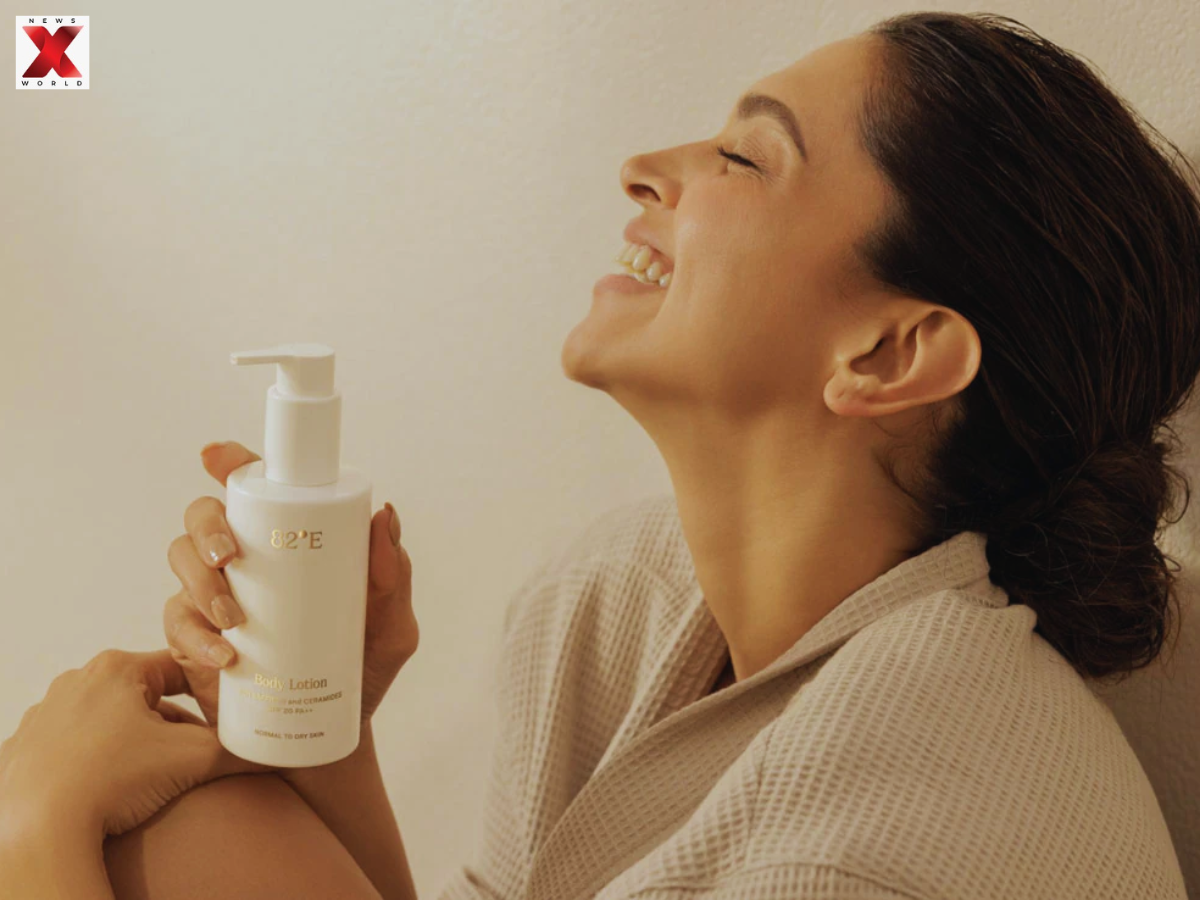
Deepika Padukone's skincare brand 82°E reports loss of ₹12.26 crore (PHOTO: X)
The skincare brand 82E by the actor Deepika Padukone is struggling to make a profit, and a decline in revenues, the latest company filings have demonstrated.
It has been indicated that the company is attempting to cut costs in order to guarantee profitability, yet to date with the exception of the losses decreasing, things have not improved.
The legal entity under which 82 degree E operates is DPKA Universal Consumer Ventures. The company is privately held and is under the name of Deepika and father, Prakash Padukone as directors.
The company has indicated in its most recent reports to the ministry of corporate affairs that 82 -E incurred a loss of 12.26 crore during the 2024-25 financial year.
The filings also indicate that the revenue of the company has decreased by more than 30 percent as 21.21 crore in 2023-24 fell to 14.66 crore in 2024-25.
The positive side of the situation of Deepika company is that 82 degree E has suffered a loss less compared to the last fiscal year. In 2023-24, the company had made losses amounting to more than 23 crore.
The company reported a drag in spending in the MCA filings. The statement further went on to say that the management is in constant efforts to make sure it augments the revenue, cutting down on spending in order to make sure it has profitable track record. This can be seen through the decrease in the company spending in the market.
The market spending of the company went down to 4.4 crore in 2024 25 compared to 20 crore the year before, a massive decline of 78 percent. The total spending was reduced as well, to slightly less than 26 crore, as compared to 47 crore.
Deepika Padukone ventured into the Indian skincare and wellness market with her skincare brand 82°E in 2022, making it a high-end self-care brand dedicated to the formulations that are underpinned by science.
At the time of launch, the brand created a buzz, and it had high awareness because of the immense celebrity power of Deepika. But, the latest filings of the company indicate that the venture is financially challenged, as its revenues are declining, and it continues to make losses.
82°E positioned itself as a luxury skincare brand, whose prices are usually above:
Minimalist
Plum
Dot & Key
The Ordinary (globally)
Dr. Sheth’s
Foxtale
This transformed 82 o E into a niche product available only to upper-urban consumers in a price-sensitive Indian market. The brand rivalry with international brands supported by dermatology at equal prices also made the buyers skeptical.
The Indian skincare market is booming with:
Science-supported D2C brands that are homegrown.
India entry International dermatology brands.
Brandt-supported beauty businesses.
Brands owned by celebrities (Katrina: Kay Beauty, Priyanka: Anomaly, and so on).
Star power is no longer a winning brand factor today but rather efficacy, transparency, and superb value-for-money.
The differentiation in 82 E was not good enough to make a difference.
When Anushka Sharma launched a fashion brand NUSH in 2017, it entered the market with a huge buzz, celebrity recognition, and excellent retail networks. Having shelves at Shoppers Stop, high visibility at Myntra and with the attractiveness of one of the most powerful actresses of Bollywood, NUSH appeared to be the next big celebrity-based fashion success story in India.
The clothing brand Nush by Anushka Sharma was also launched in 2017 but is said to have failed during the years after that due to such reasons as the inappropriateness of the claims and quality, a loss of digital presence. Although it was noted that the brand has a market worth of approximately 65 crore, it no longer has an active market presence with its site being shut down and its Instagram being inactive.
However, in a few years, the brand was slowly slipped out of the limelight. Today, NUSH is hardly active and a significant portion of consumers does not even think that it has vanished. So, what went wrong?
The following take a closer look at the most important reasons that caused the decline of the brand.
An Earlier Trust was Harmed by a Plagiarism Controversy
NUSH was thrust into an unwelcome controversy soon after the launch. Some of the online users claimed that some of the designs of the brand resembled those being sold in a Chinese wholesale site.
Even though the representatives of Anushka Sharma explained that the problem was caused not by the brand but a third-party manufacturer and the creative process of the brand, the damage was already inflicted.
The fashion world is a very competitive environment and credibility is all as far as the fashion world is concerned, the plagiarism scandal, more so during the launch, rattles the confidence of the consumers. NUSH started off on the wrong foot.
The Market had been too competitive and overcrowded.
The Indian women fashion market is among the most flooded markets and it has:
International companies such as Zara, H&M, Forever 21.
Strong homegrown players
Huge e-commerce own brands.
Fast-fashion sellers on Instagram
A face of a celebrity cannot support a brand in such an environment. NUSH has been providing trendy wearables, but nothing that is specifically innovative. It lost itself in an array of similar-looking choices.
In contrast to other celebrity brands that had created a signature identity such as the bold prints of Masaba or the quirky themes of Rheson, NUSH did not have a recognizable DNA.
Misleading Brand Positioning Crippled Its Attraction.
Was NUSH supposed to be a low-end college apparel company?
The identity of the brand did not become completely crystalized.
This disoriented stance made it hard to develop serious shoppers. Customers were unaware of the meaning of the name and in the world of fashion, emotional attachment is the key in pushing the brand towards repeat purchases.
Weak Recall and Minimal marketing Push.
As opposed to most celebrity-driven brands, NUSH never developed such strong recall indicators as:
A signature style
Consistent collections
Storytelling campaigns
A recognizable aesthetic
Although Anushka supported the brand during the introduction, she did not always wear and promote it on social networks or in real-life. The absence of the founder as a moving force reduced momentum.
Meanwhile, competitors ran away due to the high involvement of celebrities and clear marketing stories.
Innovation deficiency and No New Buzz.
NUSH was never able to sustain excitement. There were:
No major collaborations
No trending campaigns.
No growth into new categories.
No influencer-driven buzz
Fashion is all about lack of something new.
Survival was even more difficult due to the pandemic effect.
In 2020, middle-income fashion companies were the most impacted by the COVID-19 pandemic that struck India. Sales were impacted as retailers shut down, spending discretionally went down and comfort wear became popular.
NUSH lacked:
A robust online-first positioning.
An exclusive online community.
A strong identity that would be able to absorb market shocks.
In this way, the brand was not able to change as quickly as possible.
Problems in Backend and Consistency of Quality.
NUSH had to overcome a number of operational challenges according to industry insiders:
Dependence on outsourcing suppliers.
Lack of uniformity in quality collections.
Higher return rates
Ineffective supply chain performance.
Fashion retail is not merely a design matter, but a logistics, delivery, quality control and repeat buying matter. Such back end problems are damaging to the long term sustainability.
In 2019, with the introduction of Kay Beauty, a joint venture by Nykaa and Katrina Kaif, the brand has become one of the most successful celebrity brands of beauty in India. Products got good reviews, the campaign It Is Kay To Be You gained enormous momentum, and the brand has acquired the role of an inexpensive but high-quality makeup line with a visually and aesthetically pleasing identity.
However, since the past two years, there is a noticeable decline in buzz, slack sales growth, lassiteration, and relevance in a highly competitive marketplace at Kay Beauty. Although the brand has not vanished and is still going on, it is hardly the success story that was projected to be.
At the time of the launch of Kay Beauty, the Indian makeup industry was developing – still, not as saturated as it now is. Gradually the space was filled with:
Global giants (Maybelline, MAC, Huda Beauty, Rare Beauty entering through imports)
D2C brands (Sugar, MyGlamm, Mamaearth).
Labels powered by influencers (Tira tie-ups, influencer collabs, newly launched creator brands)
Brands that dermat endorses with success.
Kay Beauty found it difficult to remain in the previous unique positioning in this environment.
The rivalry got out of hand and Kay failed in its development.
Kay Beauty is co-owned with Nykaa, which used to be the most powerful beauty online shop in India. But Nykaa has faced:
Slower growth post-pandemic
Strong competition with Tira (Reliance).
Amazon/Myntra increasing beauty stocks.
Dilute retail in the mid-range cosmetics.
As the existence of Kay Beauty is closely associated with Nykaa, the brand experienced negative impacts when the momentum of Nykaa fell.
This reliance constrained the retail presence and presence of Kay.
In 2020 2022, the celebrity beauty launches in India were booming:
Deepika Padukone (82°E)
Kriti Sanon (Hyphen)
Anushka (Nush earlier)
Alia Bhatt (Ed-a-Mamma beauty collaborations).
Multiple influencer brands
Celebrity beauty products are less convincing to consumers today
They want:
Clinical credibility
Dermat-backed claims
Ingredient transparency
Celebrity image, rather than clinical power, was the foundation of Kay Beauty and this undermined its longevity.
Little Innovation and Routine Introductions.
Kay Beauty was being praised early in life as:
Lip crayon quality
Nude shade ranges
Affordable glam
But over time, the brand:
Released fewer new products
Didn’t expand into skincare
Did not launch trending formulations (skintints, hybrid makeup, serum foundations)
Absence of viral worthy innovations.
US F-35 Hit By Suspected Iranian Fire, Makes Emergency Landing, What Really Happened Mid-Air?
A US F-35 made an emergency landing after a suspected Iranian strike during a combat…
Garima Malhotra, mother of designer Manish Malhotra, passed away peacefully at 94 in Mumbai on…
The Chhattisgarh Professional Examination Board has declared CG TET 2026 results on March 19. Candidates…
