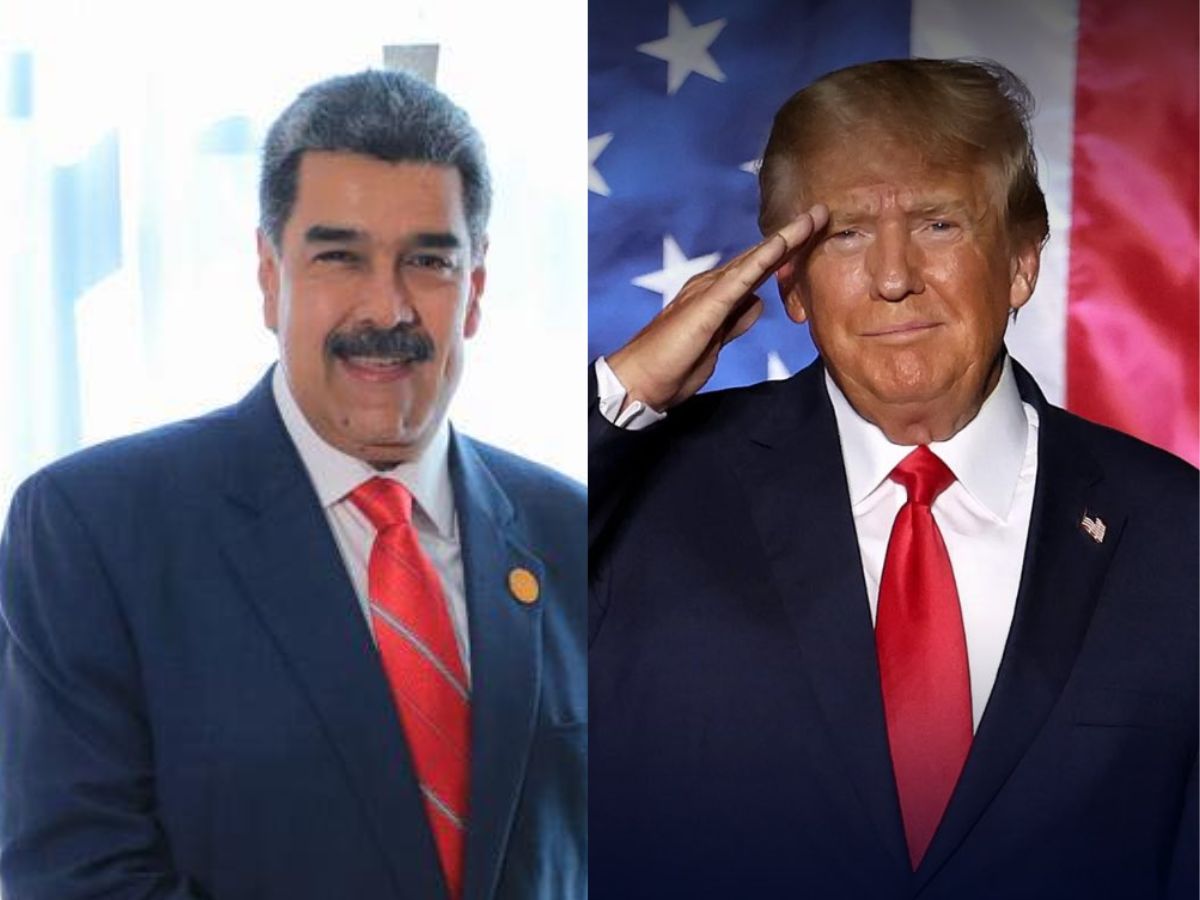
US-Venezuela tensions soar after failed Trump–Maduro negotiations. (Photo: X/@realDonaldTrump,@NicolasMaduro)
Relations between the US and Venezuela have sharply deteriorated in recent months, raising unprecedented fears of a military confrontation. Under President Donald Trump, the US has scaled up operations against what it calls Venezuelan-linked drug traffickers, while diplomatic channels with the regime of President Nicolás Maduro collapsed, setting up a potentially explosive standoff in Latin America. Here’s a more detailed understanding of the key events and implications.
According to the reports from the Miami Herald, President Trump called the Venezuelan President Nicolás Maduro personally in a high-stakes phone call and pressed him to step aside and leave the country. To that, Maduro demanded two major concessions: retaining control of Venezuela’s military and receiving global amnesty for all alleged crimes.
Trump would not budge on either of the proposals, and he insisted that Maduro, his wife, and son had to leave Venezuela safely and immediately. The call, during the week of November 16, ended abruptly and cut short negotiations that were expected to center on Maduro’s possible surrender.
The failure of diplomacy amplified fears in Washington of the mounting flood of narcotics from Venezuela into the United States. Senator Dave McCormick, R-Pa., told Fox News that drug trafficking, particularly concerning fentanyl and cocaine, has already killed more Americans than the Vietnam War, underlining the administration’s reasons for possible military action.
Following the breakdown in negotiations, Trump ratcheted up pressure on Maduro by closing the airspace over Venezuela and positioning military assets offshore, including the USS Gerald R. Ford and a Marine Expeditionary Unit capable of amphibious operations.
Trump hinted that military operations of the United States inside Venezuela might commence very soon, though he avoided talking about timelines. This aggressive stance has been accompanied by stern warnings to airlines, narcotics traffickers, and human traffickers on the risks of traveling in the region.
The US has no legal authority over Venezuelan airspace, despite an announcement to the contrary, but the declaration has had immediate operational consequences for aviation and heightened tensions in the Caribbean.
The Herald reported that the possible terms of surrender discussed on the Trump-Maduro call included:
Global amnesty for Maduro and his allies – rejected by the U.S.
Control of the armed forces in exchange for free elections – Also rejected, with the U.S. demanding immediate resignation
The demands of Maduro represented a repetition of historical precedents, like Nicaragua in 1991 under Violeta Chamorro. But Trump remained firm in insisting on Maduro’s exit, signaling the breakdown of negotiations and the rise of alternative measures that are more aggressive.
Under the banner of Operation Southern Spear, since September 2025, a series of air and naval strikes have been carried out by the U.S. military against vessels in the Caribbean and Eastern Pacific. The strikes targeted vessels allegedly operated by drug trafficking organizations, including Venezuela’s Tren de Aragua and Colombia’s National Liberation Army (ELN).
According to official US figures, at least 21 strikes have killed 83 people and destroyed 22 vessels. The Trump administration has labeled these groups as “narco-terrorists” and formally considers the actions part of a non-international armed conflict, treating maritime drug operations as quasi-warfare.
The first recognised strike happened on September 2, 2025, when a U.S. Navy vessel sank a speedboat supposedly carrying drugs from Venezuela to the southern Caribbean. All 11 people on board were killed, raising legality and human rights concerns.
The strikes continued, throughout September, October, and November, against both Caribbean and Pacific vessels. In many incidents there were multiple strikes against the same vessels, and sometimes survivors were killed in follow-up attacks. US officials said such actions were justified by the need to keep narcotics out of the United States, but their critics accused them of extrajudicial killings in violation of international law.
Human rights groups, such as Human Rights Watch, have expressed concerns that the lethal use of force against suspected traffickers violates principles for imminent threat and protection of survivors of shipwrecks under international humanitarian law.
Several U.S. lawmakers have questioned the legality of the strikes, most lately the second strike on September 2, 2025, launched by Secretary of Defense Pete Hegseth, which killed survivors from the first attack.
The initial “execute order” had reportedly been given by Hegseth, and Admiral Frank Bradley authorized further strikes. Hegseth said the actions were lawful and appropriate, arguing that intelligence reports showed the vessels threatened U.S. citizens. Critics, including lawmakers from Congress, say targeting survivors could be considered a war crime under the laws of armed conflict.
Separately, a Colombian family submitted a petition with the Inter-American Commission on Human Rights, alleging that their relative was unlawfully killed in a US airstrike. This is the first formal human rights complaint over the Trump administration’s airstrikes on suspected drug boats.
In response to U.S. actions, the country has mobilized its military across land, sea, and air, reinforcing coastal defenses. President Maduro insists that his government will resist any U.S.-led attempt at regime change, framing the strikes as a pretext for overthrowing his leadership rather than a legitimate fight against drugs.
The country has also revoked the operating rights of international airlines that suspended flights after warnings by the United States, further heightening tension in the region.
Trump and his administration have repeatedly framed narcotics trafficking as a national security threat comparable to terrorism. Secretary Hegseth and President Trump have defended military strikes as necessary to protect Americans from fentanyl, opioids, and cocaine that flow largely from Venezuelan and Colombian networks.
Trump has also suggested that future missions could involve land-based attacks as well, opening up the possibility of an enlarged conflict. The U.S. officials, however, have continued to cite counter-narcotics as their rationale in the face of warnings by critics that the strategy risks open confrontation with Venezuela.
With the escalation, many questions still linger:
Were those killed in the strikes real drug traffickers or fighters?
Did US authorities follow international law in targeting survivors of strikes?
Does the increasing military presence threaten a full-scale U.S.-Venezuela conflict?
These are some of the questions fueling debate in Washington, where lawmakers and human rights groups are scrutinizing the legality, ethics, and long-term strategic consequences of the U.S. campaign.
The standoff between the U.S. and Venezuela is a delicate cocktail of diplomatic, counter-narcotics operations, and military escalation. Failed negotiations, combined with aggressive strikes against drug vessels and U.S. military mobilization offshore, have brought both nations to a precarious point.
While the Trump administration frames its actions as a fight against drugs, Venezuela interprets them as an attempt at regime change. As neither side makes any overtures of climbing down, experts have warned that the confrontation could spiral out of a “war on drugs” into a broader geopolitical one.
The next few weeks may well determine whether diplomacy can be rescued, or whether the Caribbean and Latin America have to confront a new and perilous phase in U.S.-Venezuelan relations.
Sofia Babu Chacko is a journalist with over five years of experience covering Indian politics, crime, human rights, gender issues, and stories about marginalized communities. She believes that every voice matters, and journalism has a vital role to play in amplifying those voices. Sofia is committed to creating impact and shedding light on stories that truly matter. Beyond her work in the newsroom, she is also a music enthusiast who enjoys singing.
Punjabi actor and singer Himanshi Khurana has reportedly received a ₹10 crore extortion threat allegedly…
Donald Trump Open To Talks With Ayatollah Khamenei, Says Marco Rubio Amid US-Iran Tensions
US Secretary of State Marco Rubio has said President Donald Trump remains open to direct…
French President Emmanuel Macron will begin his India visit on February 16, with Mumbai as…
