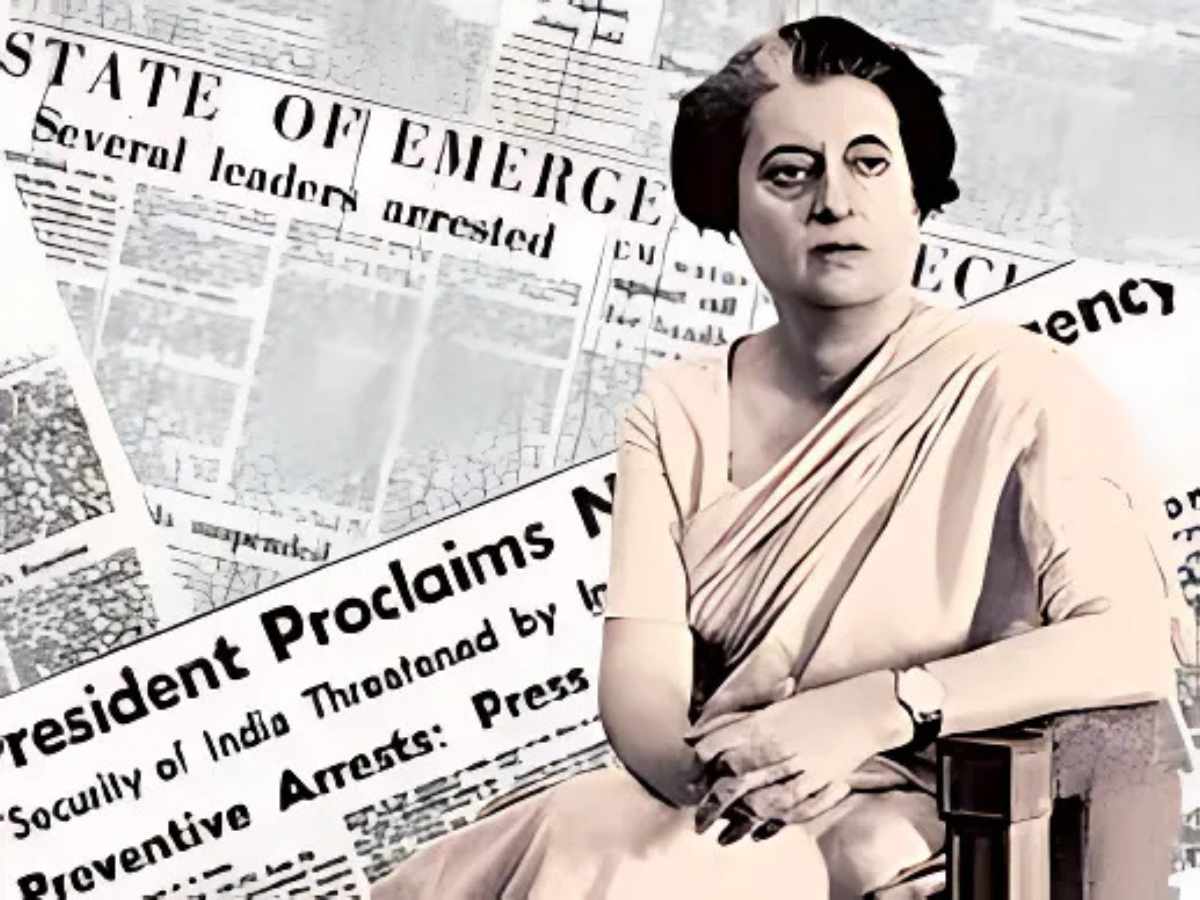
'The Day Democracy Paused': 50 Years Since India’s Emergency Began, What Are Some Commonly Asked Questions
Exactly 50 years ago, India’s democratic fabric was shaken. On June 25, 1975, Prime Minister Indira Gandhi announced on All India Radio that the President had proclaimed a state of Emergency. “The President has proclaimed the Emergency. This is nothing to panic about. I am sure you are all aware of the deep and widespread conspiracy, which has been brewing ever since I began to introduce certain progressive measures of benefit for the common man and woman in India,” Gandhi said.
What followed was a 21-month period unlike any other in independent India.
Thousands were imprisoned, the media suffered censorship, and civil liberties were placed on hold.
It all started with the general elections of 1971, wherein Mrs. Indira Gandhi won largely against Raj Narain—a socialist candidate from the Rae Bareli seat. But Narain challenged her victory and alleged that she had used Government machinery for election campaigning.
On June 12, 1975, the Allahabad High Court delivered a judgment that favored him, held Gandhi guilty of electoral malpractice, and disqualified her from holding any office for a period of six years. Instead of complying with the verdict, she declared Emergency on June 25, citing ‘internal disturbances.’
She asserted that a conspiracy was threatening national stability—and the Constitution empowered her to act on that.
Overnight, India’s democracy was put on hold:
Opposition leaders like Jayaprakash Narayan, Atal Bihari Vajpayee, L.K. Advani, and Morarji Desai were thrown into jail.
The press was heavily censored—newspapers were told what they could or couldn’t print.
Fundamental rights were suspended.
Courts were powerless, and people had no legal route for justice.
A major player during this time was Sanjay Gandhi, Indira Gandhi’s son. He ran controversial programs like forced sterilizations, slum demolitions, and other harsh measures that many criticized as authoritarian.
Article 352 was used to legally declare the Emergency, which allows for such action during war, external aggression, or internal disturbances.
The Thirty-ninth Amendment was passed in August 1975. It prevented courts from challenging the election of the Prime Minister and Speaker.
The Shah Commission, led by Justice J.C. Shah, was later set up to investigate human rights abuses during this time.
June 12, 1975: Gandhi’s election voided by the Allahabad High Court.
June 25, 1975: Emergency officially declared.
June 26, 1975: Gandhi addressed the nation on AIR.
January 18, 1977: Gandhi called for fresh elections.
March 21, 1977: Emergency lifted; elections held.
By early 1977, the Emergency saw ever-growing opposition. And then, in a sudden shock, Indira Gandhi called for general elections, with a cavalier gesture of releasing political prisoners.
The people cast their judgment and turned their back for the first time since independence on Congress during the March 1977 elections. The Janata Party, an amalgamation of various opposition groups, came into power with Morarji Desai as the Prime Minister.
Indira Gandhi: Prime Minister who declared the Emergency.
Fakhruddin Ali Ahmed: President of India, who signed the proclamation.
Sanjay Gandhi: Played a major role in implementing controversial policies.
Jayaprakash Narayan: Opposition leader whose arrest led to nationwide protests.
Justice J.C. Shah: Headed the Shah Commission to investigate abuses.
Prime Minister Narendra Modi said in a social media post, “Today is a day to pay homage to all those great men and women who resisted the Emergency. The #DarkDaysOfEmergency reminds us of how the Congress Party subverted basic freedoms and trampled over the Constitution of India, which every Indian respects greatly.”
He further added, “Any person who disagreed with the Congress was tortured and harassed. Socially regressive policies were unleashed to target the weakest sections.”
Union Home Minister Amit Shah didn’t hold back either, “On 25 June 1975, then Prime Minister Indira Gandhi, showing her dictatorial mindset, strangled the soul of Indian democracy by imposing an emergency in the country. Lakhs of people were jailed without any reason and the voice of the media was suppressed.”
Om Birla, the Lok Sabha Speaker, said, “The day of June 25, 1975, will always be known as a black chapter in the history of India.”
Shah also mentioned that the Modi government would now observe June 25 as “Constitution Murder Day.”
Article 352 of the Constitution, citing “internal disturbance.”
Fakhruddin Ali Ahmed.
Indira Gandhi.
Declared: June 25, 1975
Lifted: March 21, 1977
The State of Uttar Pradesh v. Raj Narain case on June 12, 1975, declared her 1971 election invalid.
Yes. Newspapers had to get government approval before publishing anything critical.
Sanjay Gandhi and his Youth Congress.
Yes, the Thirty-ninth Amendment in August 1975, which protected Gandhi’s election from judicial review.
The Janata Party was formed by groups like Jana Sangh, Bharatiya Lok Dal, and Congress (O).
Justice J.C. Shah, through the Shah Commission.
Also Read: Why Was Emergency Declared In India In 1975? How Long Did It Last
Ram Navami 2026: Confusion over whether Ram Navami will be celebrated on March 26 or…
Two people died while several others were injured after a bus lost control and overturned…
A powerful 7.6 magnitude earthquake struck near the Pacific island nation of Tonga, triggering tsunami…
