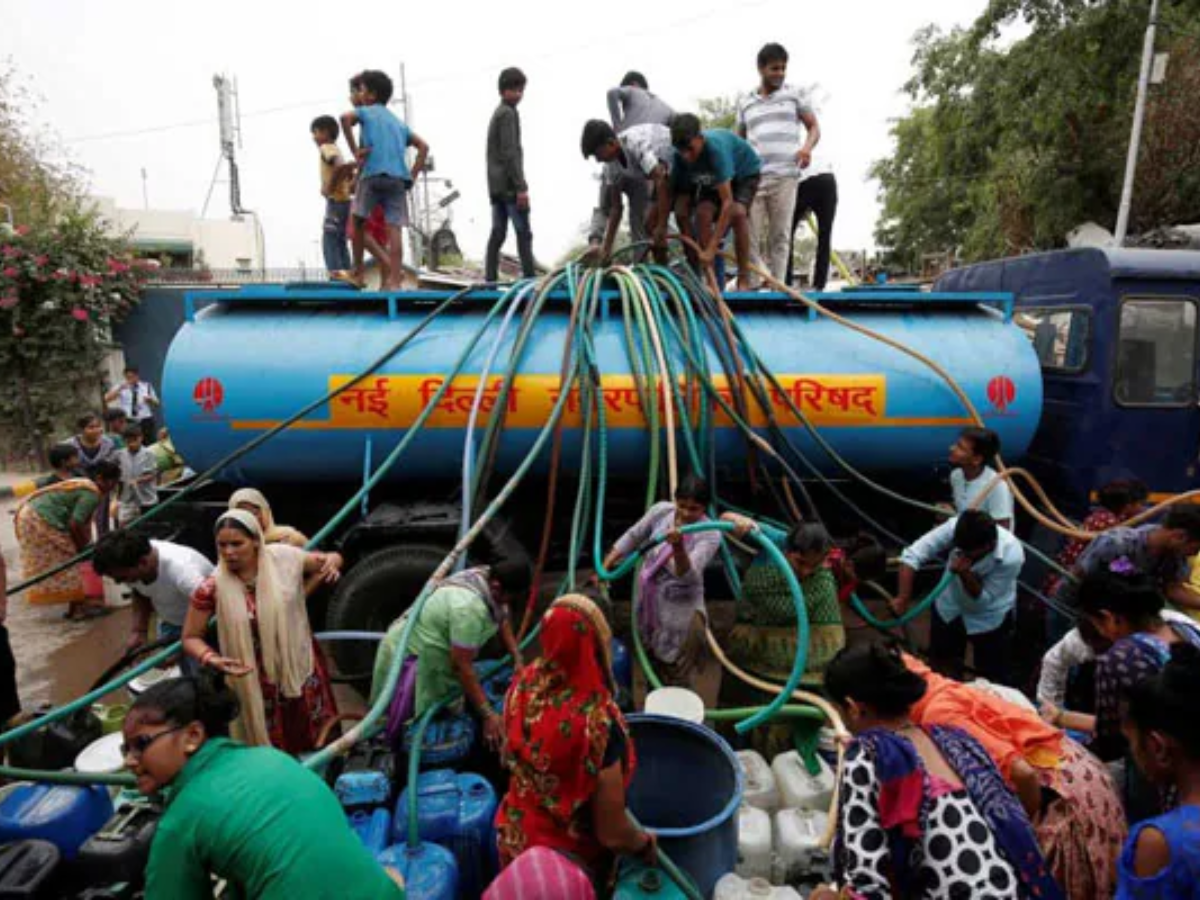
Water Cut Alert: Delhi Jal Board Announces Supply To Be Affected For 2 Days | Check Dates, Timings, Full List of Affected Areas (Pic Credits: X)
As the national capital reels under intense summer heat, Delhi is now grappling with a fresh crisis a major disruption in its water supply system. Two of the city’s primary water treatment plants, Wazirabad and Chandrawal, have scaled down operations following a significant drop in raw water availability, according to officials from the Delhi Jal Board (DJB) on Friday.
The Wazirabad pond, which serves as a crucial raw water source for the Wazirabad, Chandrawal, and Okhla treatment plants, has seen its water level plummet to 668.70 feet, well below the normal level of 674.50 feet. This alarming dip has directly impacted the production capacity of potable water across Delhi.
The DJB has stated that the decline in pond levels is making it increasingly difficult to sustain the required raw water intake for both the Wazirabad and Chandrawal Water Treatment Plants (WTPs). “It is getting difficult to maintain the required raw water supply to Wazirabad and Chandrawal WTP and consequently curtailment in production of potable water. This situation affecting the production approximately by 25-30 per cent of potable water at both,” the DJB noted in a statement issued via news agency PTI.
Under normal conditions, the Wazirabad plant produces around 131 million gallons per day (MGD) while Chandrawal contributes nearly 94 MGD. With the current reductions, Delhi is now facing a daily shortfall of nearly 70-100 MGD, a significant dent in its already strained water supply network.
Must Read: PM Modi Meets Lone Survivor of Ahmedabad Plane Crash, Visits Crash Site
According to the latest Economic Survey, Delhi’s total water requirement stands at approximately 1,290 MGD. However, DJB’s current production including tubewell extractions ranges between 990 and 1,000 MGD. This mismatch between demand and supply is particularly concerning as temperatures soar, driving consumption even higher.
The water scarcity is expected to hit several prominent localities across the city. Among the worst-affected areas are South Extension, Greater Kailash, Jahangirpuri, Moolchand, Majnu Ka Tila, Kashmere Gate ISBT, NDMC areas, ITO, Defence Colony, CGO Complex, Rajghat, WHO office, Ramleela Ground, and Delhi Gate.
In addition, Civil Lines, Hindu Rao Hospital, Kamla Nagar, Shakti Nagar, Karol Bagh, Pahar Ganj, parts of the NDMC zone, Cantonment, and adjoining regions are also likely to experience disrupted water supply in the coming days.
The DJB has urged citizens to adopt strict water conservation measures. “The public is advised to make judicious use of water. Water tankers shall be available on demand from the DJB helpline 1916,” the statement emphasized.
As of now, there is no official estimate on when water levels might stabilize or when treatment plants will resume normal operations.
Must Read: Air India Plane Crash: Influencer Air Hostess Killed In The Tragedy
Swastika Sruti is a Senior Sub Editor at NewsX Digital with 5 years of experience shaping stories that matter. She loves tracking politics- national and global trends, and never misses a chance to dig deeper into policies and developments. Passionate about what’s happening around us, she brings sharp insight and clarity to every piece she works on. When not curating news, she’s busy exploring what’s next in the world of public interest. You can reach her at [swastika.newsx@gmail.com]
How Pre-Existing Conditions Affect Your Medical Insurance Premium?
When it comes to medical insurance premiums and coverage in general, having a pre-existing disease…
Lalit Modi Had IPL Blueprint Ready in 1997–98, Reveals Former Delhi Capitals Coach Ahead of IPL 2026
Saba Karim reveals Lalit Modi proposed the Indian Premier League in the 1990s; launched in…
Industrialising Wall Construction for Hyperscale Data Centers
Compatibility of AAC Wall Panels with High-Performance Structural Systems New Delhi [India], March 24: India’s…
