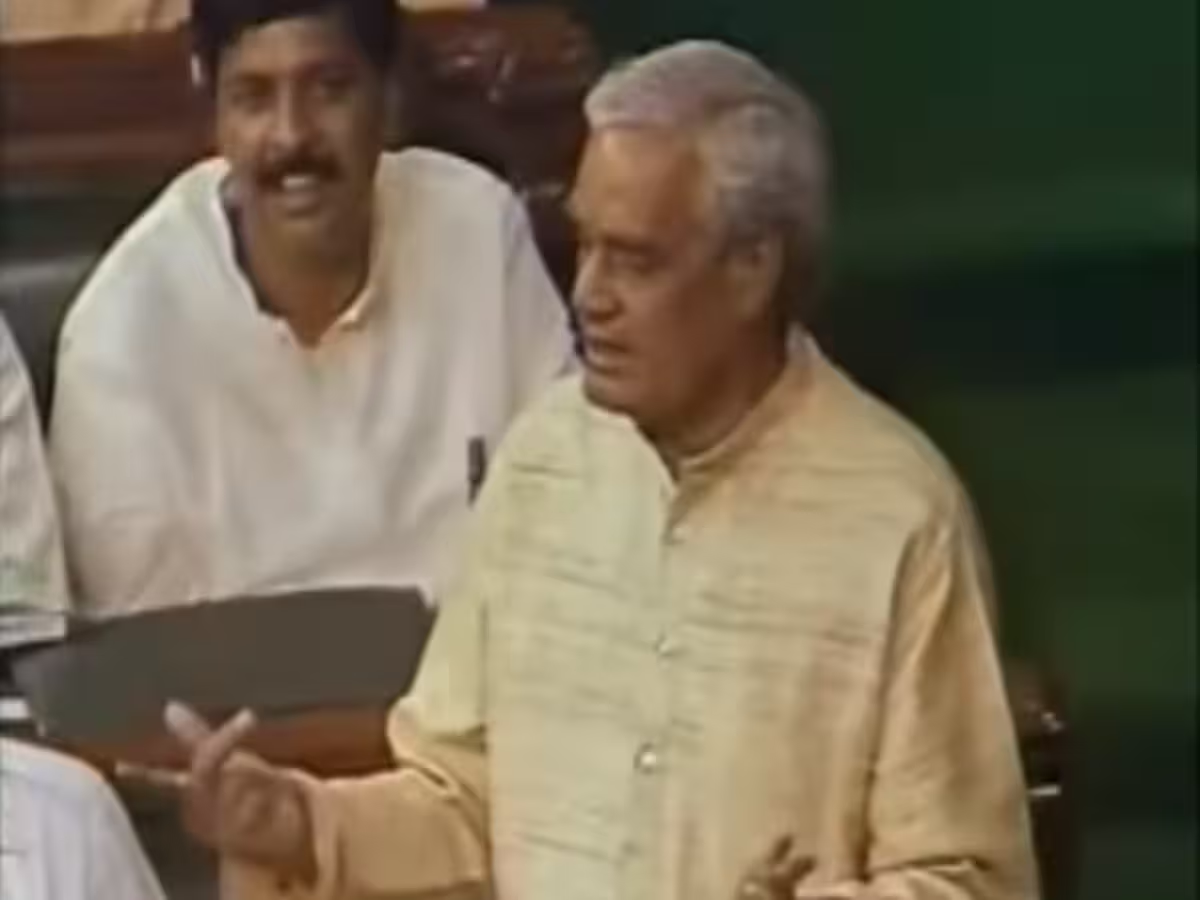
Some of the most famous Parliamentary speeches in India’s history, from Nehru’s Tryst with Destiny on the eve of India’s Independence to Modi’s inaugural speech as Prime Minister in 2014. These addresses capture defining political moments, embody national ideals, and inspire transformative change.
On the eve of Independence, India’s first Prime Minister addressed the Constituent Assembly, capturing the nation’s transition from colonial rule to self-governance.
“At the stroke of the midnight hour, when the world sleeps, India will awake to life and freedom.”
Delivering his concluding remarks before the adoption of the Constitution, Ambedkar warned that political freedom without social equality would be hollow.
“Political democracy cannot last unless there lies at the base of it social democracy.”
Patel defended the unification efforts that brought over 500 princely states into the Indian Union after independence.
“The safety and preservation of the independence of India is a sacred trust of the whole people.”
Speaking in Parliament, Mukherjee voiced opposition to the special status granted to Jammu and Kashmir under Article 370.
“Ek desh mein do Vidhan, do Pradhan, aur do Nishan nahi chalenge.”
In his early months as Prime Minister, Shastri reaffirmed India’s commitment to peace amid regional and global tensions.
“We believe in peace and peaceful development, not only for ourselves but for people all over the world.”
During the crisis in East Pakistan, Gandhi warned Parliament of the humanitarian disaster unfolding on India’s borders.
“The way things are going, it looks as if a whole people may be wiped out of their homeland.”
After failing to secure a majority in the Lok Sabha, Vajpayee resigned as Prime Minister, emphasizing the continuity of the nation above partisan politics.
“Governments come and go, parties appear and disappear, but this country should remain immortal.”
In his role as Lok Sabha Speaker, Chatterjee urged members to preserve Parliament’s function as a forum for debate, not disruption.
“Parliament is the supreme forum of debate, not disruption.”
Defending the Indo–US Civil Nuclear Agreement, Singh argued that the deal was vital for India’s energy security and global standing.
“We are not a one-issue government. We will proceed with the nuclear deal because it is in our national interest.”
In his prominent speech to Parliament as Prime Minister Modi outlined his government’s priorities for inclusive development.
“This government is dedicated to the poor, to the youth, to the villages, and to the farmers of India.”
As Finance Minister, Jaitley hailed the Goods and Services Tax as a transformative reform for India’s economy.
“The GST is a historic economic reform that will create one India, one tax, one market.”
Responding to tensions with China, Swaraj reaffirmed India’s uncompromising stance on sovereignty and security.
“India will not compromise on its security and territorial integrity.”
In his inaugural address, Kovind stressed the role of citizens in nation-building.
“Nations are built by disciplined and dedicated citizens.”
In his final address to Parliament, Mukherjee reminded lawmakers of the institution’s purpose as a place for reasoned debate.
“Parliament is a place for deliberation, not agitation.”
Speaking during colonial rule, Gokhale highlighted Bengal’s role as a thought leader in India’s political awakening.
“What Bengal thinks today, India thinks tomorrow.”
Also Read: Shadows of Courage: Untold Stories of India’s Bravehearts
Chaitra Navratri 2026, starting March 19, honors Maa Durga’s nine divine forms. Sharing heartfelt wishes…
A bomb threat at Dick's Sporting Goods in Canton Marketplace, Georgia, triggered evacuations and heavy…
The Coyote Flats Fire near Rockerville, Rapid City, has grown to 30–50 acres amid hot,…
