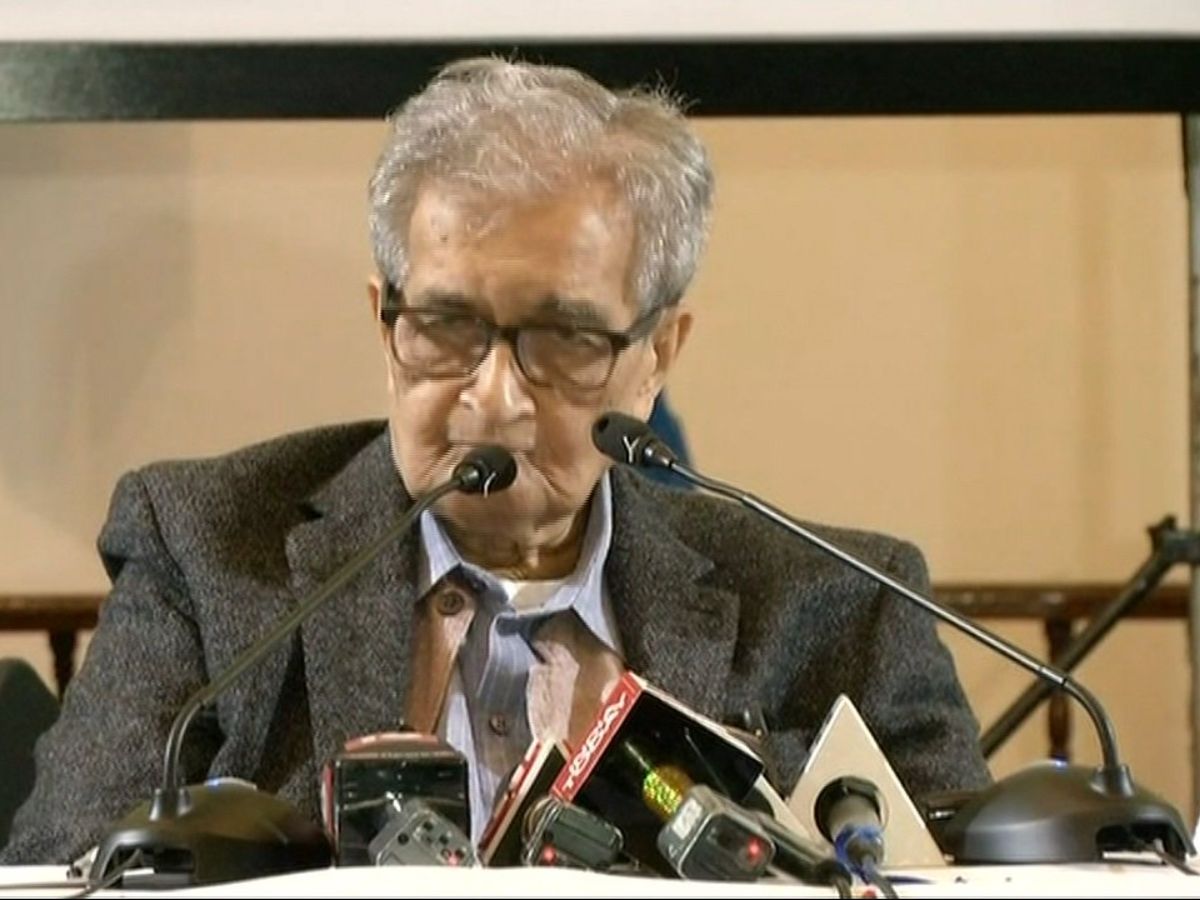
Amartya Sen warns Bihar’s voter list revision may silence the marginalised.(Photo: ANI)
Nobel Prize-winning economist Amartya Sen has sounded warning over the Election Commission’s exercise of conducting a special intensive revision (SIR) of voter rolls in Bihar, warning that the process may deprive poor and marginalized citizens of their right to vote.
Addressing newsmen on Friday, Sen emphasized that procedural improvements should never be made at the expense of fundamental democratic rights. “You cannot build a superior system by stifling the rights of the poor,” he asserted.
The winner of the 1998 Nobel Prize in Economics pointed out how millions of Indians, particularly from poor communities, don’t have proper documents. “Many people don’t have documents. Many can’t vote… If, in the name of trying to improve things a little, harm is caused to many, then that becomes a serious mistake. You cannot justify seven new mistakes just to correct one,” he warned.
The SIR electoral roll is an innovative voter list validation campaign by the Election Commission of India, that aimed at conducting free and fair elections. Under house-to-house counting, the ECI creates new electoral rolls without dependency on prior voter lists. The exercise is generally carried out when current rolls are outdated, incorrect, or need to be rebuilt in entirety usually before large-scale elections or after delimitation of constituencies.
In Bihar, the SIR started on July 1, 2025, as a part of preparation for the forthcoming state assembly polls. More than 4.89 crore enrolled voters are being checked by trained Booth Level Officers (BLOs) who are going door-to-door to make sure that no eligible voter is omitted and no ineligible individual is found on the rolls.
The Election Commission initiated the SIR process in Bihar to sanitize and authenticate electoral rolls before the next assembly elections. The inaugural phase of the exercise, however, has set off stinging political party and rights activist criticism.
According to estimates, over 65 lakh enumeration forms were left out of the draft rolls. This reduced the number of voters registered in Bihar from approximately 7.9 crore to 7.24 crore a huge cut that has generated fears of widespread disenfranchisement.
Sen’s remarks bolster rising anxieties that the change would disproportionately impact the poor, migrants and marginalisation for whom documentation is difficult. Opponents argue that although the aim of producing accurate electoral rolls is laudable, the process must be participatory and aligned with ground realities.
For Bihar, with a profound politicisation of citizens, the uproar goes to the heart of democracy. As Sen said, the vote is more than an administrative process – it is a lifeline for those on the margins.
ALSO READ: What Is Special Intensive Revision? Bihar Voter List Row Set To Dominate Parliament Monsoon Session
Sofia Babu Chacko is a journalist with over five years of experience reporting on Indian politics, crime, human rights, gender issues, and stories about marginalized communities. She believes journalism plays a crucial role in amplifying unheard voices and bringing attention to issues that truly matter. Sofia has contributed articles to The New Indian Express, Youth Ki Awaaz, and Maktoob Media. She is also a recipient of the 2025 Laadli Media Awards for gender sensitivity. Beyond the newsroom, she is a music enthusiast who enjoys singing. Connect with Sofia on X: https://x.com/SBCism
A bomb threat at Dick's Sporting Goods in Canton Marketplace, Georgia, triggered evacuations and heavy…
The Coyote Flats Fire near Rockerville, Rapid City, has grown to 30–50 acres amid hot,…
Dhurandhar 2 sees Ranveer Singh as Hamza navigating Karachi’s criminal underworld in Aditya Dhar’s intense,…
