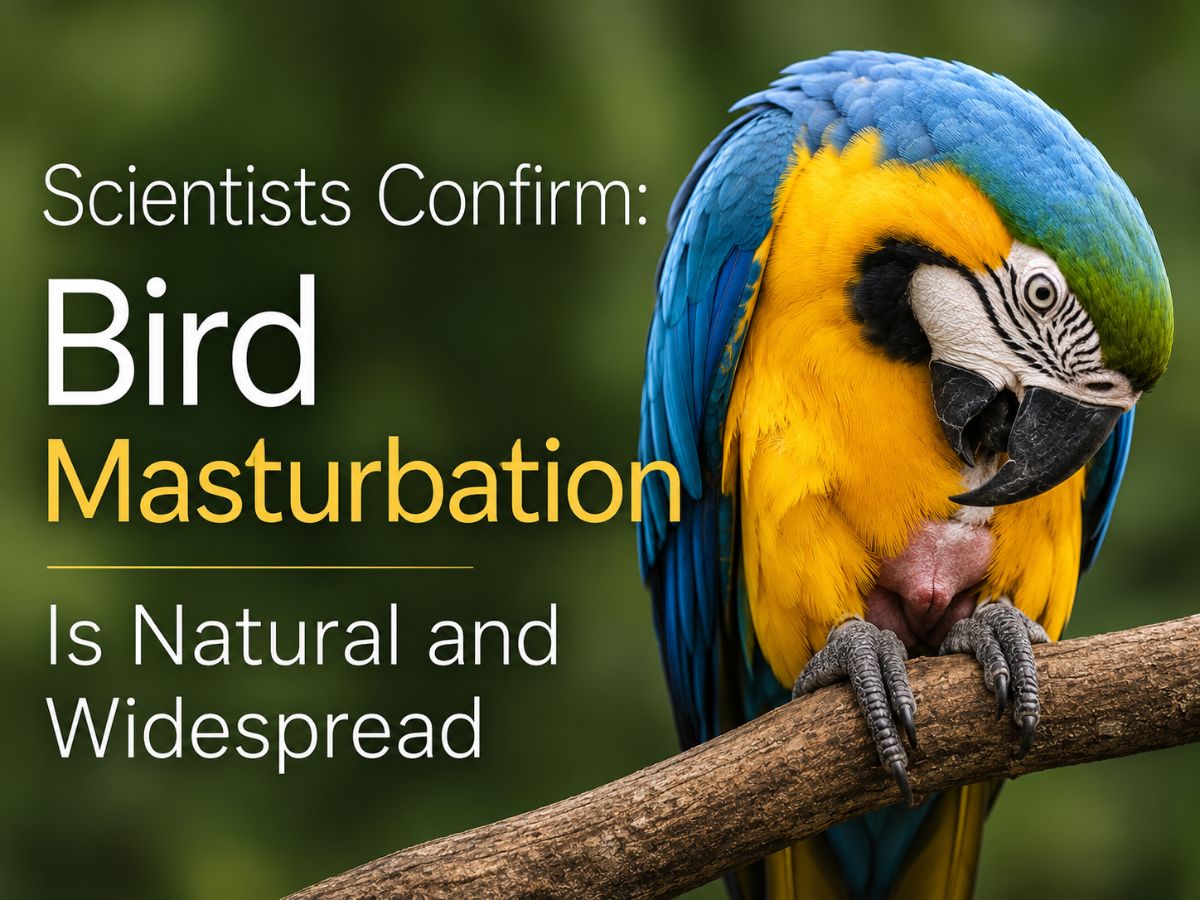
(Photo generated by AI)
For years, bird owners and breeders have often regarded masturbation in pet birds, especially parrots, as a warning sign of stress, boredom, loneliness, or poor living conditions. But a new scientific study is challenging that long-held belief. Researchers have found self-stimulatory sexual behaviour is common across a wide range of bird species, and seems to be a natural part of avian biology rather than an abnormal habit related to captivity. The findings come from the first large-scale evolutionary investigation into masturbation among birds.
Unlike most mammals, birds generally do not have external genitalia. Instead, reproduction takes place through the cloaca, a multifunctional opening used for reproduction, urination, and defecation. ‘Avian self-pleasure is usually a rather inelegant affair in which a bird rubs their cloaca (a shared orifice for both excretion and reproduction) against an object, like a branch, twig, or toy. This is often accompanied by a lot of flapping and self-satisfied vocalisation,’ the research team explained.
The scientists argue that this behaviour should not automatically be viewed as a welfare concern. ‘Despite assumptions that masturbation among captive birds like parrots is a result of their often-solitary living, our study finds that it is natural, healthy, and widespread across diverse bird species, even in different environments,’ said evolutionary biologist Chloe Heys, who led the research.
Masturbation has previously been documented in many animals, including primates, dolphins, horses, squirrels, marine iguanas, and penguins. Scientists have long suspected that similar behaviour exists in many additional species, but birds have received relatively little scientific attention. The new research brings together observations from across the avian world and suggests that self-stimulation is an ancient trait that has persisted throughout bird evolution.
For the study, researchers from the Universities of Lancashire, Swansea, and Oxford examined records involving 120 bird species from 22 major avian groups. They examined factors like age, sex, habitat, social environment and mating systems.
The analysis revealed that masturbation is much more widespread among birds than has been recognised, although there are differences in frequency between species. Most of the reported cases were male birds, 55% of reported observations, but female birds made up 36% of observations, showing that the behaviour is not restricted to one sex and is seen throughout the avian family tree. The researchers also found evidence of the behaviour in both captive and wild environments, providing additional support for the notion that it is a naturally occurring biological trait, rather than a response to captivity.
The findings of this research could have significant implications for bird owners, breeders and veterinarians. In the past, avian masturbation has frequently been regarded as a behavioural issue, and owners have occasionally sought to prevent the behaviour through training, environmental adjustments, veterinary intervention or even medication. But the researchers say there is little evidence to support the idea that masturbation is inherently damaging or a sign of poor welfare. Rather, the findings suggest it should be seen as a normal part of avian sexual behaviour.
Scientists think that there are a number of biological and reproductive benefits that can be gained from masturbation. One idea is that it allows a person to relieve strong sexual urges. But, researchers suggest that the behaviour may actually have some much larger evolutionary advantages than simply satisfying sexual urges in the moment.
The study found that masturbation was more prevalent in bird species that mate with multiple partners. This trend suggests that self-stimulation may have a role to play in reproductive competition and might even boost the prospects of successful fertilisation. Further research is needed to fully understand its evolutionary function, but the findings add to the growing evidence that masturbation is a universal, naturally occurring behaviour throughout the animal kingdom.
In fact, the investigators conclude, avian masturbation should be considered a normal and healthy aspect of bird biology that probably has existed for millions of years, rather than something abnormal.
ALSO READ: Maurizio Cattelan’s Famous €5.8 Million Banana Artwork Stolen Again From French Museum
Harshita is a journalist and digital content writer specializing in breaking news, current affairs, travel, education, and trending stories. She is focused on delivering accurate, timely, and engaging content with a strong emphasis on clarity and audience relevance.
Did Joe Biden’s Son Hunter Biden Leave Cocaine Bag At White House? Here’s What He said
A claim linking Hunter Biden to a cocaine bag found at the White House went…
Singapore Lawyer Earning Rs 2 Crore Struggles To Find Match After Strict Checklist | Watch
A 39-year-old Singapore-based Indian lawyer earning Rs 2 crore has gone viral after a matchmaker…
Pakistan Upholds Death Sentence In French Tourist Gang Rape Case
Lahore High Court has upheld the death sentences of two men convicted in the 2020…
