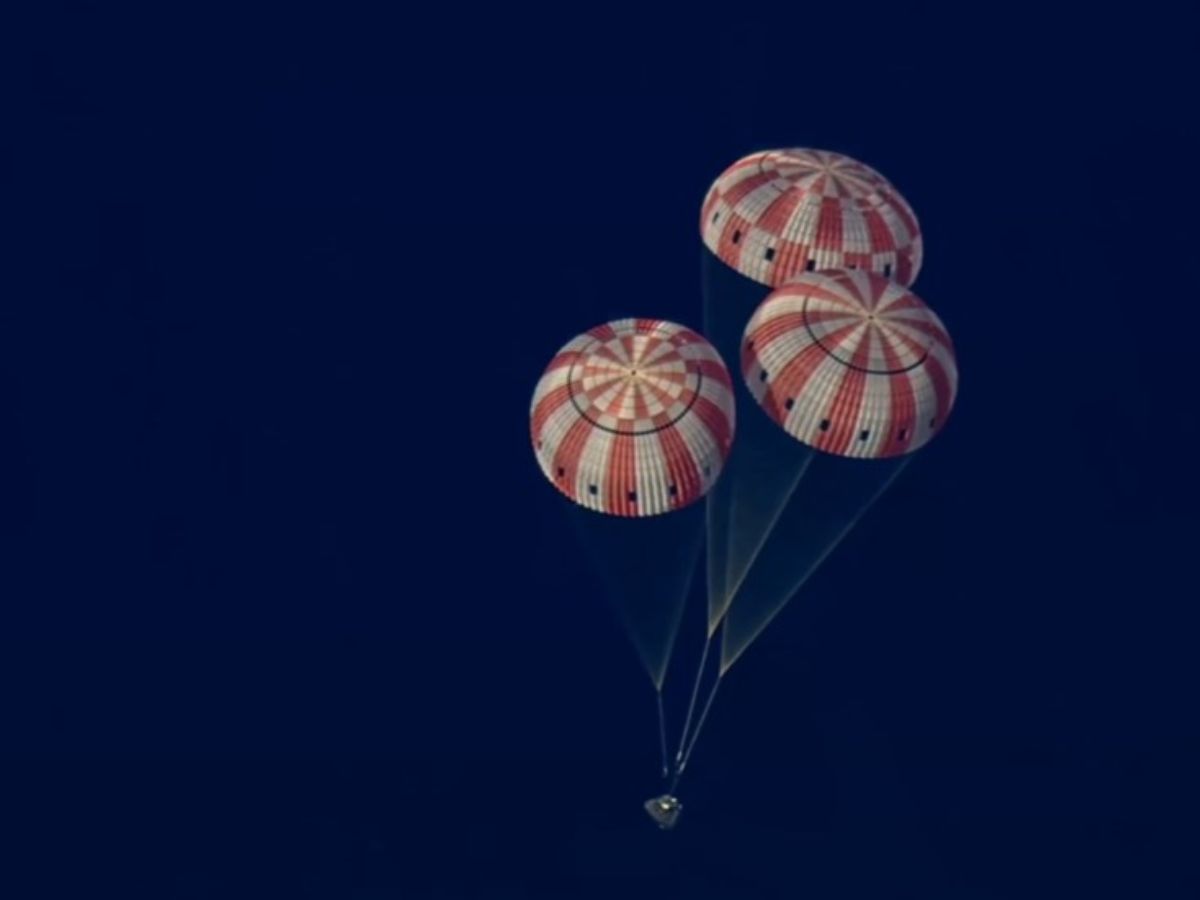
Artemis II Mission Ends With Pacific Splashdown; NASA’s First Moon Voyage Of 21st Century Ends Successfully | WATCH (Image: @NASA)
The National Aeronautics and Space Administration (NASA) announced on Saturday that the crew of Artemis II had safely returned to Earth after successfully splashing down in the Pacific Ocean, marking a historic milestone in human space exploration. NASA posted a joyful “fist bump” update on X just before reentry, giving viewers a peek into the crew’s last preparations as they prepared the spacecraft for descent.
NASA shared the information in a post on X, writing, “Fist bump! The crew of Artemis II is currently less than 35,000 miles from Earth. The weather is favourable for splashdown, and the astronauts are getting the spacecraft ready for reentry.” The crew broke the record for the furthest human spaceflight distance at 252,756 miles (406,771 km) from Earth while navigating the far side of the Moon, marking a significant milestone for the mission. Another unique occasion in human space travel occurred during the voyage when the crew saw a solar eclipse from space. The US Indo-Pacific Command states that the crew and the Orion spacecraft will be recovered by the US Navy’s USS John P. Murtha (LPD-26) after splashdown.
A crucial component of NASA’s larger strategy to send people back to the Moon and further deep space exploration is the Artemis II mission. The crew included Canadian Space Agency astronaut Jeremy Hansen and NASA astronauts Reid Wiseman, Victor Glover, and Christina Koch. Notably, Artemis II became the furthest human space traveller ever, surpassing the Apollo 13 mission’s previous record of 248,655 miles from Earth.
NASA’s first crewed test mission under the Artemis program, Artemis II, is intended to verify vital systems needed for a long-term human presence outside of low-Earth orbit.
According to NASA’s official website, Artemis II has five primary aims. These included demonstrating systems and operations necessary for a crewed lunar campaign; retrieving flight hardware and data, evaluating performance for future missions; demonstrating emergency system capabilities and validating related operations to the extent feasible, such as abort operations and rescue procedures, as needed; and completing additional objectives to verify subsystems and validate data.
Artemis II also marks the first crewed mission to travel around the Moon in more than 50 years, carrying astronauts farther into space than any humans have travelled before, reinforcing a new era of lunar exploration.
(With Inputs From ANI)
Also Read: Iranian Delegation Arrives In Pakistan For High-Stakes Peace Talks With US; Who’s Part Of The Team?
The makers of Daadi Ki Shaadi, starring Neetu Kapoor and Kapil Sharma, have officially unveiled…
Brazilian surfer-lawyer Tayane Dalazen survived a nurse shark attack while freediving at Fernando de Noronha.…
IPL vs PSL: Following Adam Zampa's exit, another overseas cricketer has criticized the IPL 2026,…
