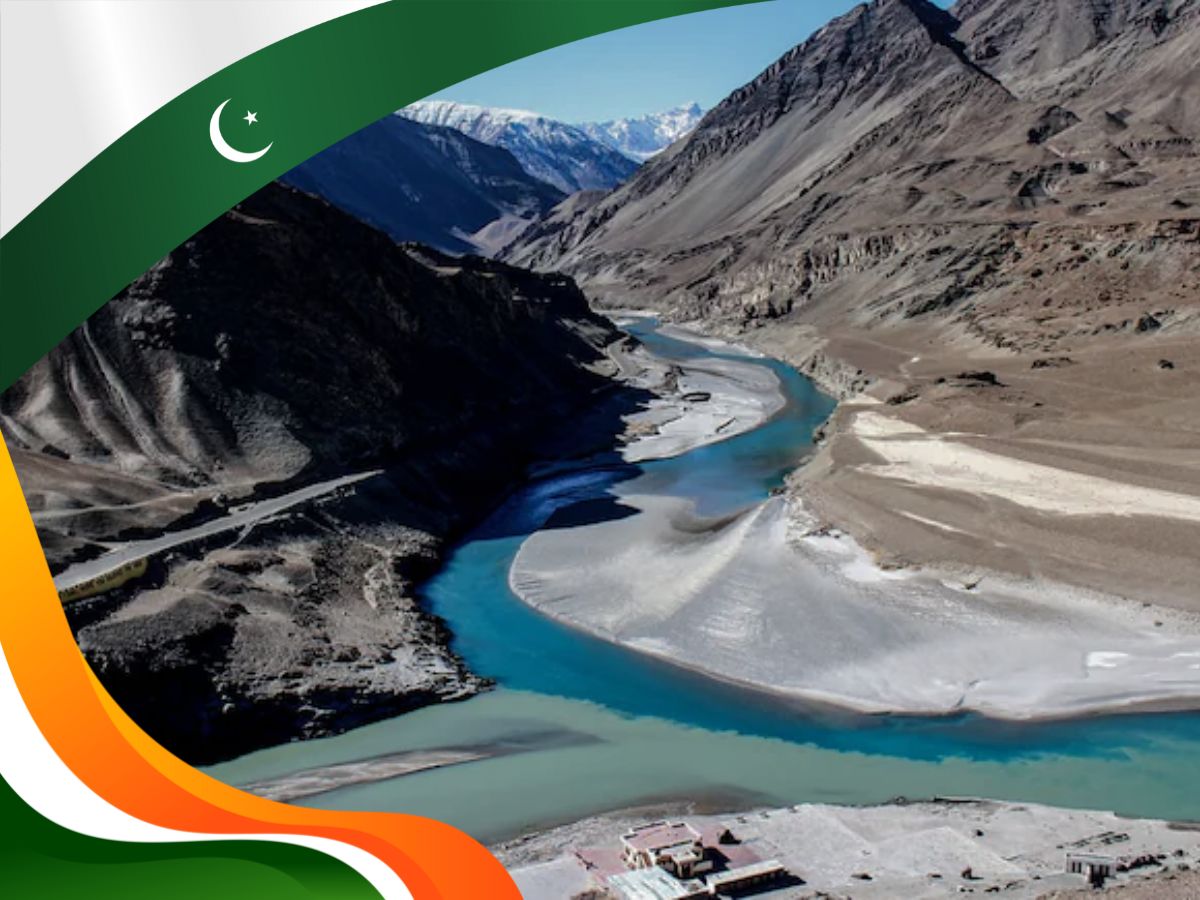
India’s control over Indus waterflow puts Pakistan’s agriculture at risk.(Photo: Canva)
India’s growing control over the flow of the Indus River could worsen Pakistan’s already critical water stress and severely impact its agriculture sector, according to the Ecological Threat Report 2025 released by the Sydney-based Institute for Economics and Peace (IEP). The report warns that Pakistan where nearly 80% of irrigated agriculture depends on the Indus basin could face severe shortages if India alters water releases from its upstream dams.
The concern comes at a time when India has formally placed the Indus Waters Treaty (IWT) of 1960 in abeyance, following the Pahalgam terror attack in April 2025, which New Delhi attributed to Pakistan-backed terrorists. With the treaty suspended, India is no longer bound by its water-sharing commitments, raising fears of strategic water leverage.
Although India cannot entirely block or permanently divert the Indus waters due to the treaty design and engineering limitations, the IEP report highlights that India can manipulate flows within its technical capacity, particularly by adjusting timing of releases from run-of-the-river dams during critical agricultural periods. Even minor operational changes during summer could restrict flows into Pakistan’s plains, which rely on the river system to sustain crops and livelihoods.
The report reveals Pakistan’s biggest weakness: extremely limited water storage capacity. The country’s dams can hold only 30 days of river flow, compared to India’s storage capacity of several months. “If India were to significantly reduce the flow, Pakistan’s densely populated agricultural regions could face acute shortages, especially during dry seasons,” the report notes.
The strategic vulnerability became evident in May when India flushed reservoirs at the Salal and Baglihar dams on the Chenab without notifying Pakistan an event that led to a sudden surge of water across the border. The IEP report states that such unannounced activity shows India’s growing leverage over river management after placing IWT in suspension.
Adding to Pakistan’s woes, Afghanistan has accelerated plans to build a dam on the Kunar River, further tightening Pakistan’s access to upstream water sources. The developments come at a time when Pakistan’s farmers are already struggling against climate-induced disasters, oscillating between floods and severe drought.
The report also cites shifting geopolitical dynamics including the recent defence pact between Pakistan and Saudi Arabia, under which both nations are obligated to support each other in case of external conflict. While the agreement has been debated primarily in the context of nuclear cooperation, the IEP notes that it could have wider regional military implications if water tensions escalate.
As Pakistan grapples with dwindling resources, inadequate storage infrastructure, and unpredictable river flows, experts warn that water scarcity could evolve into a national security challenge, potentially deepening economic instability and stoking cross-border tensions.
Sofia Babu Chacko is a journalist with over five years of experience reporting on Indian politics, crime, human rights, gender issues, and stories about marginalized communities. She believes journalism plays a crucial role in amplifying unheard voices and bringing attention to issues that truly matter. Sofia has contributed articles to The New Indian Express, Youth Ki Awaaz, and Maktoob Media. She is also a recipient of the 2025 Laadli Media Awards for gender sensitivity. Beyond the newsroom, she is a music enthusiast who enjoys singing. Connect with Sofia on X: https://x.com/SBCism
Iran has asked India to release three tankers seized in February as both sides discuss…
Rahaman's most high-profile moment came during the 2024 Indian general election, when CPI(M) fielded him…
The Rajya Sabha elections in Bihar and Odisha saw major political drama on Monday, with…
