
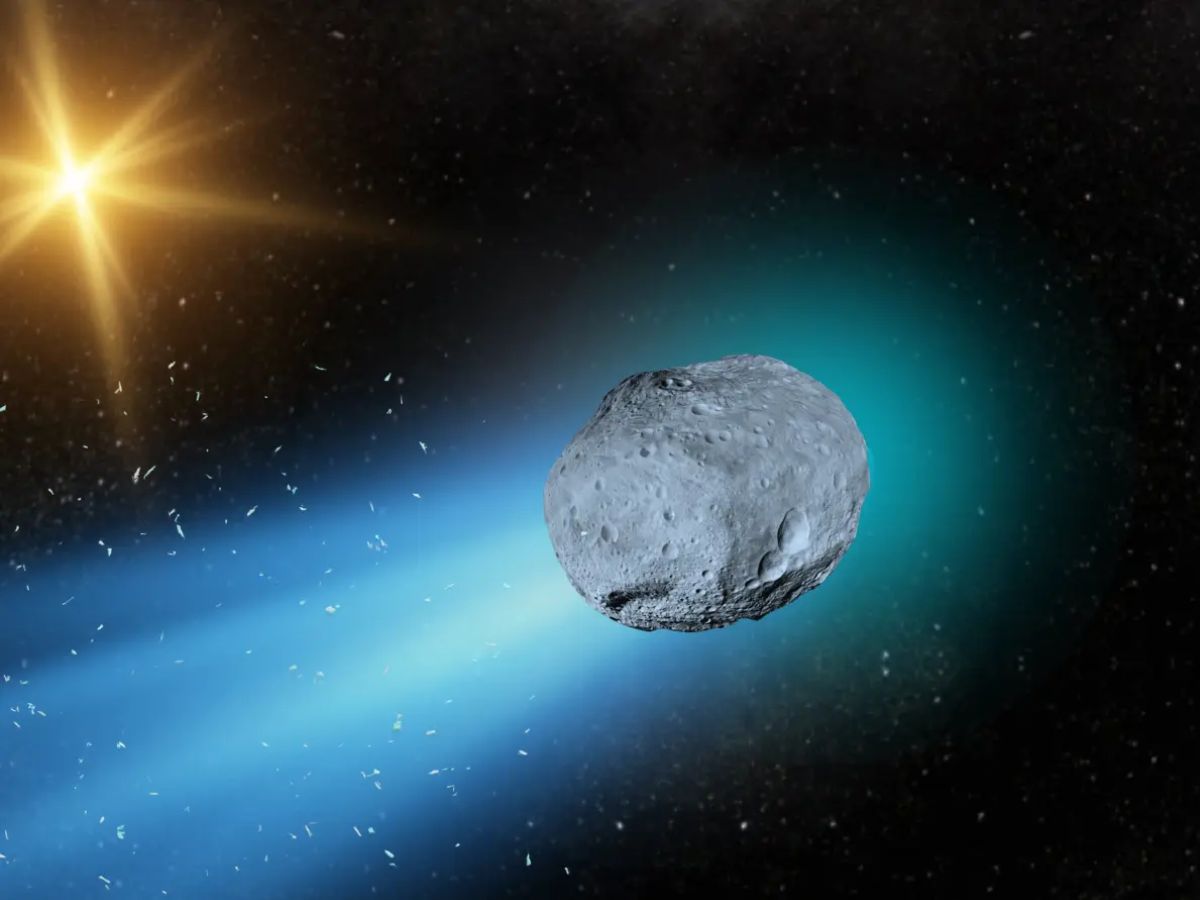

Yes, comet 3I/ATLAS showed several unusual behaviors in its approach to the Sun that surprised astronomers and inspired multiple theories.
Rapid Brightening and Blue Appearance
In late October 2025, during its approach towards the Sun, comet 3I/ATLAS appeared to rapidly brightened and its brightness appeared to increase several magnitudes greater than typical comets we’ve seen in our own solar system. Typically, comets to brighten with the Sun as the warming Sun heats up the icy surface of the comet, causing gas and dust jets to form, which leads to the usual brightening. This comet first “turned distinctly blue” and brightened at a faster rate than expected. It is uncommon for a comet to become blue shifted and scientists suspected unique materials could be present or “it follows an unknown process”. Actually, most of the observations came from space-based telescopes, such as NASA’s STEREO-A and ESA’s SOHO, because this comet was located behind the Sun from Earth perspective.
Strange Tail Changes: Anti-Tail Phenomenon
Normally, comets develop tails that point away from the Sun as solar wind gradually moves dust and gas in that direction. The astronomers of 3I/ATLAS instead observed what has been termed “an anti-tail” which is a stream of dust and gas that points toward the Sun, seemingly opposite to its trajectory. This anti-tail orientation was first observed in September of 2022 by observers and astounded the astronomers because it violates the expected behavior of normal comets. The tail switched back to its predicted orientation as the comet got even closer, and researchers had a dilemma of sorts physis. In reality, the phenomenon involve unusual geometry, in terms of how sunlight scatters off of dust particles, while the emergence of a pronounced anti-tail is quite rare.
Unusual Movement: Possible Non-gravitational Forces
A third shocking observation in 3I/ATLAS was the comet’s movement. The Jet Propulsion Laboratory of NASA reported that the comet appeared to have non-gravitational acceleration during perihelion, the closest distance to the Sun. While normal comets can change speed slightly due to jets of gas, 3I/ATLAS was observed to shift more than acceptable, possibly even sideways. Some experts proposed by Avi Loeb, astrophysicist of Harvard, argued that this observed movement might indicate a technological mechanism, like an engine, to cause acceleration although it is put into the “controversial many awaiting more.”
The bright blue color, reversed anti-tail and strange changes in speed of Comet 3I/ATLAS has made it one of the strangest interstellar visitors to date. Scientists continue to investigate the comet to better understand the causes behind these strangeness and what they reveal about the objects that enter our solar system from beyond.
The information presented is based on current astronomical observations and publicly available research. Some findings are still under review, and interpretations may evolve as new data emerges from ongoing space studies.
Also Read: 3I/ATLAS: What Did India’s Space Telescope Really See When NASA Went Silent
Vani Verma is a content writer with over 2 years of experience in lifestyle, entertainment, health and digital media. She has a knack for creating engaging and research-driven content that resonates with readers, blending creativity with clarity. Passionate about media trends, culture, and storytelling, she strives to craft content that informs, inspires, and connects.




