

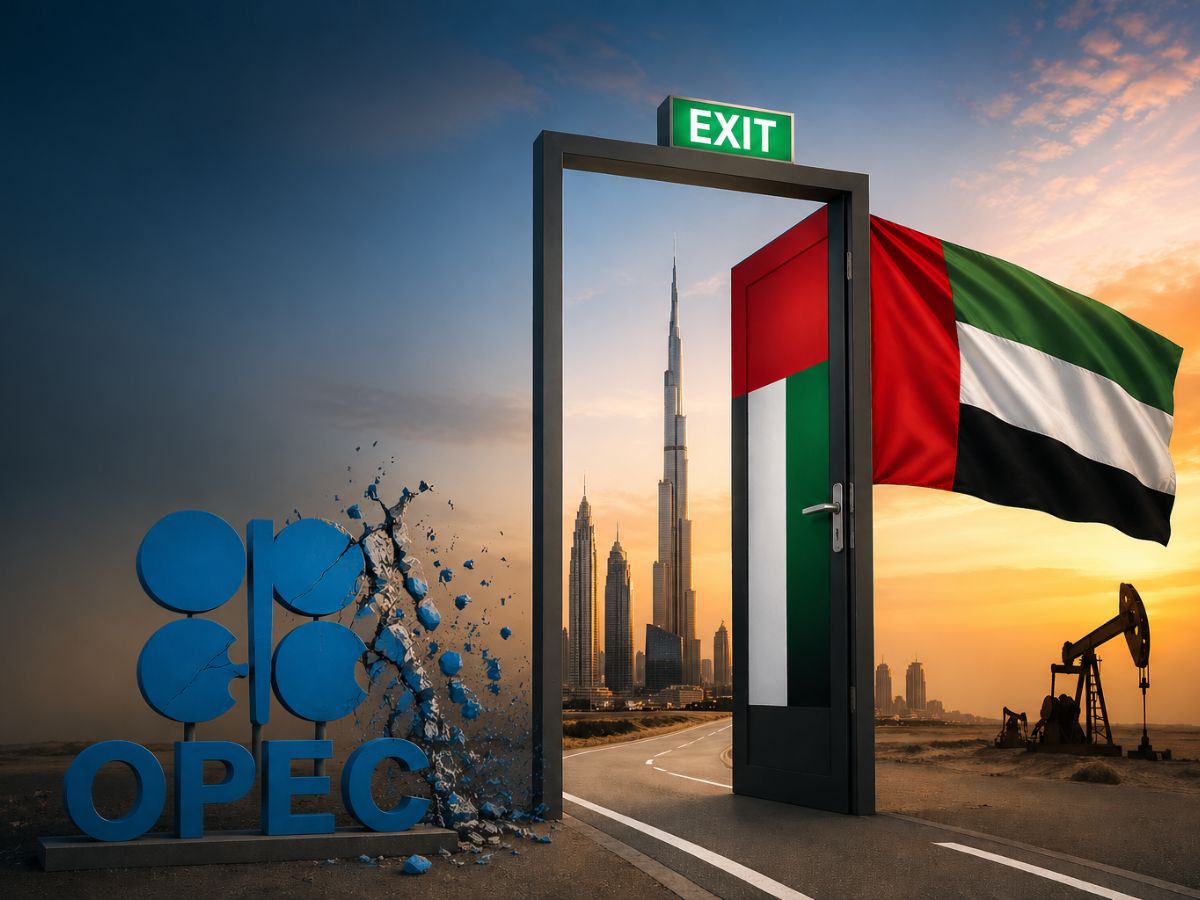
On Tuesday, the United Arab Emirates said, it is leaving Organization of the Petroleum Exporting Countries (OPEC), dealing a blow to the oil producers group. The decision comes during a major energy crisis linked to the Iran war, which has highlighted growing tensions among Gulf countries.
As one of OPEC’s biggest oil producers, the UAE’s exit could weaken the group’s control over global oil supply. It also shows increasing differences between the UAE and Saudi Arabia, which is seen as the main leader of OPEC.
It could also free the UAE to increase output once exports via the Gulf resume as it would no longer be governed by OPEC quotas.
In his first public comments since the announcement, UAE Energy Minister Suhail Mohamed al-Mazrouei told Reuters in a telephone interview that the decision was taken after examining the country’s energy strategies.
He said the UAE had not discussed the issue with any other country.
“This is a policy decision, it has been done after a careful look at current and future policies related to level of production,” Mazrouei said.
UAE WILL LEAVE ON MAY 1
He also said the world would demand more energy, implying the UAE would be positioned to meet that need.
Oil prices on international markets trimmed gains on Tuesday following the UAE‘s announcement it would on May 1 leave OPEC and OPEC+, which brings together OPEC and allied producers.
Mazrouei said he did not expect much immediate market impact from the news because of constraints in the Strait of Hormuz.
OPEC Gulf producers have been struggling to ship exports through the Strait, a chokepoint between Iran and Oman through which a fifth of the world’s crude oil and liquefied natural gas normally passes, because of Iranian threats and attacks against vessels.
As Gulf supplies have become stuck, the International Energy Agency said OPEC+’s share of global oil output fell to 44% in March from about 48% in February. It is likely to fall further in April as production shut-ins become more pronounced – and then further in May as the fourth biggest producerleaves the group.
A WIN FOR US PRESIDENT DONALD TRUMP?
The UAE‘s exit represents a win for U.S. President Donald Trump, who in a 2018 address to the U.N. General Assembly accused the organisation of “ripping off the rest of the world” by inflating oil prices.
Trump has also linked U.S. military support for the Gulf with oil prices, saying that while the U.S. defends OPEC members, they “exploit this by imposing high oil prices”.
Analysts said it was also positive for consumers and the broader economy.
“This opens the door for the UAE to gain global market share when the geopolitical situation normalises,” said Monica Malik, chief economist at ADCB.
Jorge Leon, analyst at Rystad, noted the UAE‘s significance as one of the few members of OPEC, apart from Saudi Arabia, with spare production capacity that allows it to add extra oil to the market.
“Outside the group, the UAE would have both the incentive and the ability to increase production, raising broader questions about the sustainability of Saudi Arabia’s role as the market’s central stabiliser,” he said.
WIDENING RIFT BETWEEN UAE AND SAUDI ARABIA
Once firm allies, Abu Dhabi and Riyadh have developed a simmering rivalry, clashing on issues from oil policy and regional geopolitics to the race for foreign talent and capital.
The UAE is a regional business and financial hub and one of Washington’s most important allies. It has pursued an assertive foreign policy and carved its own sphere of influence across the Middle East and Africa.
Especially after coming under attack during the Iran war, the UAE has strengthened its relationships with the United States and Israel, with which it opened ties in the 2020 Abraham Accords. It views the relationship with Israel as a lever for regional influence and a unique channel to Washington.
Some Gulf leaders, meanwhile, met in person on Tuesday in Saudi Arabia, a summit that a Gulf official said aimed to craft a response to the thousands of Iranian missile and drone strikes their nations have faced since the U.S. and Israel launched their war on Iran in late February.
(Inputs from Reuters)





