

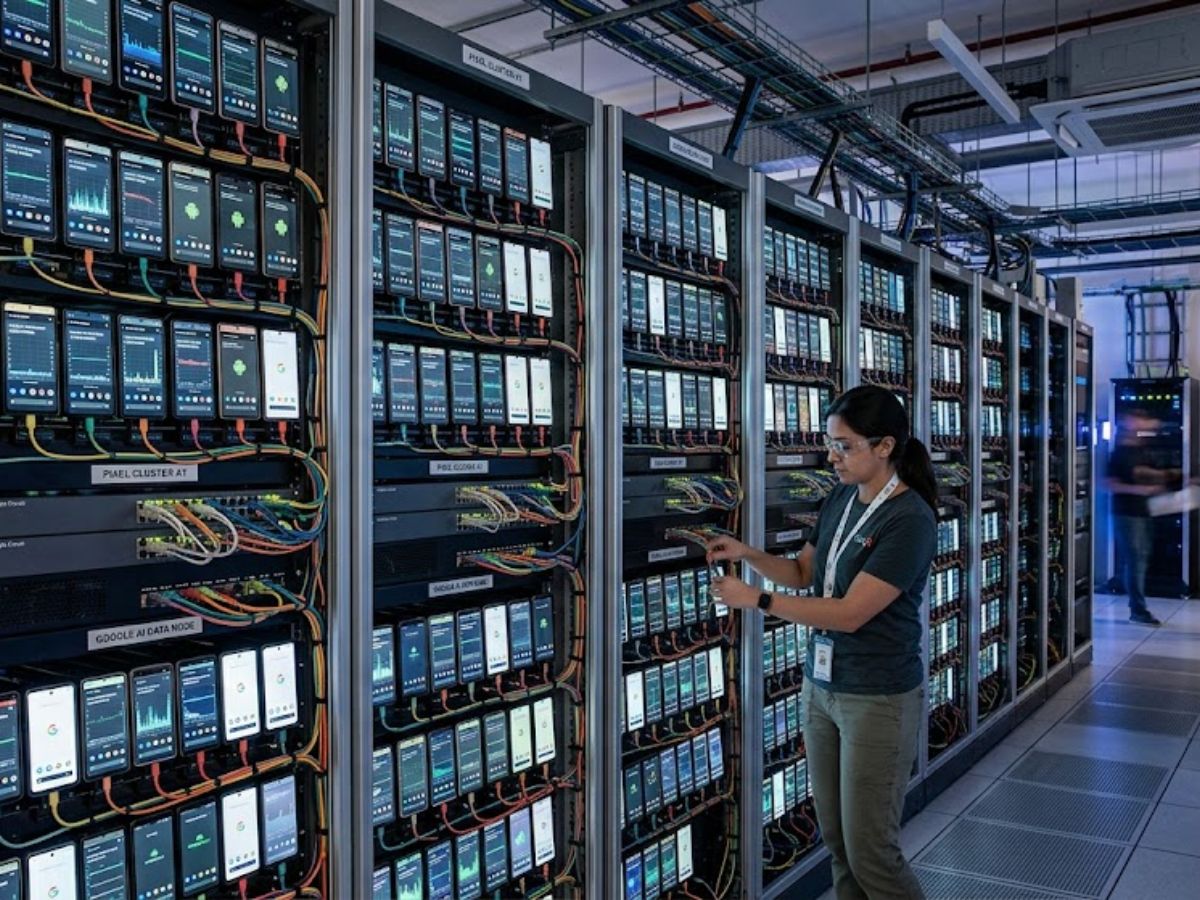
That old phone sitting in your drawer collecting dust might have a second life ahead of it. Google, working with researchers at the University of California San Diego, has published a research blog revealing a project that could fundamentally change how data centres are built and powered. The idea is straightforward but genuinely clever: instead of manufacturing new, expensive server hardware to run AI workloads, why not use the millions of old smartphones that people have already discarded?
The project, published on June 12, 2026, on Google’s research blog, describes a process called phone cluster computing. Researchers are extracting the motherboards from retired smartphones, grouping them into clusters, and redeploying them as a general-purpose computing platform. With Google’s support, the University of California San Diego plans to deploy a data centre built from 2,000 Pixel smartphones that will provide hundreds of researchers and students with low-cost, low-carbon cloud computing, reducing the need for newly manufactured hardware and the carbon emissions that come with it.
Why an Old Phone Is More Powerful Than You Think
Most people assume that once a phone feels slow or outdated, it is done. But that is not really true from a computing standpoint.
The single-threaded performance of modern smartphones’ processor cores is on par with or better than those of modern multicore servers. The most significant difference between a smartphone and a server is size: servers contain dozens of powerful processor cores and huge memory capacity, while a smartphone has a handful of heterogeneous processor cores and 8 to 12GB of memory.
Put simply, your old phone still has real computing muscle. The challenge is not power. It is getting many phones to work together in a coordinated way.
SPEC benchmarking results indicate that 25 to 50 phones put together equate to the output of a modern server. The phones are organised into self-managing clusters of 25 to 50 devices, with jobs across devices managed using containerised applications running on Kubernetes.
Before the phones can be used in this setup, they go through a preparation process. Smartphones must be processed to remove all but the motherboard, stripping out the display, battery, chassis and peripheral hardware like cameras. The Android operating system is replaced with a general-purpose Linux distribution to make the devices programmable for cloud computing tasks.
The Carbon Problem That Started All of This
The carbon footprint of computing comes from two main sources. Operational carbon reflects emissions from energy used while running hardware. Embodied carbon covers emissions from manufacturing the hardware in the first place. While operational carbon gets addressed through cleaner energy and better efficiency, the manufacturing footprint is a much harder problem to solve.
On average, people replace their phones every four years. Many of those replaced phones have their core computing functions fully intact and are still relatively powerful devices. While an old phone may no longer interest its first owner, putting it back in service can directly reduce the environmental footprint of computing by avoiding the need for further raw material extraction.
The motherboard alone is responsible for approximately 50 percent of a smartphone’s total embodied carbon, based on Google’s internal assessments. By reusing motherboards rather than manufacturing new server components, the project targets the single most carbon-intensive part of the device.
What Happens Next
Early experiments show that even a moderately sized cluster of 20 phones can support peak submission rates for a class of more than 75 students, with grading speeds comparable to Amazon’s cloud backend. A 2,000-phone deployment will be capable of supporting a hundred such classes simultaneously.
The full system is expected to launch in Fall 2026 and will also serve as a testbed for smartphone-based computing at scale, particularly investigating how reliable consumer-grade hardware holds up under sustained, long-term use.
For now this is a university research project, not a product you can sign up for. But the underlying idea, that billions of discarded phones worldwide could be networked into useful computing infrastructure, has much bigger implications. As AI workloads grow and the demand for data centre capacity keeps rising, solutions like this one might move from academic experiment to mainstream infrastructure faster than anyone expects.
Syed Ziyauddin is a media and international relations enthusiast with a strong academic and professional foundation. He holds a Bachelor’s degree in Mass Media from Jamia Millia Islamia and a Master’s in International Relations (West Asia) from the same institution.
He has work with organizations like ANN Media, TV9 Bharatvarsh, NDTV and Centre for Discourse, Fusion, and Analysis (CDFA) his core interest includes Tech, Auto and global affairs.
Tweets @ZiyaIbnHameed





