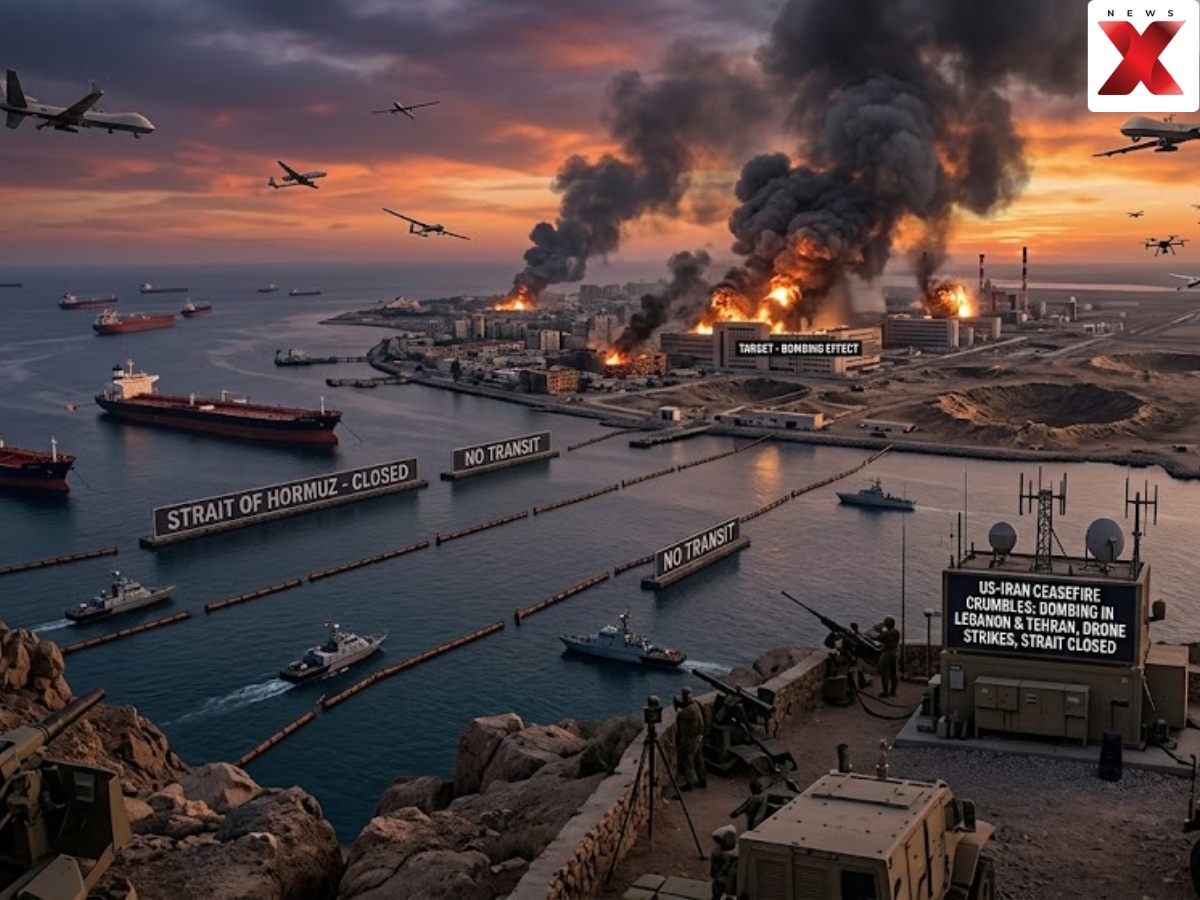
US-Iran ceasefire faces cracks as Israel strikes Lebanon. Photo: Gemini.
The US and Iran reached a ceasefire deal on Wednesday, April 9, reportedly brokered by Pakistan and China. However, hours after the announcement, cracks started to appear as Israel continued to bomb Lebanon. Israel claimed that the truce in Lebanon is not part of the deal. IDF reportedly also carried out strikes in Tehran. Iran and other Gulf Arab countries continued to strike each other with drones even after the deal.
Prime Minister of Pakistan, Shehbaz Sharif, who acted as a mediator between Washington and Tehran, urged all parties to exercise restraint and respect the ceasefire for two weeks, as agreed upon, so that diplomacy can take a lead role towards the peaceful settlement of the conflict.”
Israel reportedly carried out its largest strikes in Lebanon since the war start with some reports claiming that the IDF struck 100 locations in one minute.
Iran retaliated by threatening to close the Strait of Hormuz again. Reports claimed Iran closed the strategic waterway and important oil chokepoint later in the day. However, White House denied the reports.
Earlier in the day, Iran claimed that Donald Trump ‘accepted’ its ten demands, which included collecting tolls on ships passing through the strait and uranium enrichment inside Tehran. However, later, White House Karoline Leavitt said that the 10 demands shared by Iran are different from the ones accepted by Trump.
The White House clarified that Iran presented two 10-point plans, out of which one was “unserious, unacceptable” and was “literally thrown in the garbage” by US President Donald Trump.
White House Press Secretary Karoline Leavitt said that the other 10-point plan was “workable”, upon which the US has agreed for two-weeks ceasefire and further negotiations.
Karoline Leavitt clarified that the media has “falsely” reported the “discarded” 10-point plan as being accepted by the US.
“Iran has agreed to open the Strait of Hormuz, and as the president said, we have received a proposal from the Iranians that has been determined to be a workable basis on which to negotiate,” she said.
“I have seen a lot of inaccurate coverage today from the media. The Iranians originally put forward a 10-point plan that was fundamentally unserious, unacceptable, and completely discarded. It was literally thrown in the garbage by President Trump and his negotiating team. Many outlets have falsely reported that plan as being acceptable to the US,” Leavitt added.
Leavitt said that the “workable plan” aligned with the US 15th-point proposal, reaffirming Donald Trump’s stance to end Uranium enrichment in Iran.
“President Trump and the team determined the new modified plan was a workable basis on which to negotiate and to align it with our own 15-point proposal. The President’s red lines, namely the end of Iranian enrichment in Iran, have not changed. And the idea that President Trump would ever accept an Iranian wish list as a deal is completely absurd,” she said.
“The President will only make a deal that serves in the best interests of the United States of America, and he and his negotiating team will focus on this effort over the next two weeks, so long as the Strait of Hormuz remains open, with no limitations or delays. These extraordinarily sensitive and complex negotiations will take place behind closed doors over the course of the next two weeks,” she added.
Earlier, Trump had announced that Washington intends to demand a total cessation of uranium enrichment in Iran, while simultaneously initiating discussions regarding sanctions relief and tariff reductions. The President characterised the recently brokered ceasefire as the start of a “very productive regime change” for the Islamic Republic.
In a statement shared via his Truth Social platform, Trump maintained that the United States is prepared to “work closely with Iran” following the recent hostilities. He further suggested that the foundations for a more comprehensive international settlement have effectively been established.
Addressing the nuclear issue directly, Trump specified the administration’s primary objectives. “There will be no enrichment of uranium, and the United States will, working with Iran, dig up and remove all of the deeply buried nuclear ‘dust’,” he asserted, in an apparent reference to the remains of the nation’s nuclear framework.
The diplomatic engagement between the US and Iran is set to take place in Islamabad this weekend, where both sides will hold direct talks aimed at ending weeks of intense hostilities following the outbreak of war.
The meeting follows an immediate ceasefire agreement between the US and Iran for two weeks after weeks of conflict in the region.
The US delegation will be led by Vice President JD Vance and the Iranian delegation will be led by Speaker of Parliament Mohammad Bagher Ghalibaf.
This comes after Trump suspended the “bombing and attack” campaign on Iran, announcing a two-week double-sided ceasefire and saying that the 10-point proposal from Iran was workable.
(With inputs from ANI)
Zubair Amin is a Senior Journalist at NewsX with over seven years of experience in reporting and editorial work. He has written for leading national and international publications, including Foreign Policy Magazine, Al Jazeera, The Economic Times, The Indian Express, The Wire, Article 14, Mongabay, News9, among others. His primary focus is on international affairs, with a strong interest in US politics and policy. He also writes on West Asia, Indian polity, and constitutional issues. Zubair tweets at zubaiyr.amin
Actress Abhirami Venkatachalam has called out certain Instagram subscribers for making inappropriate demands and displaying…
A humanoid robot named Nila, dressed in a saree, greeted voters at the VOC Government…
Meta has launched Muse Spark, a new multimodal AI model aimed at building personal superintelligence.…
