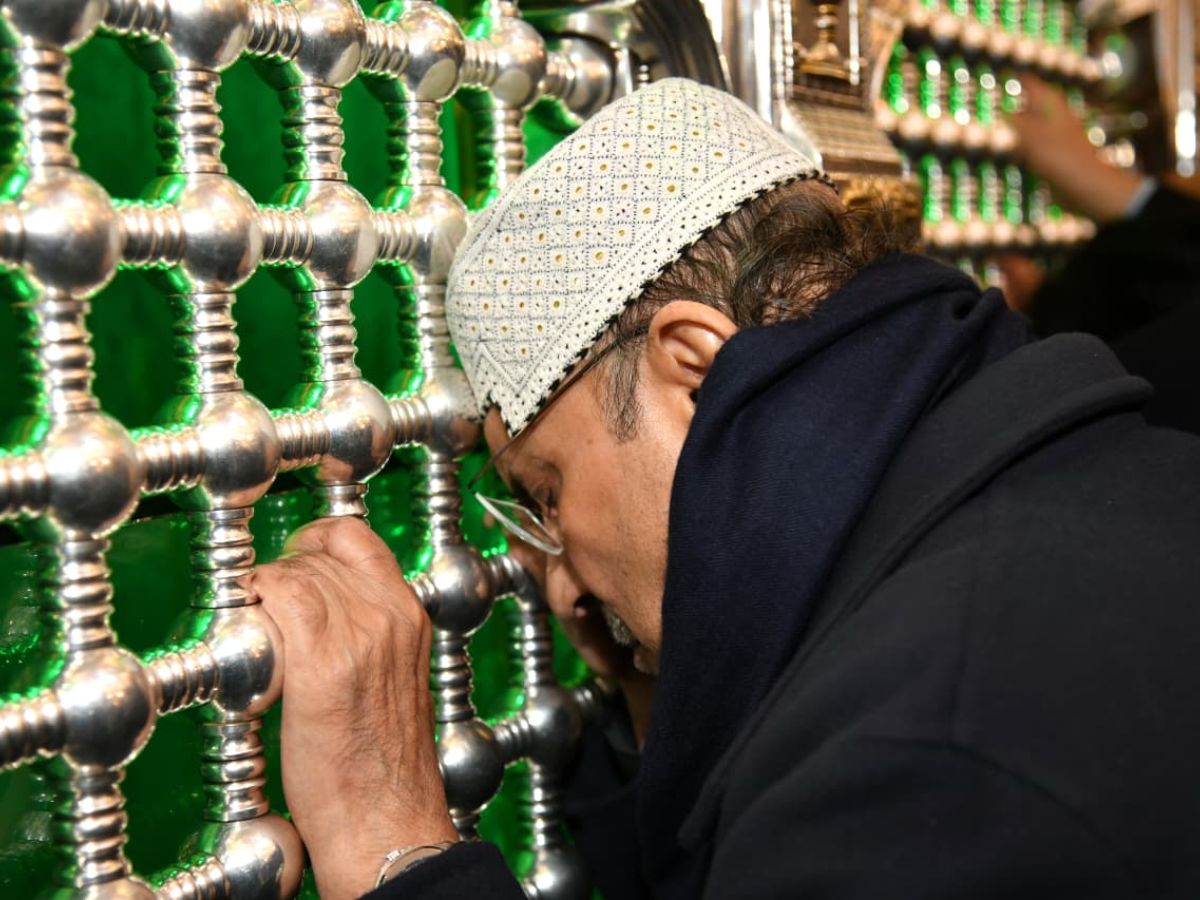
Pak President Asif Ali Zardari reveals he was advised to take shelter in a bunker. (Photo: X/@PresOfPakistan)
Pakistan President Asif Ali Zardari has made a rare and striking admission about the tense days during India’s Operation Sindoor, revealing that he was advised by his Military Secretary to take shelter in a bunker as Indian precision strikes hit key targets across Pakistan. Zardari, however, said he refused the advice, claiming leaders do not hide during moments of war.
His comments come even as Islamabad has consistently attempted to downplay the impact of India’s military operation launched in response to the April 22 Pahalgam terror attack, which left 26 civilians dead.
Speaking at a public event on Saturday, Zardari said his Military Secretary rushed to him with an urgent message as Indian strikes began under Operation Sindoor.
“My Military Secretary came and said, ‘Sir, the war has started. Let’s go to the bunker,’” Zardari recalled. He added that he had anticipated the escalation days earlier but refused to move to safety.
“If martyrdom is to come, it will come here. Leaders don’t die in bunkers. They die on the battlefield,” the Pakistani President said, according to ANI.
Zardari’s remarks offer a rare public glimpse into the anxiety within Pakistan’s top leadership during the four-day military escalation in May. His admission contradicts Pakistan’s official narrative that has sought to project calm and control amid India’s strikes on military installations and terror infrastructure.
India launched Operation Sindoor on May 7, carrying out strategic precision strikes until May 10, when a ceasefire was announced following outreach from Pakistan.
Operation Sindoor was launched by India in response to the April 22 terror attack in Pahalgam, Jammu and Kashmir, where Pakistan-backed attackers allegedly asked victims their religion before killing 26 civilians. Indian officials described the attack as an attempt to incite communal violence and destabilise the country internally.
In retaliation, India targeted terror camps and later Pakistani military installations in Pakistan and Pakistan-occupied Jammu and Kashmir, aiming to degrade terrorist infrastructure and deter further attacks.
During Operation Sindoor, India struck terror infrastructure and repelled subsequent Pakistani aggression by targeting airbases and key military facilities. Pakistan’s Deputy Prime Minister and Foreign Minister Ishaq Dar later acknowledged that India had hit the Nur Khan Air Base in Rawalpindi’s Chakala, damaging military installations and injuring personnel.
Dar admitted that India sent at least 80 drones towards Pakistan within 36 hours, claiming 79 were intercepted while one caused damage.
The Indian Air Force has stated that six Pakistani aircraft, including five fighter jets and an AEW&C (Airborne Early Warning and Control) system, were downed during Operation Sindoor. Air Chief Marshal A.P. Singh said the strikes were precise and effective, significantly weakening Pakistan’s aerial capabilities during the escalation.
The strikes led to heightened cross-border shelling and fears of a wider military confrontation between the two nuclear-armed neighbours. Hostilities eventually eased after Pakistan’s Director General of Military Operations contacted his Indian counterpart to propose a ceasefire.
The ceasefire was later confirmed by India’s Foreign Secretary Vikram Misri, who said both sides agreed to halt military operations on land, sea and air.
Zardari’s bunker revelation stands out as one of the most candid acknowledgements from Pakistan’s leadership about the seriousness of India’s military retaliation. While Islamabad has publicly sought to minimise the impact of Operation Sindoor, the President’s comments suggest the strikes triggered alarm at the highest levels of power in Pakistan.
The episode marks one of the most intense military confrontations between India and Pakistan in recent years before diplomatic channels brought the crisis to a halt.
Sofia Babu Chacko is a journalist with over five years of experience covering Indian politics, crime, human rights, gender issues, and stories about marginalized communities. She believes that every voice matters, and journalism has a vital role to play in amplifying those voices. Sofia is committed to creating impact and shedding light on stories that truly matter. Beyond her work in the newsroom, she is also a music enthusiast who enjoys singing.
Rolls-Royce plans to expand in India across defence, aviation, and energy, aiming to create 10,000…
The Delhi-NCR region is currently experiencing a sharp rise in flu-like cases, largely linked to…
MS Dhoni Ordered to Pay ₹10 Lakh by Madras High Court: Full Details Explained
MS Dhoni filed the ₹100 Cr defamation suit in 2014 against two media organisations, a…
