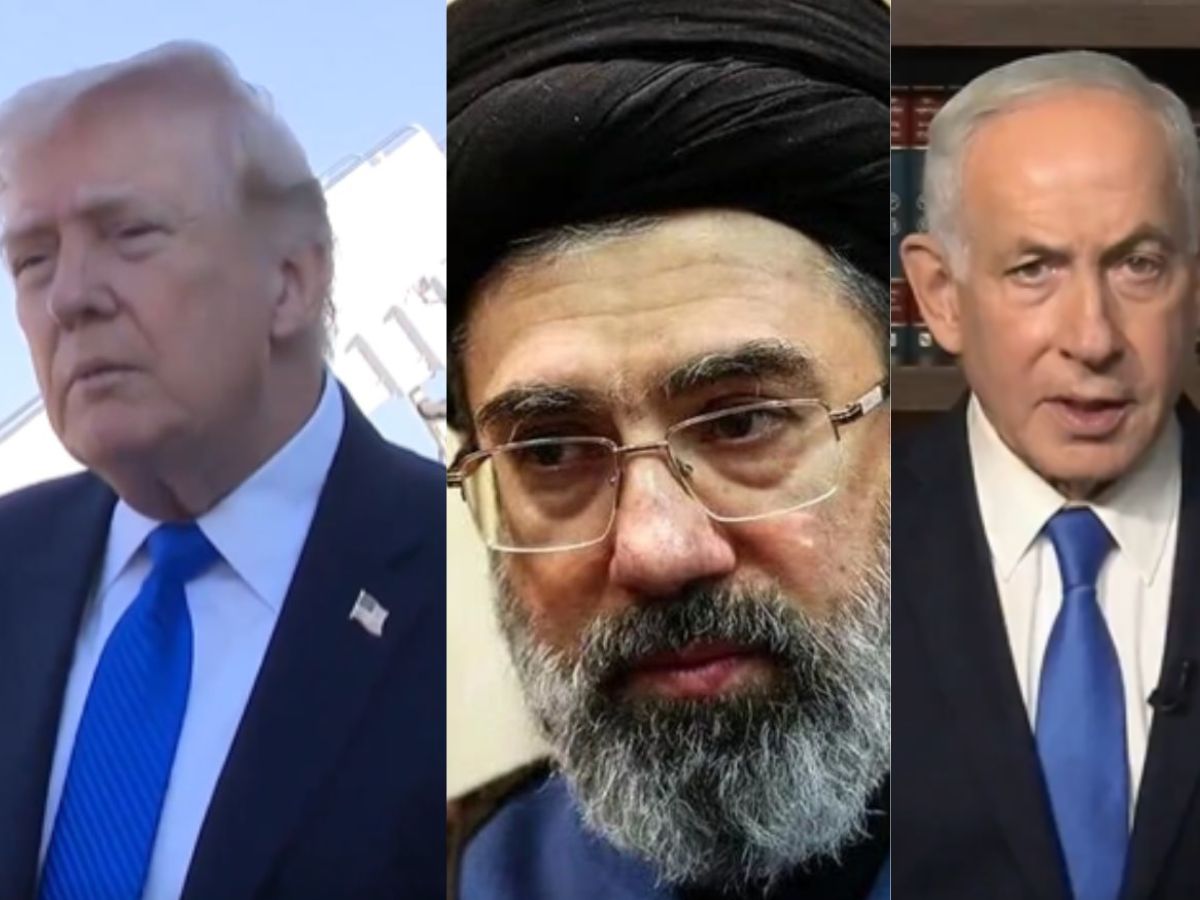
What’s Happening With US-Iran ‘Talks’? (Photo: X)
In one of the most dramatic confrontations of storylines on March 23rd the United States and Iran gave drastically divergent accounts of diplomatic engagements in the face of an escalating Middle East dispute. President Donald Trump said that Washington had very good and productive talks with the Iranian counterparts, implying that there was a momentum on eliminating the hostilities between the two sides and foreshadowing that a deal could be reached to end the current war. He described such talks as substantive enough to warrant a five day delay in planned US military attacks on Iranian energy infrastructure, and termed the sessions as in depth, detailed and constructive meetings. Trump noted that the negotiation would go on over the next few days and was optimistic but cautiously so that a broad resolution was possible through the negotiations but also pointed out that in case the talks failed, the military might go back to war.
However, Iran immediately rejected this characterization. The Iranian officials led by the speaker of the parliament Mohammad Bagher Ghalibaf also went to social media to refute the claims of Trump and categorically said that no negotiations were conducted with the United States. Ghalibaf referred to the reports of negotiations as fake news meant to control the world market as well as get the US and its ally Israel out of the quagmire that they were stuck in. The Foreign Ministry spokesman of Iran supported this point of view, stating that despite the messages that were sent through friendly third countries regarding a possible negotiation, there were no direct or indirect contacts between Tehran and Washington. This contradiction revealed a dramatic division in the accounts of the government and brought up questions about what might have actually transpired behind the scenes or not.
The setting to this argument is the mounting tension between the US and Israel and Iran. Things have escalated after the US and Israel airstrike earlier in 2026 that killed the Iranian Supreme Leader which has resulted in Iranian missile and drone attacks across the region. The scenario very quickly grew to a larger clash where both civilian and military targets in Iran were bombarded and Tehran answered back with attacks on ally forces. The threat by Trump to attack the power plants of Iran in this unstable atmosphere was conditional and he would not do so without the Strait of Hormuz which was an important global oil transit route which was effectively closed by Iran. This ultimatum was followed by the Trump announcement of productive dialogues and seemed to be a reason to postpone imminent strikes, whereas Iran did not see the grounds in this statement.
According to analysts and regional analysts, mediation activities by third party states can be confusing the picture. Even as the two capitals maintain a strict grip on their messages to their citizens, countries such as Turkiye, Pakistan, and Egypt have been reported to deliver messages between Washington and Tehran. As Trump implied that US representatives were in contact with a senior individual in Iran, alluding to back channel or mediated communication, the Iranian leaders disproved it, stating that there was no such communication. Others have taken the US remarks as an effort to calm international financial markets and to soothe worries relating to oil price spikes by foaming at the mouth of diplomatic advances. Nevertheless, lack of transparency has just contributed to confusion on the course of the conflict.
The disputing claims have also echoed across the world markets. The initial reaction of President Trump was the increased stock futures rallies in the US and a sudden decrease in oil prices with key indexes rising and crude benchmarks declining by significant amounts as people anticipated de-escalation. This optimism was however dampened after the Iranian officials denied the validity of the direct negotiations as some analysts in the market cautioned that such a mismatch would negatively affect the confidence of investors and lead to volatility in both the commodities and the financial markets. The tug-of-war over the story describes how geopolitical tensions and communications can impact on economic expectations even when no diplomatic breakthroughs are yet to be verified.
Nevertheless, the conflict still has regional and international actors who insist on de escalation, which calls on both the parties to seek diplomatic pitfalls to restrain the conflict. But, the essential distrust between Washington and Tehran is deep. Iran has openly declared that it will not participate in negotiations in the shadow of its military threats and its leadership is adamant in its war objectives. At the same time, the United States has indicated an act of pressure and some form of critical engagement to the extent that diplomacy is the most desirable option, but it is always ready to re-engage in military activities. Consequently, regardless of whether the opposing statements indicate real confusion, or calculated communication, or the sophisticated combination of either, the assertions made by Trump and the refutation made by Iran underscores the fact that it is still hard to find a way out of conflict.
WATCH: Lionel Messi Brings His Ballon D’Or To Inter Miami Academy, Interacts With Young Players
Lionel Messi brought his Ballon d’Or to Inter Miami Academy, interacting with young players and…
Ashok Kharat Viral MMS: There are several cases filed against Ashok Kharat, in rape, extortion…
Get your 24 March 2026 horoscope today with detailed astrology predictions for all zodiac signs.…
