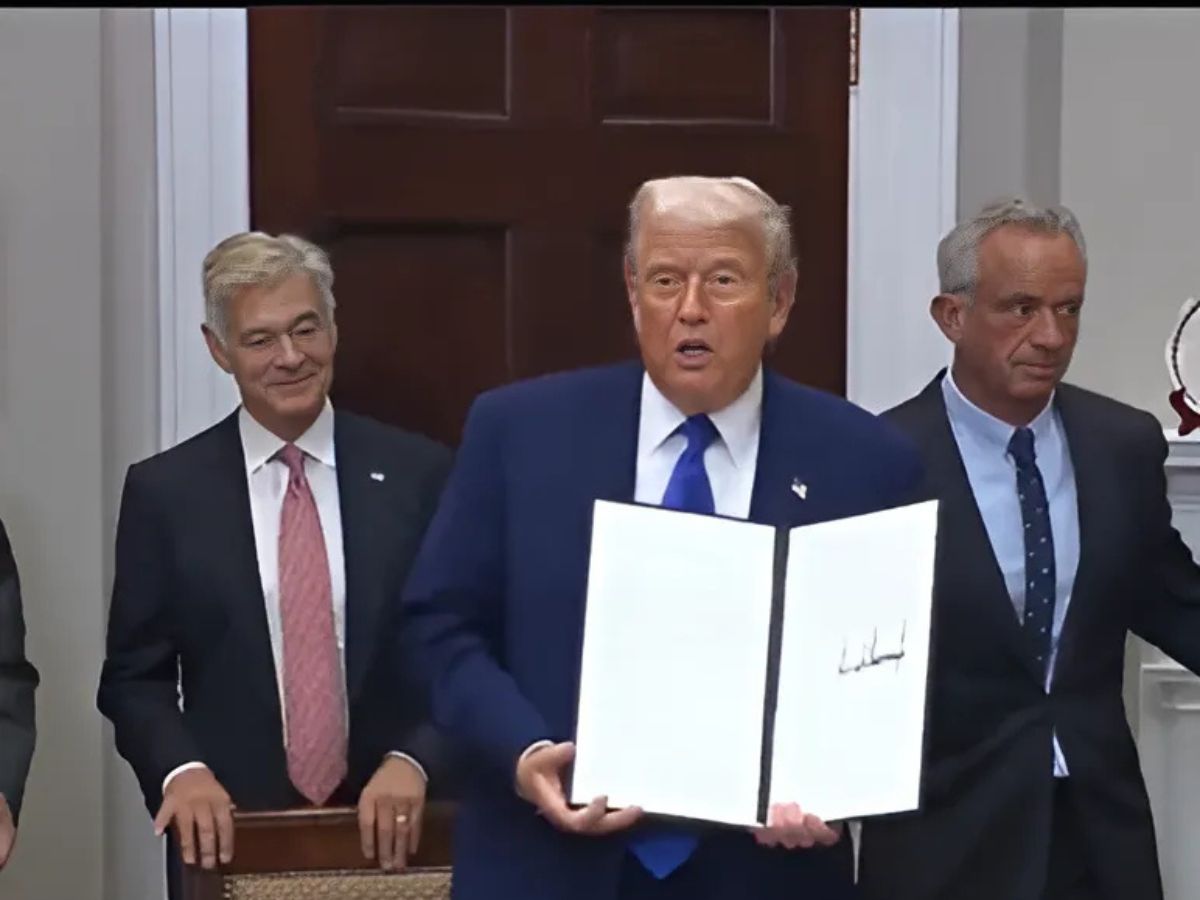
Donald Trump’s 100% tariff on patented drug imports from Oct 1 risks US medicine shortages and hits India’s pharma exports. Photo: X.
US President Donald Trump has announced a 100 percent tariff on branded and patented pharmaceutical imports starting October 1. The development is seen as a blow to India’s crucial pharmaceutical exports. Trump stated the tariffs would apply unless companies are “building” pharmaceutical plants in the United States, defining that as facilities “breaking ground” or “under construction.”
The United States imported nearly $233 billion in pharmaceutical and medicinal products in 2024, according to the US Census Bureau. The possibility of prices doubling for certain medicines has raised concerns about higher health-care expenses, including increased Medicare and Medicaid costs, ahead of the 2025 election season.
The announcement stunned the industry as Trump had previously suggested tariffs would be phased in gradually to allow companies time to establish US-based factories.
Often called the “Pharmacy of the World,” India supplies 20 per cent of global generic medicines and contributes 60 per cent of global vaccines, according to the India Brand Equity Foundation. The country also hosts the largest number of US FDA-approved plants outside America. Formulations and biologics represent nearly 79 per cent of India’s pharmaceutical exports.
Between April and December FY25, India exported ₹1.87 lakh crore ($21.7 billion) worth of pharmaceutical products to top destinations including the US, UK, South Africa, the Netherlands, and France. Overall, India’s global pharma exports exceeded $30 billion in 2024–25.
The United States remains India’s single-largest pharmaceutical market, accounting for 31 per cent of Indian pharma exports in 2024–25. India shipped $3.6 billion in drugs to the US in 2024, and another $3.7 billion in the first half of 2025, data from the Pharmaceutical Export Promotion Council of India shows.
While the tariffs primarily target patented drugs, a segment dominated by multinational firms, there is concern that complex generics and specialty medicines – key exports for India – could also face restrictions.
Indian pharmaceutical giants Dr. Reddy’s, Sun Pharma, Lupin, and Aurobindo have built their success on the US market’s demand for affordable generics. Generics account for nine out of ten prescriptions in the US but represent only 1.2 per cent of its healthcare budget.
With formulations and biologics making up 75 per cent of India’s exports, any extension of tariffs beyond patented drugs could squeeze Indian manufacturers and significantly affect American patients who rely on low-cost Indian medicines.
Ahead of the announcement, Indian drugmakers warned of potential supply disruptions and worsening US medicine shortages.
“If implemented, we will have no choice but to stop supplying drugs to the US. Patients there will suffer more than Indian manufacturers.”
Sun Pharma
Dr. Reddy’s Laboratories
Lupin
Cipla
Aurobindo Pharma,
Also Read: Donald Trump Approves TikTok Deal Through Executive Order, Oracle Among New Buyers
Zubair Amin is a Senior Journalist at NewsX with over seven years of experience in reporting and editorial work. He has written for leading national and international publications, including Foreign Policy Magazine, Al Jazeera, The Economic Times, The Indian Express, The Wire, Article 14, Mongabay, News9, among others. His primary focus is on international affairs, with a strong interest in US politics and policy. He also writes on West Asia, Indian polity, and constitutional issues. Zubair tweets at zubaiyr.amin
SOF Olympiad Level 2 Result 2026 Announced, Check Scores At Official Website
The Science Olympiad Foundation (SOF) has posted the SOF Level 2 Result 2026 on the…
Dr. Anjali R. Pandey Honoured with Skill Bharat Samman 5.0 for Excellence in School Leadership
Mumbai: Dr. Anjali R. Pandey, Principal of B.S.M. Dnyananand School, Thane, has been conferred with…
Iran holds a state funeral in Tehran for top officials Ali Larijani and Gholamreza Soleimani,…
