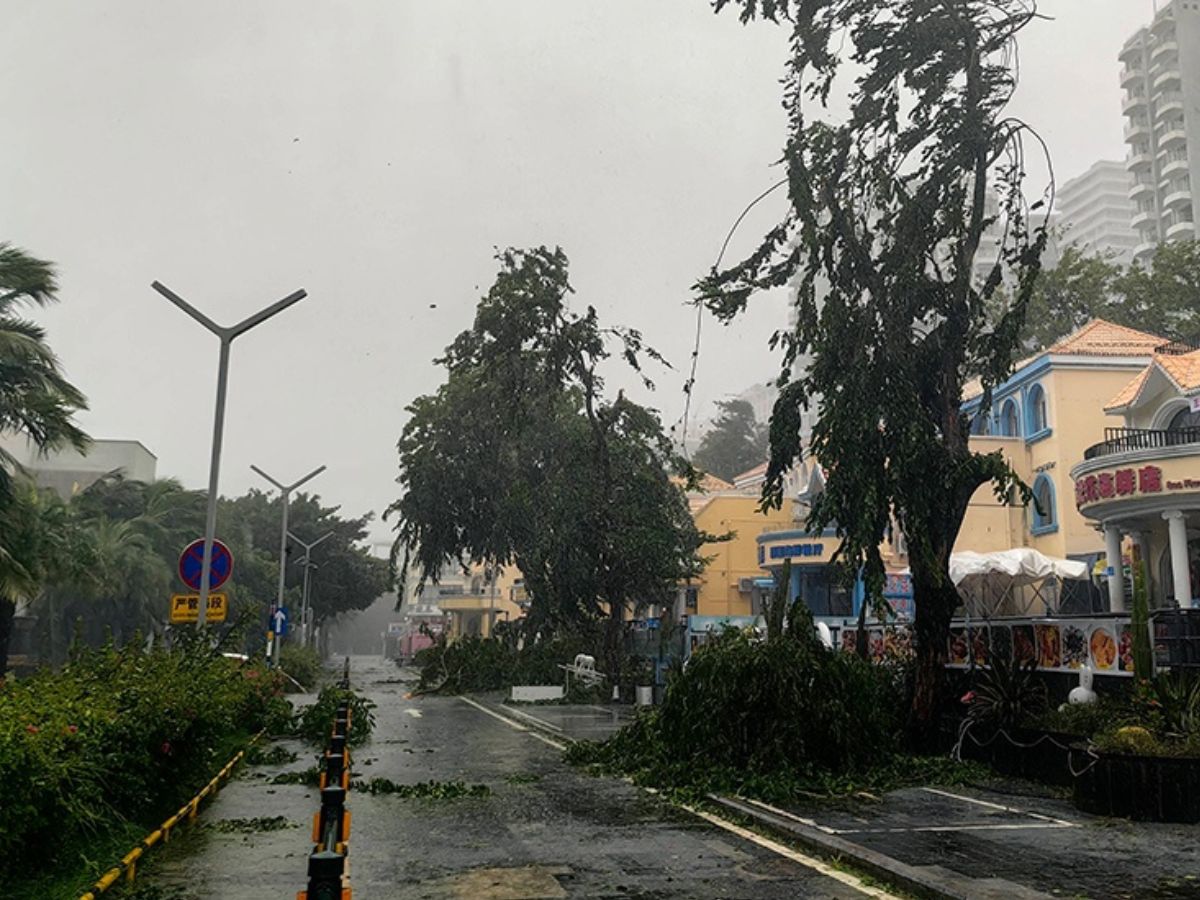
Vietnam braces for Typhoon Kajiki with 103 mph winds; hundreds of thousands evacuated, schools and airports closed. Photo/X.
Typhoon Kajiki, the year’s most powerful storm is set to hit Vietnam as authorities have already evacuated hundreds of thousands across potential risk areas. Authorities ordered to shut schools and airports as the storm, with winds of up to 103 mph, was set to hit central Thanh Hoa and Ha Tinh provinces on Monday. The typhoon is the equivalent of Category 2 Atlantic hurricane.
Before making landfall in Vietnam, Kajiki pounded south China, bringing powerful winds and heavy rain on Hainan Island and Guangdong province on Sunday. Approximately 20,000 residents were evacuated from vulnerable areas, said China’s Xinhua News Agency.
There has already been one death. A man in Nghe An province died on Friday when he was electrocuted trying to fix his roof, Xinhua reported.
Vietnamese state media cited authorities as saying that 600,000 people would be evacuated and 152,000 houses sheltered in Thanh Hoa, Quang Tri, and Danang provinces. To aid the effort, the government has mobilized 16,500 soldiers and 107,000 paramilitary troops for evacuations and rescue missions.
Two airports, one in Thanh Hoa province and the other in Quang Binh province, were shut down, the civil aviation authority confirmed. Boats were also ordered not to venture out to sea as airlines suspended flights. Both Vietnam Airlines and Vietjet cancelled flights numbering dozens in the area affected.
A government official cautioned late Sunday, “this is an extremely dangerous, fast-moving storm.”
Following the impact on Vietnam, Kajiki is predicted to track inland through Laos and northern Thailand, causing cause for concern of additional damage.
Vietnam, whose coastline is along the long South China Sea, is especially susceptible to typhoons that regularly bring fatal flooding and landslides.
Kajiki will be stronger than last year’s Typhoon Yagi, which claimed 300 lives and wrought £2.4 billion in damages, officials warned.
Experts have attributed the growing intensity of storms to global warming. A research report published last year established that cyclones in Southeast Asia are developing closer to the coast, developing faster, and lasting longer, thus posing more lives in danger.
City University Hong Kong Earth Science Professor Benjamin P. Horton informed Sky News, “it’s scary to look at our projections from only a year ago already coming true. We are no longer forecasting the future – we are living it.”
As China’s southernmost province lowered its alert level on Monday morning, officials cautioned of continued disruption. In Sanya, the resort city on Hainan Island, residents were directed to seek shelter on Sunday evening. By Monday, reports of uprooted trees and destroyed buildings were received.
Also Read: Typhoon Kajiki Soaks Southern China’s Hainan Island, Vietnam on High Alert
Zubair Amin is a Senior Journalist at NewsX with over seven years of experience in reporting and editorial work. He has written for leading national and international publications, including Foreign Policy Magazine, Al Jazeera, The Economic Times, The Indian Express, The Wire, Article 14, Mongabay, News9, among others. His primary focus is on international affairs, with a strong interest in US politics and policy. He also writes on West Asia, Indian polity, and constitutional issues. Zubair tweets at zubaiyr.amin
A three-alarm fire ravaged a Midwood commercial building on Avenue H, spreading through six connected…
Israeli PM Benjamin Netanyahu announced that recent joint Israel-U.S. strikes destroyed Iran’s nuclear and missile…
Israeli Prime Minister Benjamin Netanyahu says Israel is weakening Iran’s military, destroying missiles, nuclear infrastructure,…
