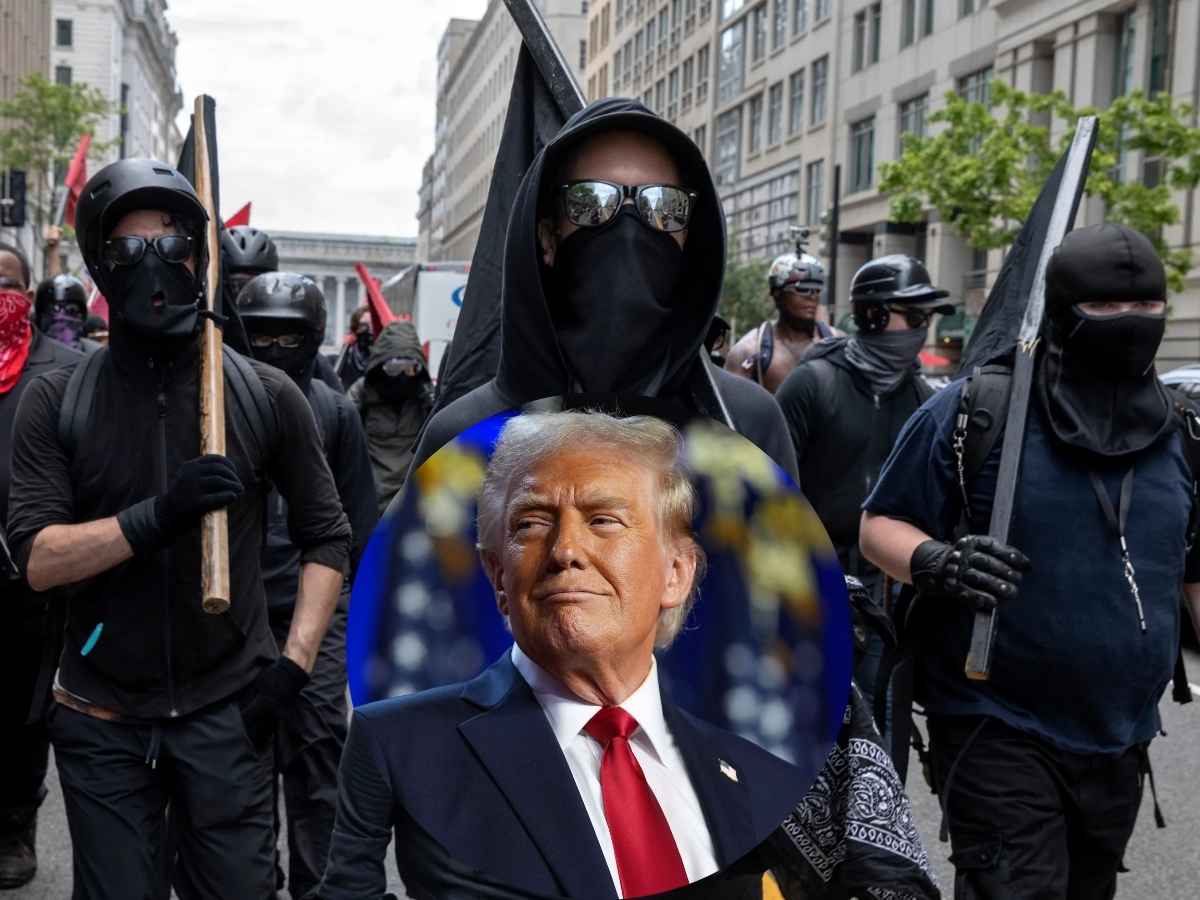
Donald Trump moves to label Antifa a terrorist group, spotlighting its militant anti-fascist roots and decentralized activist network. Photos: X.
US President Donald Trump on Wednesday announced his intention to designate Antifa – short for “anti-fascist,” a term used to describe a loose network of far-left activists – as “a major terrorist organization.” Trump has threatened to ban the organization since his first term.
The Trump administration has repeatedly blamed Antifa for instigating violence during demonstrations, accusing the group of “agitating attacks on police, inciting looting, and burning down businesses.”
Antifa is not a traditional organization but rather an ideology shared by a loosely connected collection of individuals. Mark Bray, a history professor at Dartmouth College and author of The Anti-Fascist Handbook (2017), describes Antifa as a movement that “wholeheartedly support[s] militant self-defense against the police and the targeted destruction of police and capitalist property.”
Bray states that Antifa operates without a centralized leadership or hierarchical chain of command, making it unlike conventional political groups.
Estimating Antifa’s size is difficult. Its members, Bray notes, range from Marxists and Leninists to social democrats and anarchists.
“It is impossible to ascertain the exact number of people who belong to Antifa groups because members hide their political activities from law enforcement and the far right, and concerns about infiltration and high expectations of commitment keep the sizes of groups rather small,” Bray wrote in a Washington Post op-ed on Monday.
Most organizing and fundraising occur across various social media platforms before activists gather from different locations for protests.
The followers of Antifa are recognized by their black clothing and masks, which hide their identities during protests. The movement’s volunteers even resort to confrontations that include property damage, viewing such actions as a form of political expression.
Antifa has its ideological lineage to early 20th-century European movements that fought fascism, including opponents of Benito Mussolini in Italy and Adolf Hitler in Germany.
In the United States, the modern movement emerged from Anti-Racist Action in 1987, which mobilized against neo-Nazi groups. One of the most prominent contemporary chapters, Rose City Antifa, was established in Portland in 2007.
Zubair Amin is a Senior Journalist at NewsX with over seven years of experience in reporting and editorial work. He has written for leading national and international publications, including Foreign Policy Magazine, Al Jazeera, The Economic Times, The Indian Express, The Wire, Article 14, Mongabay, News9, among others. His primary focus is on international affairs, with a strong interest in US politics and policy. He also writes on West Asia, Indian polity, and constitutional issues. Zubair tweets at zubaiyr.amin
PNG Gas: In a major policy shift, the Centre has tightened rules around domestic gas…
Apple has released iOS 26.4 with new features like AI playlists in Apple Music, offline…
Chennai Super Kings captain Ruturaj Gaikwad has cleared the air on the opening combination for…
