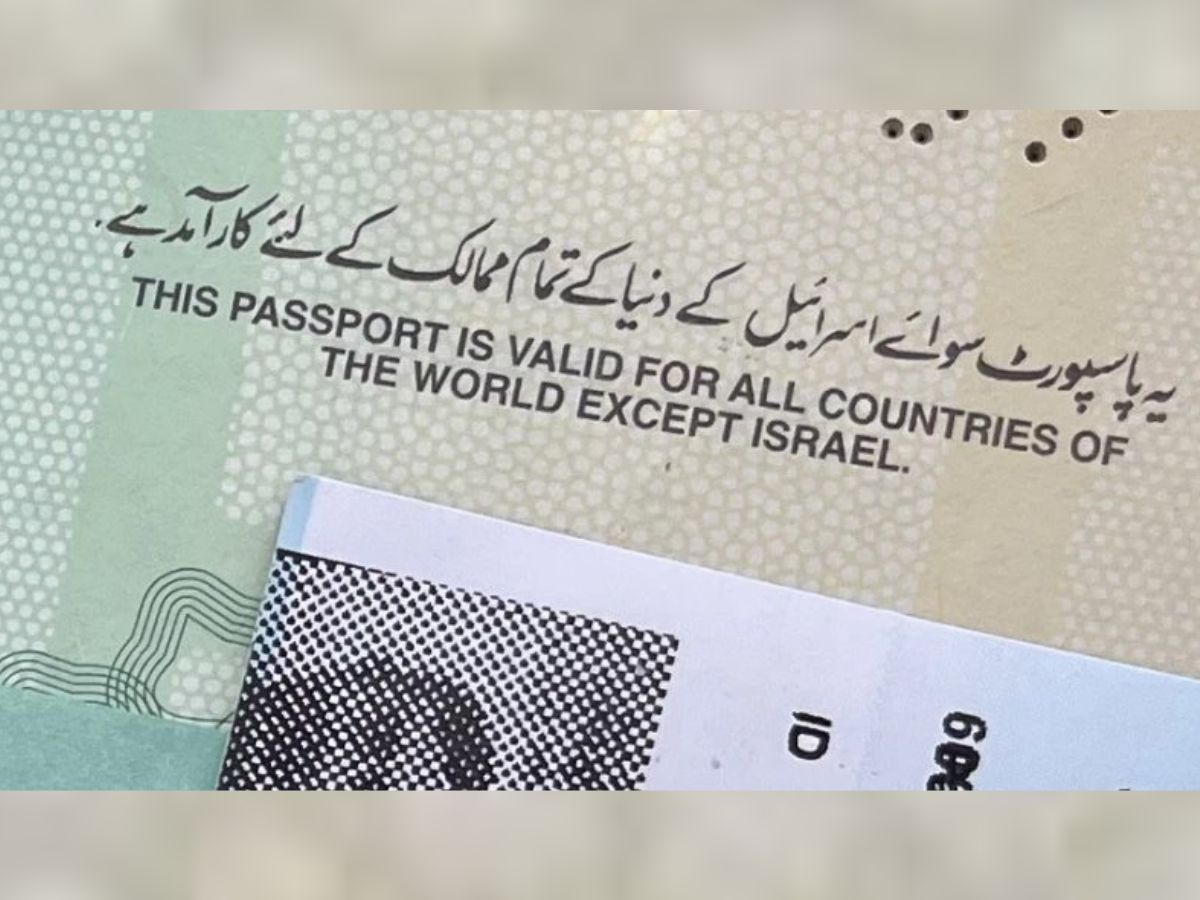
What Is Pakistan’s ‘Valid For All Countries Except Israel’ Passport Rule And Why Has Trump’s Statement Brought It Into Spotlight? (Via X)
Pakistan’s longstanding policy of refusing to recognise Israel has come under renewed attention after US President Donald Trump suggested that several Muslim-majority nations, including Pakistan, should normalise relations with Israel before any future peace agreement involving the United States and Iran. While Islamabad has not issued an official response through its government or foreign ministry, Pakistan’s Defence Minister Khawaja Asif firmly rejected the idea, arguing that Pakistan and Israel are separated by fundamentally different political and ideological positions.
In defending Pakistan’s stance, Asif pointed to a unique feature of the country’s passport policy, one that directly reflects its non-recognition of Israel.
Pakistan is one of the few countries whose passport carries the clause that it is valid for all countries of the world except Israel.
The statement recapitulates the official position of Islamabad of not recognising Israel as a sovereign state and lends to its long-standing support of the Palestinian cause. As a result, Pakistani passport holders cannot normally travel to Israel.
The restriction has remained in place for decades and remains a visible indicator of Pakistan’s foreign policy position.
Assuming Pakistan eventually decides to engage with Israel, for example through the Abraham Accords, the passport restriction would no longer be feasible.
Recognition of Israel would both be coupled with diplomatic ties, travel and visa arrangements, trade and official contacts. In that case it would be left as a policy inconsistency which the international passport holder would have to travel to all countries of the world except Israel.
Any future policy shift could therefore require amendments to passport documents and related travel rules.
Pakistan is not the only South Asian country to have adopted such a passport policy. Bangladesh also carried a similar “except Israel” clause in its passports for decades.
However, in 2021, Dhaka removed the wording from its travel documents while maintaining that its official policy towards Israel had not changed. The move demonstrated that passport language and diplomatic recognition do not always evolve simultaneously.
Defence Minister Khawaja Asif dismissed suggestions that Pakistan could join the Abraham Accords, saying such a move would conflict with the country’s core principles.
He also reiterated that Pakistan’s passports do not recognise Israel as a travel destination, underlining Islamabad’s continued support for Palestine.
Earlier this year, Pakistan’s Foreign Office also clarified that participation in international peace initiatives should not be interpreted as support for the Abraham Accords or any shift in its position on Palestine.
The Abraham Accords are a group of accords brokered by the United States that brought about diplomatic relations between Israel and several Arab nations. They were first announced while Donald Trump was president and represented a major diplomatic development in the Middle East. As a result of accepting the framework, the countries that signed on opened up to diplomatic relations, trade, tourism, and investment with Israel.
Recently, Trump has argued that more Muslim-majority states, especially those in the Gulf, should come on board as part of an ongoing bid to transform politics in the region and establish greater stability.
Despite renewed international discussion, there is currently no indication that Pakistan intends to alter its position on Israel. Government officials continue to maintain support for Palestinian statehood and have rejected suggestions of joining the Abraham Accords.
For now, the phrase “valid for all countries except Israel” remains a defining feature of Pakistani passports and a reflection of the country’s longstanding diplomatic stance.
Try these six desk exercises and stretches to relieve lower back pain fix your posture…
Motorola is facing controversy after reports claimed its phones secretly redirected Amazon app launches through…
US trade delegation will visit India from June 1–4 for key talks to advance interim…
