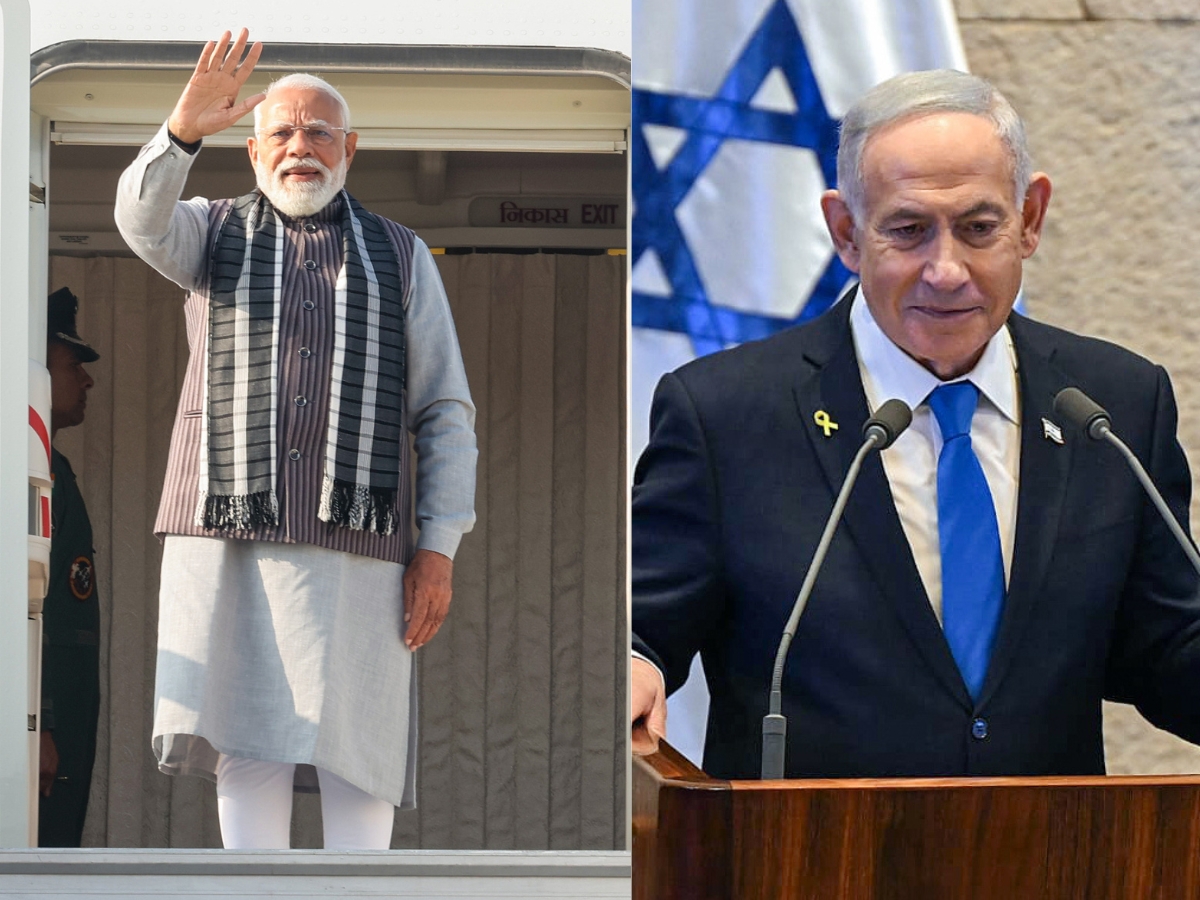
PM Modi Israel visit coincides with US F-22 deployment as Netanyahu unveils Hexagon alliance plan with India at centre.
Prime Minister Narendra Modi is on a two-day visit to Israel from February 25 to 26. At the same time, the United States has deployed its fifth-generation stealth fighter aircraft, the F-22 Raptor, to Israel, with the jets landing at an air base of the Israeli Air Force in southern Israel on Tuesday.
The timing of the deployment comes as PM Modi is scheduled to hold high-level engagements during his trip, including bilateral talks with Israeli Prime Minister Benjamin Netanyahu, an address at the Knesset, and interactions with the Indian diaspora.
“I look forward to my discussions with Prime Minister Netanyahu aimed at further strengthening our cooperation across various domains, including science and technology, innovation, agriculture, water management … defence and security, trade and investment, as well as people-to-people ties,” PM Modi said while leaving for Israel.
PM Modi’s trip, his second to Israel as Prime Minister, comes at Netanyahu’s invitation. According to India’s Ministry of External Affairs, the two leaders are “expected to exchange perspectives on regional and global issues of mutual interest.”
Ahead of PM Modi’s visit, Netanyahu unveiled a broad geopolitical concept he termed a “hexagon of alliances.” The proposal positions India as a central pillar alongside Israel, Greece and Cyprus, with the possibility of including select Arab, African and Asian countries.
The proposal was disclosed ahead of the visit in a statement issued by Israel’s foreign office on February 22.
The announcement comes amid elevated regional tensions, particularly between Israel and Iran. At the same time, Saudi Arabia and Pakistan formalised a Strategic Mutual Defence Agreement in September 2025, a pact some analysts have compared to an “Islamic NATO,” with Turkey signalling possible interest.
Netanyahu’s proposal is widely viewed as a strategic response to this evolving geopolitical landscape.
In the February 22 statement, Netanyahu framed the idea as an effort to replicate what he described as Israel’s “victories” against the “Shia axis,” also known as the “axis of resistance,” an informal Iran-backed network of groups opposed to Israeli and Western influence in the Middle East.
Explaining his vision, Netanyahu said, “In the vision I see before me, we will create an entire system, essentially a ‘hexagon’ of alliances around or within the Middle East.”
He added, “The intention here is to create an axis of nations that see eye to eye on the reality, challenges, and goals against the radical axes, both the radical Shia axis, which we have struck very hard, and the emerging radical Sunni axis.”
So far, no government has publicly endorsed the proposal.
According to observers, India may adopt a cautious stance on joining the alliance. As a founding member of the Non-Aligned Movement, New Delhi has historically avoided rigid bloc politics while maintaining engagement with multiple global powers, including China, Russia and the United States.
India also maintains strong relationships across the Gulf region, which hosts a large Indian diaspora that sends billions of dollars in remittances annually. At the same time, New Delhi has close ties with Iran, often described as “civilisational,” while deepening strategic cooperation with Saudi Arabia.
These overlapping partnerships are likely to influence India’s approach, with New Delhi expected to balance its strategic interests carefully rather than committing fully to any single geopolitical bloc.
PM Modi’s visit is expected to centre on strengthening India-Israel relations across multiple sectors, including defence, technology, agriculture, water management, trade, and people-to-people ties.
Also Read: Defence, AI To Be On Centrestage: PM Modi To Embark On Two Day Visit To Israel From February 25
Zubair Amin is a Senior Journalist at NewsX with over seven years of experience in reporting and editorial work. He has written for leading national and international publications, including Foreign Policy Magazine, Al Jazeera, The Economic Times, The Indian Express, The Wire, Article 14, Mongabay, News9, among others. His primary focus is on international affairs, with a strong interest in US politics and policy. He also writes on West Asia, Indian polity, and constitutional issues. Zubair tweets at zubaiyr.amin
Ten-month executive education programme strengthens strategic readiness, executive presence & C-suite leadership pathways for women…
After Supreme Court Rap, NCERT Set To Drop Judicial Corruption Chapter From Textbooks: Sources
Judicial Corruption Topic to Be Deleted from NCERT Books Following Supreme Court Rap
A detailed office order outlining arrangements for Vivek Banzal’s planned Prayagraj visit triggered nationwide outrage…
