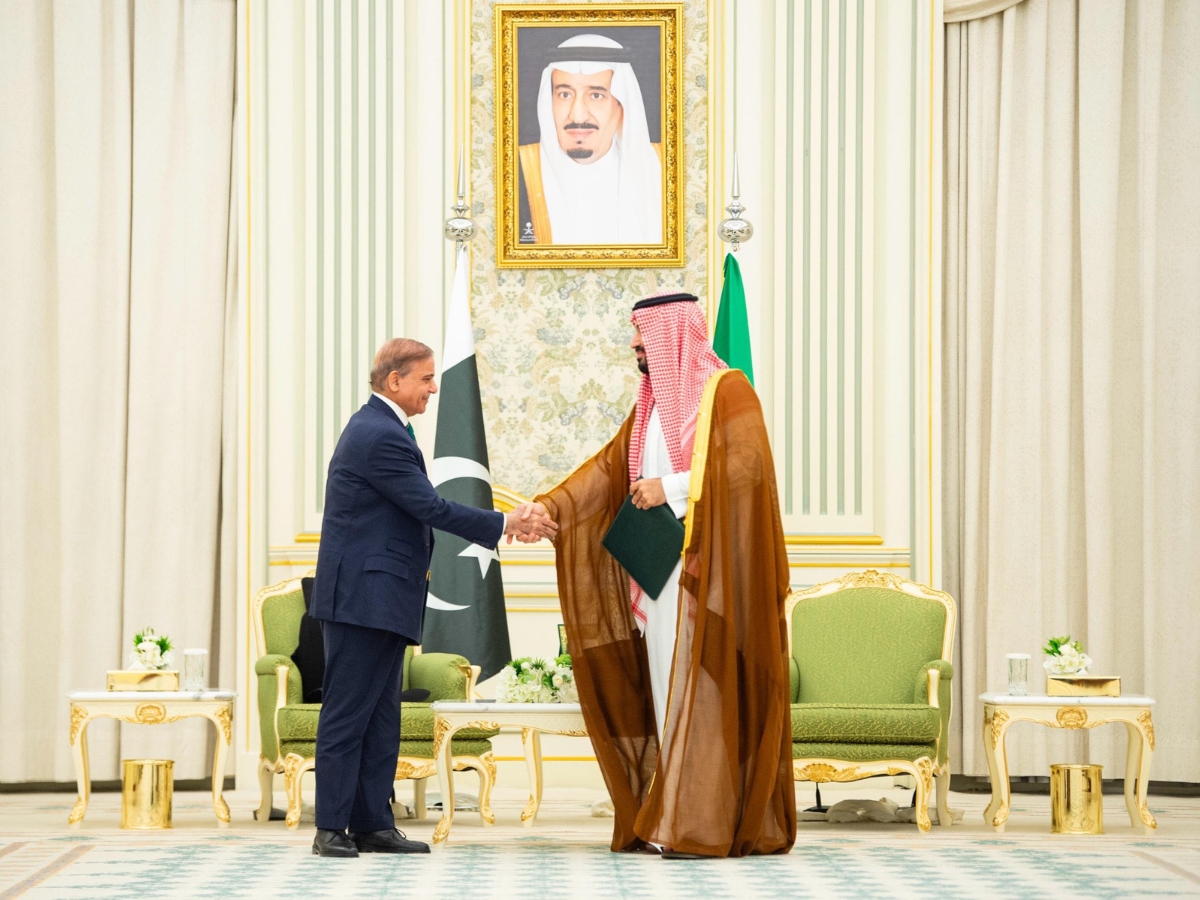
India studies Saudi-Pakistan defence pact declaring an attack on one as aggression on both amid rising South Asia tensions. Photo: X.
Pakistan and Saudi Arabia, on September 17, signed a mutual defence agreement under which an attack on either nation would be treated as an “aggression against both.” The pact has raised eyebrows across the world, including India, with New Delhi saying it is closely examining the pact.
Ministry of External Affairs (MEA) spokesperson Randhir Jaiswal confirmed that New Delhi had been tracking developments leading to the pact.
“We have seen reports of the signing of a strategic mutual defence pact between Saudi Arabia and Pakistan. The Government was aware that this development, which formalises a long-standing arrangement between the two countries, had been under consideration,” Jaiswal said in response to media queries.
He added that India would “study the implications of this development for our national security as well as for regional and global stability.” The statement further emphasised that the government remains committed to “protecting India’s national interests and ensuring comprehensive national security in all domains.”
The “Strategic Mutual Defense Agreement” was signed on Wednesday during Pakistani Prime Minister Shehbaz Sharif’s visit to Saudi Arabia at the invitation of Crown Prince Mohammed bin Salman.
According to a statement published by the Saudi Press Agency and cited by AFP, the agreement “aims to develop aspects of defence cooperation between the two countries and strengthen joint deterrence against any aggression.” It further states, “Any aggression against either country shall be considered an aggression against both.”
Also Read: India Reacts As Pakistan-Saudi Arabia Sign Major Defence Deal: ‘Studying, Aware Of The Development’
The defence pact comes just months after a four-day military conflict between India and Pakistan marked by drone and missile exchanges. That clash followed India’s Operation Sindoor strikes on May 7, launched in retaliation to the April 22 terrorist attack in Pahalgam. The operation targeted and destroyed key terror infrastructure inside Pakistan and in Pakistan-occupied Kashmir
South Asian analysts and commentators offered varied interpretations of the Saudi-Pakistani move.
“Pakistan has not only inked a new mutual defense pact, it inked it with a close ally that’s also a top partner of India’s,” said Michael Kugelman, a South Asia analyst.
“This pact would not deter India from attacking Pakistan. But with three key powers—China, Turkey, and now KSA – fully on Pakistan’s side, Pakistan is in a very good place.”
Strategic affairs expert Dr. Brahma Chellaney criticised the alliance sharply saying “Axis of terror backers: Saudi Arabia – once branded by Trump as ‘the world’s biggest funder of terrorism’- and Pakistan, the world’s most notorious state sponsor of terrorism, signed a mutual defense pact declaring that an attack on one is an attack on both.”
Former U.S. diplomat Zalmay Khalilzad raised broader security questions, “A potentially consequential step in Pakistan-Saudi relations has reportedly been announced, a mutual defense agreement (not on the level of a treaty, but it’s not clear if Saudi Arabia and Pakistan make a distinction between a treaty and an agreement) stating that any aggression against one country would be considered aggression against both.
“Was this in reaction to the Israeli attack on a target in Qatar? Or does this confirm long-standing rumors that the Pakistani nuclear weapons program is unofficially ‘co-sponsored’ by the Saudis? Does the agreement have secret annexes, and if so, what do those say? Is the agreement an indication of declining confidence in U.S. deterrence and defense on the part of Saudi Arabia and perhaps others? Pakistan has nuclear weapons and delivery systems that can hit targets across the Middle East, including Israel. It also is developing systems that can reach targets in the U.S. Many questions… dangerous times.”
Also Read: Saudi Arabia-Pakistan Defence Deal: Could Riyadh Use Pakistan’s Nuclear Weapons?
Zubair Amin is a Senior Journalist at NewsX with over seven years of experience in reporting and editorial work. He has written for leading national and international publications, including Foreign Policy Magazine, Al Jazeera, The Economic Times, The Indian Express, The Wire, Article 14, Mongabay, News9, among others. His primary focus is on international affairs, with a strong interest in US politics and policy. He also writes on West Asia, Indian polity, and constitutional issues. Zubair tweets at zubaiyr.amin
Ahmed Shehzad accused the board of prioritizing the "branding" of 6–8 specific players for the…
NHIDCL Recruitment 2026 Open For Multiple Roles, Check Key Details Here
The National Highways & Infrastructure Development Corporation Limited (NHIDCL), under the Ministry of Road Transport…
A U.S. court sentenced Indian-origin Sital Singh to four years in prison for his role…
