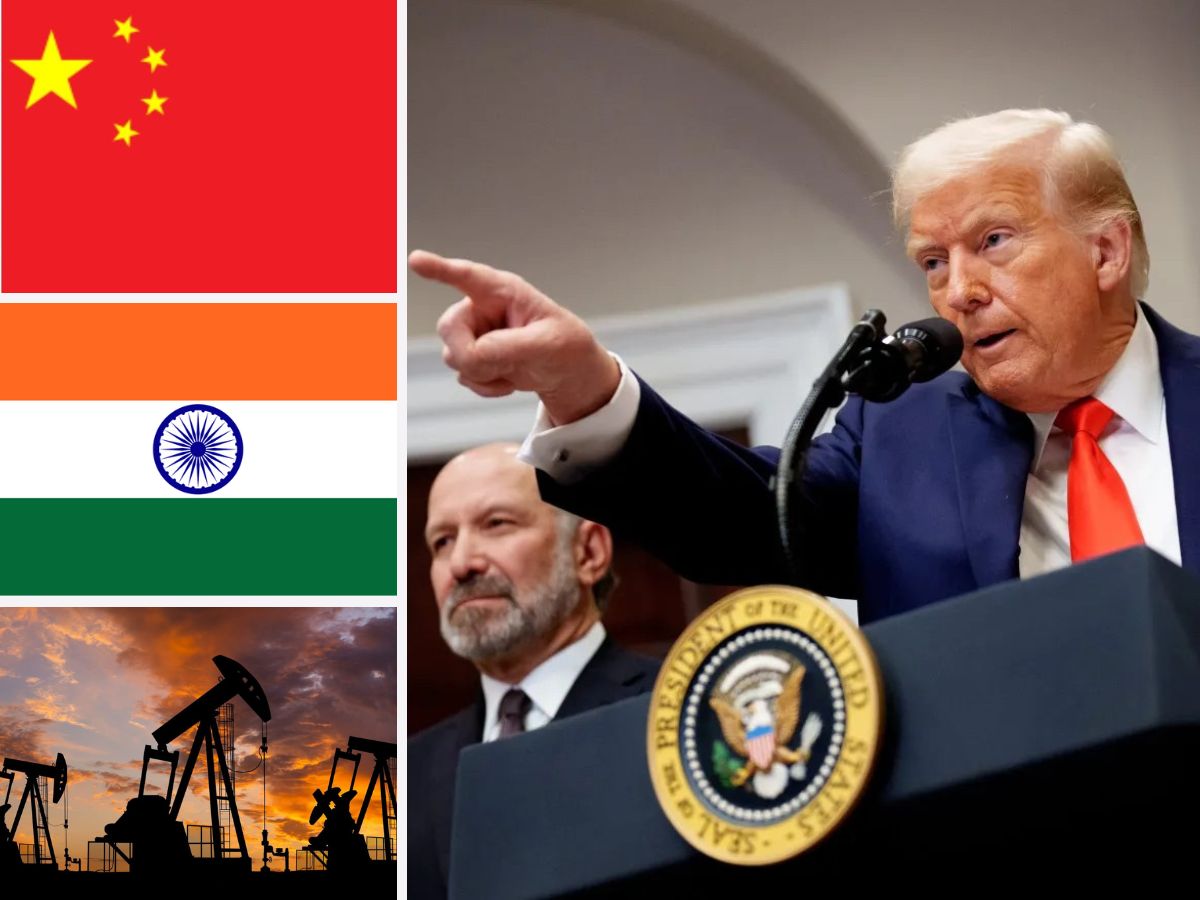
In the ever-evolving landscape of global trade pressures, one question remains crucial in understanding the current geopolitical standoff between the United States and China: Why is the US hesitant to impose tariffs on China for importing Russian oil, mainly after its significant tariffs on Chinese goods in 2018?
Is the rare earth element (REE) market, which China controls, persuading US decision-making? Or is President Donald Trump merely biding his time for a strategic moment? This explainer decodes the complex changing aspects of oil imports, tariffs, and China’s rare earth advantage, shedding light on why the US is unwilling to take action against one of its largest opponents despite growing global worries over Russian oil exports.
The Context: Trump’s 2018 Tariff War
The origins of this trade standstill can be outlined back to President Trump’s aggressive tariff policies during his first term in office, starting in 2018. Confronted with what he considered unfair trade practices by China, specifically the trade deficit with the US, Trump started a series of retaliatory tariffs on Chinese goods.
By the time the US-China trade conflict was in full swing, over $370 billion in Chinese goods were subject to added tariffs. These tariffs were a straight attempt to level the playing pitch, control China’s industrial intelligence, and, in Trump’s words, end China’s “unfair trade practices.”
At the heart of these tariffs was a two-fold strategy: spread on economic pressure while aggressively pushing for structural restructurings in China’s economic model. Specifically, the US accused China of using its currency, stealing intellectual assets, and striking unfair barriers on US businesses functioning within its borders.
Fast forward to 2023, Trump’s tariffs on Chinese goods remains a crucial feature of the US-China trade partnership. While the US has moved back some of these tariffs, China’s huge import of Russian oil has raised new worries, mainly after Russia’s invasion of Ukraine in 2022.
The US, alongside its European allies, has executed various sanctions against Russia, but then again China, as the largest consumer of Russian oil, has largely escaped direct sanctions.
The Current US Strategy: Tariffs on Russia but Not on China
In August 2023, Trump declared that he would enforce a 50% tariff on Indian exports to the US, mentioning India’s continued trade ties with Russia, particularly in oil. The rationale was clear, Russia’s attack of Ukraine posed a “national security threat” to the US, and any country remaining to buy Russian oil was, in essence, undermining Western approvals and backing up Russia’s war efforts. India, though historically a Russian ally, was singled out for its cumulative oil imports from Russia, which have increase significantly since the beginning of the war.
Also Read: Starting Sept 1: These 5 Financial Rules Could Blow Your Budget? LPG, ATM Fees, What Else?
Though, in spite of China’s position as the world’s major importer of Russian oil, importing 109 million tonnes in 2022 alone, the US has therefore far abstained from imposing tariffs on Chinese oil imports. This increases a significant question: Why is China, a country that has constantly resisted US pressure and remains to reinforce Russia’s oil market, not facing the same tariffs?
The Rare Earth Factor: China’s Strategic Advantage
The vital cause behind the US’s unwillingness to focus on China with extra tariffs lies in the strategic value of these rare earth elements, also known as REEs. These critical minerals, which comprise of 17 metals used in the manufacturing of critical products, like smartphones, electric vehicles, and military systems, are controlled by China.
From 1990s, China has controlled about 85-95% of the international rare earth supply, giving it substantial leverage over the US and its partners. Rare earth elements are vital for many sectors, especially defence and clean energy, where China regulate most of the supply chain in a strong negotiating position. For example, electric vehicle (EV) batteries, wind turbines, and military jets all need rare earths for production.
In 2010, China for the time being suspended rare earth exports to Japan in a diplomatic clash over the Senkaku Islands, giving the world an indication of China’s capability to manipulate the global supply chain. This change distressed the US, which depend on on Chinese REEs for high-tech industries. Any interruption in the flow of these resources would have shattering consequences for American technology businesses and defense servicers.
In April 2025, China heightened tensions again by imposing export limitations on certain rare earths, further showcasing its effect over this critical market. The US, still deeply reliant on Chinese rare earths, faces a dilemma, hitting back to China by imposing tariffs on its oil imports would endanger the already fragile supply chain of rare earths, which could cripple US industrial production and defense manufacturing.
Trump’s Strategic Pause: Timing the Next Move
In spite of the gravity of the circumstances, Trump has not taken instant action on Chinese oil imports from Russia, choosing instead for a “wait-and-see” approach. Through a press briefing in August 2023, he commented that he did not directly need to consider reciprocal tariffs against China but hinted that he may do so in two to three weeks.
Also Read: Does NVIDIA Meet Investor Expectations? Q2 FY26 Earnings Display Amazing AI Growth
This interruption raises significant questions: Is Trump waiting for the right diplomatic instant, or is he trying to abstract more concessions from China in other areas, such as rare earth trade or anything else?
China’s geopolitical placement in the ongoing Russia-Ukraine war confuses matters further. While the US has pursued to isolate Russia over sanctions, China has preserved its support for Russia, although in a measured way. By remaining Russian oil importer, China is fundamentally resisting the global sanctions regime but at the same time safeguarding that it doesn’t directly provoke the US hooked on a complete trade war. A tariff on Chinese oil imports might drive China closer to Russia, worsening tensions in an existing unstable region.
Why India Was Targeted: A Separate Strategy?
India’s situation is different from China’s for numerous reasons. India, in spite of being a significant partner of Russia, has been trying to continue a neutral position on the Russia-Ukraine war. Though, India’s constant import of cheap Russian oil has made it an easy target for the US, particularly as oil prices have turn out to be a significant global issue. India’s efforts to sell back Russian oil to other countries also augmented the anger of the US, as emphasized by US Treasury Secretary Scott Bessent’s remarks regarding India’s “profiteering” from cheap Russian oil.
By concentrating on India, the US seems to be sending a message to other nations, including China, that it will not accept continued support for Russia’s war practices. Nevertheless, any change against China would probably have extensive consequences, both in terms of trade and rare earth supply chains, which is why the US is stepping carefully.
Also Read: Vikran Engineering IPO Day 2: NIIs Rushing In, Should You Follow The Crowd Or Stay Careful?
Ankur Mishra is a journalist who covers an extensive range of news, from business, stock markets, IPOs to geopolitics, world affairs, international crises, and general news. With over a decade of experience in the business domain, Ankur has been associated with some of the reputed media brands. Through a sharp eye on global marketplaces along with deep insights and analysis of business strategies, Ankur brings simplicity to the complex economic matrix to decode market trends and empower people.
He is committed to entrenched data, facts, research, solutions, and a dedication to value-based journalism. He has covered trade tariff wars, international alliances, corporate policies, government initiatives, regulatory developments, along with micro- and macroeconomic shifts impacting global fiscal dynamics.
A bomb threat at Dick's Sporting Goods in Canton Marketplace, Georgia, triggered evacuations and heavy…
The Coyote Flats Fire near Rockerville, Rapid City, has grown to 30–50 acres amid hot,…
Dhurandhar 2 sees Ranveer Singh as Hamza navigating Karachi’s criminal underworld in Aditya Dhar’s intense,…
