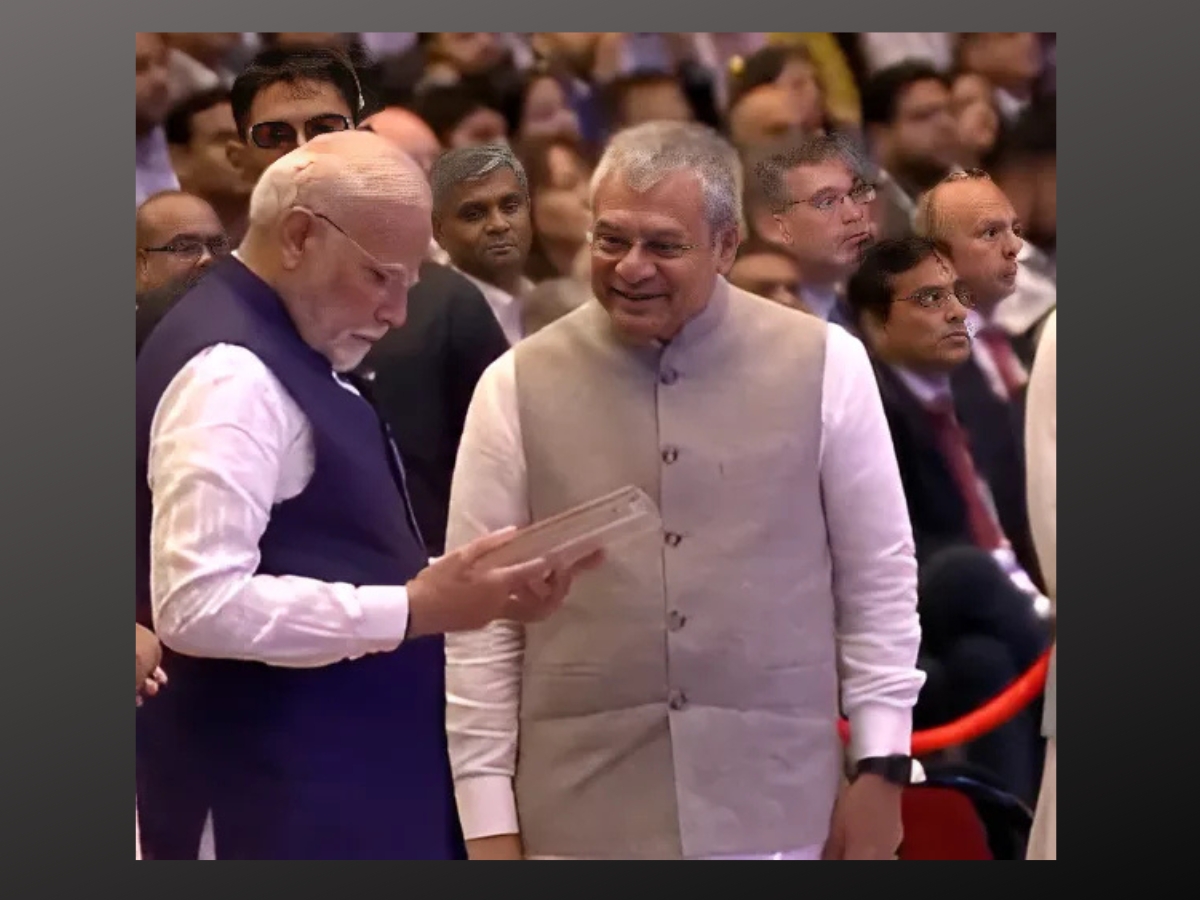
PM Modi receives Vikram 32-bit processor from Ashwini Vaishnaw at Semicon India 2025. Photo/X-ANI.
Vikram Semiconductor Chip: Union IT minister Ashwini Vaishnaw on Tuesday presented the first made-in-India chip to Prime Minister Narendra ModiVaishnaw presented the Vikram 32-bit processor and test chips of four approved projects to PM Modi.
Prime Minister Narendra Modi inaugurated the fourth edition of the ‘Semicon India’ in the national conference and delivered a strong message that the world trusts India and is ready to build the semiconductor future with India. Noting the presence of dignitaries at the conference, including experts and representation of more than 40-50 countries as well as India’s youth power, PM Modi said, “Today am here with the confidence that the world trusts India, the world believes in India and the world is ready to build the semiconductor future with India.”
The Vikram processor is developed by the Semiconductor Lab of the Indian Space Research Organisation (ISRO). It is India’s first fully indigenous 32-bit microprocessor designed to withstand the harsh conditions of launch vehicles.
The fabrication and packaging of the processor were carried out at the Semiconductor Hub in Mohali, Punjab.
The first large-scale rollout of the ‘Made in India’ chip is expected to be handled by CG-Semi at its Outsourced Semiconductor Assembly and Test (OSAT) pilot facility in Sanand, Gujarat.
The Modi government had approved the first proposal for a semiconductor unit in Sanand in 2023.
Through the Design Linked Incentive (DLI) scheme, 23 chip design projects have been sanctioned to support startups and innovators.
Companies such as Vervesemi Microelectronics are already developing advanced chips for defence, aerospace, electric vehicles, and energy systems.
The Vikram 32-bit microprocessor incorporates a custom instruction set architecture and supports the Ada programming language, which is widely recognised for its reliability in critical systems such as satellites, air traffic control, and launch vehicles.
It also features floating-point computation capability, enabling complex mathematical calculations for applications such as spacecraft trajectory prediction, sensor data analysis, and 3D graphics rendering.
According to ISRO, the processor is compatible with open-source software toolsets and comes with a proprietary simulator as well as an Integrated Development Environment (IDE). It has also been successfully tested with flight software, ensuring readiness for practical applications.
‘Semicon India – 2025’, the three-day conference is aimed at catalysing India’s Semiconductor ecosystem and will focus on advancing a robust, resilient, and sustainable semiconductor ecosystem in India.
The conference features sessions on the progress of the Semicon India Programme, semiconductor fab and advanced packaging projects, infrastructure readiness, smart manufacturing, innovations in R&D and artificial intelligence, investment opportunities, state-level policy implementation, and other topics.
Over 20,750 attendees are expected to participate, including more than 2,500 delegates from 48 countries, over 150 speakers, including 50 global leaders, and more than 350 exhibitors. It will also include roundtable discussions from 6 countries, country pavilions, and dedicated pavilions for Workforce Development & Start-Ups, among others.
PM detailed the progress of the Semicon India program starting from 2021. “By the year 2023, India’s first semiconductor plant was approved. In 2024, we approved additional plants. In 2025, we cleared five additional projects. Overall, an investment of more than Rs 1.5 lakh crore is being made in ten semiconductor projects. This shows the world’s growing trust in India…We have implemented the National Single Window System. Through this, all the approvals from the Centre and the states are being received on a single platform. As a result, our investors are now freed from a significant amount of paperwork…”
The India Semiconductor Mission (ISM) was launched in 2021. In just three and a half years, the initiative has achieved substantial progress.
To date, the government has approved 10 semiconductor manufacturing projects across six states—Gujarat, Assam, Uttar Pradesh, Punjab, Odisha, and Andhra Pradesh—with a cumulative investment exceeding ₹1.60 lakh crore.
Further, he emphasised that in this industry speed is paramount and that “the less there is paperwork, the more there will be wafer work.”
“Our journey in this sector began late, but nothing can stop us now,” he said, adding that commercial chips would roll out of India this year.
(With inputs from ANI)
Also Read: New Semiconductor Forum Launched: Can It Turn India Into The World’s Next Chip Superpower?
Zubair Amin is a Senior Journalist at NewsX with over seven years of experience in reporting and editorial work. He has written for leading national and international publications, including Foreign Policy Magazine, Al Jazeera, The Economic Times, The Indian Express, The Wire, Article 14, Mongabay, News9, among others. His primary focus is on international affairs, with a strong interest in US politics and policy. He also writes on West Asia, Indian polity, and constitutional issues. Zubair tweets at zubaiyr.amin
A bomb threat at Dick's Sporting Goods in Canton Marketplace, Georgia, triggered evacuations and heavy…
The Coyote Flats Fire near Rockerville, Rapid City, has grown to 30–50 acres amid hot,…
Dhurandhar 2 sees Ranveer Singh as Hamza navigating Karachi’s criminal underworld in Aditya Dhar’s intense,…
