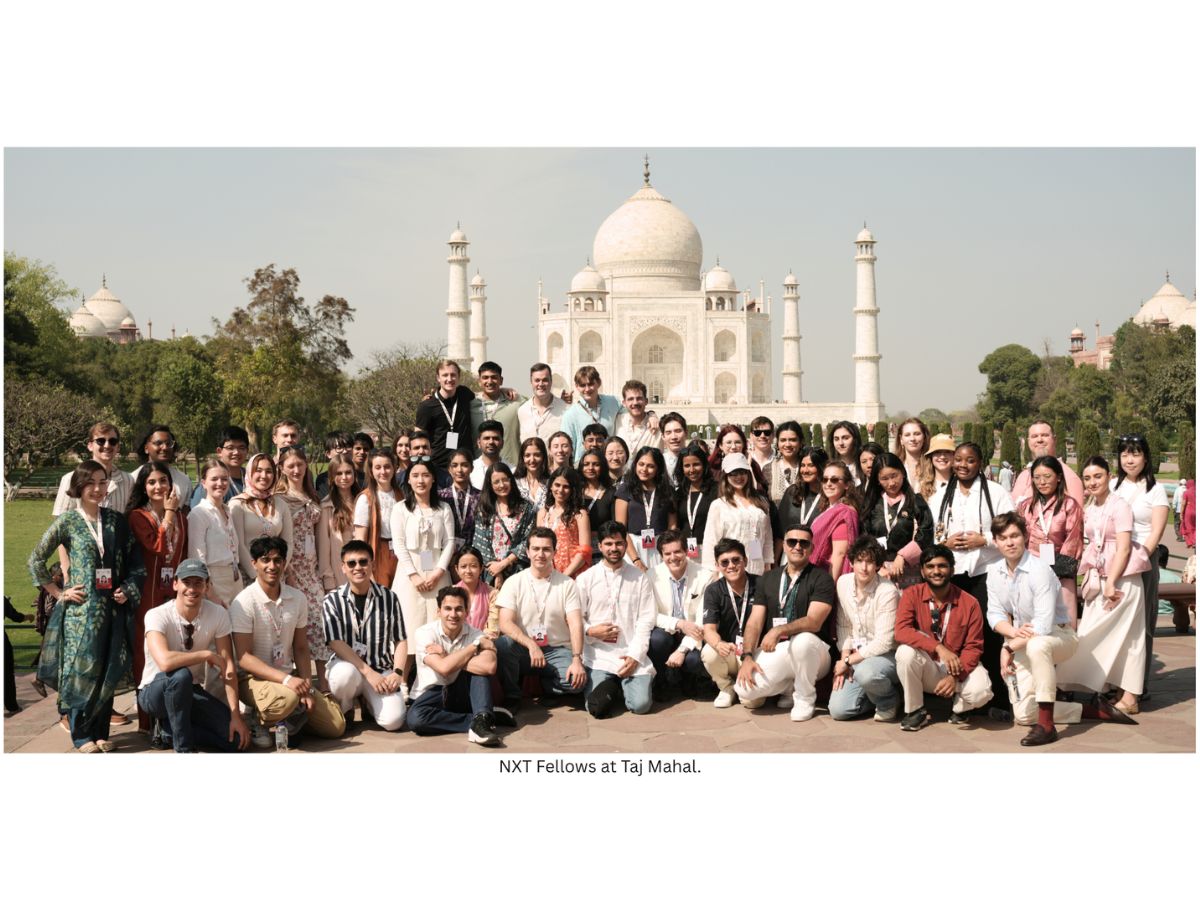
NXT Fellows at Taj Mahal.
To understand India’s future, the NXT Fellowship believes one must first understand its soul. The program’s cultural immersion journey took its inaugural cohort from the iconic Taj Mahal to the historic hills of Neemrana, providing a sensory-rich exploration of a country that is both an ancient civilisation and a modern powerhouse.
The fellows participating in this journey were a diverse group of 65 scholars from 37 universities across 21 countries, including Shreya Radhakrishan Deshmukh and Akshita Saxena from MIT Pune, Anoushka Sanjiv Rabha and Mith R Jain from IIT Madras, Rintaro Ando and Nicolatetsuyad’hautcourt Kawawa from the University of Tokyo, Mariia Anishchenko, Sofia Shergina and Anastasia Guseva from Higher School of Economics, Isabella Ridout from London School of Economics, Marianna Caballero Tuesca from Columbia Business School, Claire Julia Peterson from Stanford University, Ryland Prescott Pitts and Phuong Mina Cao from The Fletcher School, Bess Hooper and Brody Lane Rogers from the UC Berkeley, and Schwarzman Scholars Bradley James Jardine, Nina Olivia Gohel, Rowan Humphreys.
These students, nominated by prestigious institutions, were invited to look past the headlines and experience India’s traditions firsthand. Whether through a yoga session led by Dr. Tanu or a sound bathing experience, the scholars were introduced to India’s longstanding wellness traditions as a foundation for modern life.
The experience reached a high point at Neemrana, where a specially curated Bharat Bazaar introduced fellows to the art of Indian craftsmanship. The scholars didn’t just observe; they participated:
They learned the art of Pagdi (Safa) tying, exploring how headgear symbolizes identity and honour.
They engaged with Ittar perfume traditions from Kannauj, creating their own fragrance blends.
They explored Chhappa, the centuries-old technique of hand-block printing, and Mehendi body decoration.
In the ‘Chai’ corner, they curated personalised tea and coffee blends, sourced from Assam and South India.
Guided by historians and cultural experts, the fellows explored how India’s past is not a relic, but a foundation for its future. By the time they participated in the evening’s traditional cultural performances, the 65 scholars had moved beyond the tourist gaze, gaining a visceral, human connection to the traditions that continue to fuel India’s modern identity.
Accompanied by historians like Hindol Sengupta, who discussed India as a “civilisational state,” the fellows gained a deeper appreciation for how cultural and philosophical traditions continue to shape India’s modern identity.
The journey culminated in a visit to the Taj Mahal on March 11, offering a moment of quiet reflection on India’s architectural legacy. By experiencing the “Bharat Bazaar” and the wonders of Agra, these 65 global minds returned home with a piece of India’s heart.
Second Lady Usha Vance reveals she doesn’t always agree with Vice President JD Vance, stressing…
Actor Sayani Gupta has ventured into production with the launch of her banner, Sayani Gupta…
Kharg Island is Iran’s key oil lifeline handling most exports, and while Donald Trump sees…

