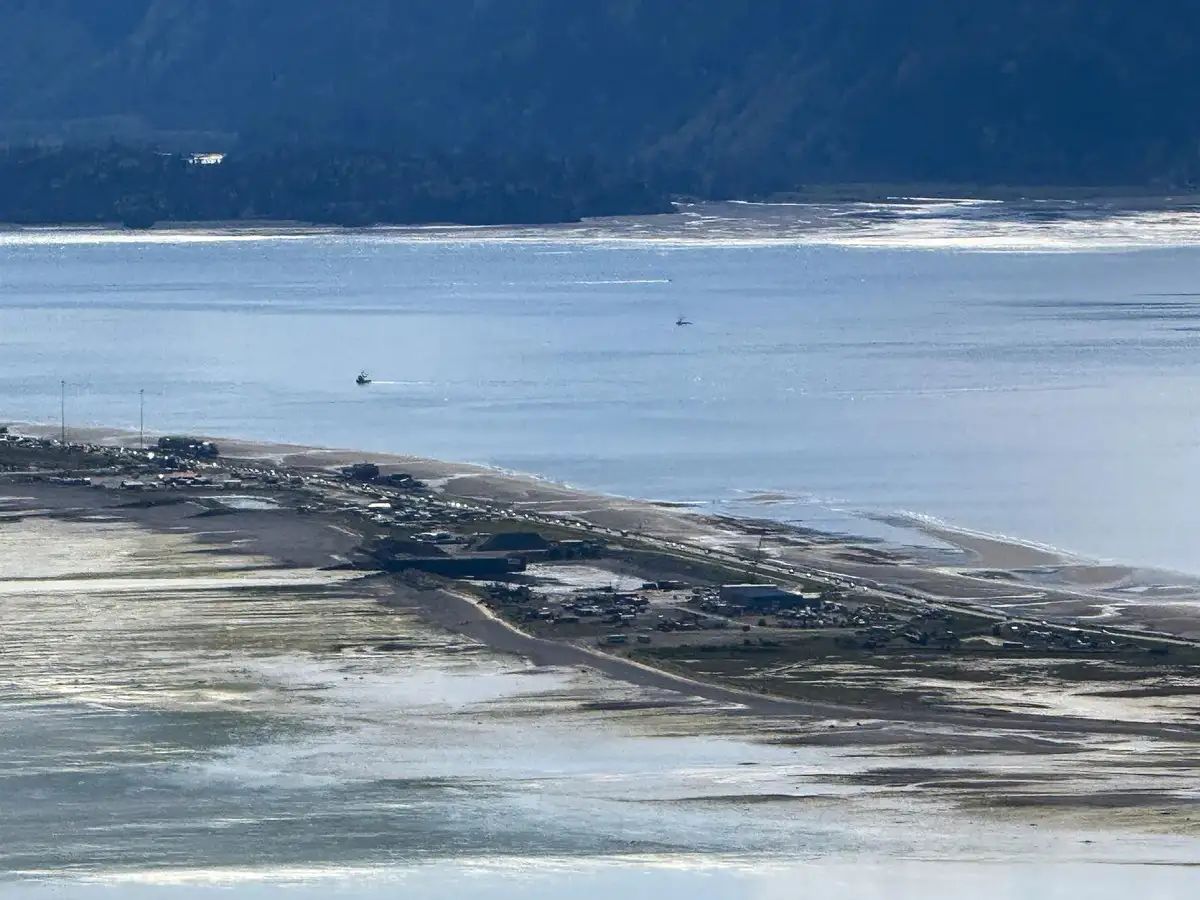
7.3 magnitude earthquake strikes off Alaska coast, triggers tsunami warning for South Alaska and Alaska Peninsula. Photo/X.
Alaska Earthquake: A strong earthquake of magnitude 7.3 struck off the coast of Alaska on Wednesday, leading authorities to issue a tsunami warning for various parts of southern Alaska and the Alaska Peninsula.
According to the US Geological Survey (USGS) the epicenter of earthquake was located about 54 miles (87 kilometers) south of Sand Point, a small island town in Alaska and occurred at approximately 12:37 p.m. local time (2037 GMT). The agency said that the quake originated at a relatively shallow depth of 20.1 kilometers beneath the ocean floor triggering strong currents.
Following the quake, the National Tsunami Warning Center in Palmer, Alaska, confirmed a tsunami had been generated and warned of expected impacts. The warning covered “South Alaska and the Alaska Peninsula, Pacific coasts from Kennedy Entrance, Alaska (40 miles southwest of Homer) to Unimak Pass, Alaska (80 miles northeast of Unalaska),” according to the center.
“A tsunami has been confirmed and some impacts are expected,” the warning stated, urging coastal communities in the region to remain alert.
According to NOAA, tsunamis are a series of powerful currents caused by the sudden displacement of a large volume of water in the ocean . The most common cause for the generation of tsanumis is large earthquakes which occur below or near the ocean floor. The earthquake shifts the seabed vertically and displaces the water above leading to the tsunami.
Almost 80% of all tsunamis that generate worldwide are triggered by the earthquakes. When the seafloor moves abruptly due to earthquake, either rising or droppin, it pushes the overlying water, creating waves that travel quickly in all directions across the ocean.
It is not that every earthquake lead to a tsunami. For a tsunami to form, the earthquake must be stronger enough and shallow enough beneath the ocean floor to cause vertical displacement of the seabed significantly.
Also the type of earthquake matters whether it will trigger a tsunami or not. Earthquakes, which cause vertical movement of the seabed like thrust quakes, are far more likely to generate tsunamis compared to the strike-slip earthquakes, which cause the horizontal movement of the seabed.
However, there have been cases where large strike-slip earthquakes, above magnitude 8, have created small tsunamis due to secondary effects such as underwater landslides.
NOAA’s Pacific Tsunami Warning Center categorizes earthquakes of different magnitudes and the ability to generate tsunamis:
According to the agency, earthquakes of magnitudes below 6.5 very unlikely to trigger tsunamis.
Quakes of magnitudes 6.5 to 7.5 usually do not produce destructive tsunamis but might cause small sea level changes near the epicenter. Damage-causing tsunamis are rare and often result from secondary events like landslides.
Magnitudes 7.6 to 7.8 earthquakes may produce destructive tsunamis near the epicenter; smaller waves can be observed farther away. Large distant damage is uncommon.
While as magnitude 7.9 and greater create destructive local tsunamis are possible, with significant sea level changes and damage over a broader area. A magnitude 9.0 earthquake may also trigger aftershocks above magnitude 7.5, increasing tsunami risk.
1. Sumatra, Indonesia, December 26, 2004
A 9.1-magnitude earthquake struck off Sumatra’s coast at about 30 kilometers depth. The fault zone was roughly 1,300 km long, causing several meters of vertical displacement of the seabed resulting in a tsunami which was 50 meters high and traveled as far as 5 km inland near Meulaboh, Sumatra.
2. North Pacific Coast, Japan , March 11, 2011
A 9.0-magnitude earthquake at a depth of 24.4 km triggered a tsunami with waves as high as 10 meters traveling at 800 km/h along Japan’s east coast. The tsunami killed more than 18,000 people and displaced approximately 452,000. The quake also caused a nuclear emergency at the Fukushima Daiichi power plant, leading to radioactive leaks. The World Bank estimated the financial cost at $235 billion, with recovery expected to take up to five years.
3. Lisbon, Portugal, November 1, 1755
An 8.5-magnitude earthquake caused three massive tsunami waves up to 30 meters high that struck coastal towns in Portugal and southern Spain. The waves reached as far as Carlisle Bay in Barbados, rising 1.5 meters. The combined effects of the earthquake and tsunami killed an estimated 60,000 people across Portugal, Morocco, and Spain.
Also Read: Massive Earthquake Of Magnitude 7.2 Shakes Alaska Peninsula, Tsunami Warning Issued
Zubair Amin is a Senior Journalist at NewsX with over seven years of experience in reporting and editorial work. He has written for leading national and international publications, including Foreign Policy Magazine, Al Jazeera, The Economic Times, The Indian Express, The Wire, Article 14, Mongabay, News9, among others. His primary focus is on international affairs, with a strong interest in US politics and policy. He also writes on West Asia, Indian polity, and constitutional issues. Zubair tweets at zubaiyr.amin
Pete Hegseth warned that Iran will face another round of major US strikes, signalling a…
Iran’s strike on Qatar’s Ras Laffan LNG hub amid escalating Middle East tensions has triggered…
West Bengal BJP 2nd Candidate List 2026: BJP releases 2nd Bengal list with 111 names;…
