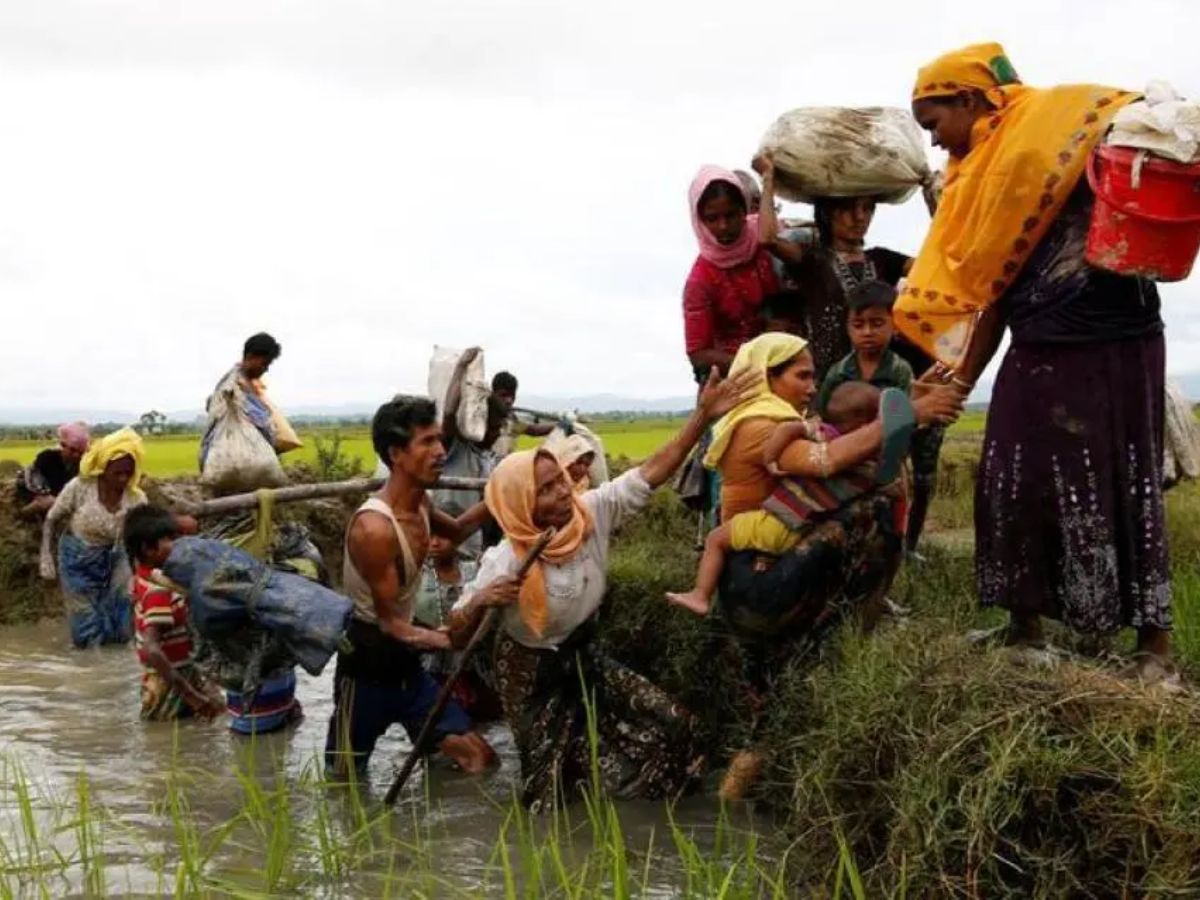
SC to decide if Rohingya, Myanmar’s persecuted Muslim minority, are refugees or illegal migrants in key deportation case. Photo/X.
The Supreme Court of India on Thursday started hearing a batch of petitions to establish whether the members of the community are refugees or illegal migrants. The top court is hearing several petitions that challenge the deportation of Rohingya migrants and question their legal status.
A three-judge bench headed by Justice Surya Kant began by framing the pivotal legal issue, “the first major issue is whether they are refugees or illegal migrants. The rest is consequential.”
The bench also comprised Justices Dipankar Datta and N Kotiswar Singh.
Justice Surya Kant clarified, “if they are refugees, they are entitled to certain protections under law. If not, they are illegal migrants and should be deported back to their country.”
The court heard a batch of 22 cases involving the deportation of foreigners either held in detention camps or claiming refugee status. The bench ordered that cases involving Rohingya migrants be grouped separately for focused hearing, with other foreign nationals’ cases to be heard independently.
UN Secretary-General António Guterres has described Rohingyas as “one of, if not the, most discriminated people in the world.” The community is an ethnic minority predominantly that resides in Myanmar’s Rakhine State. In the earlier part of 2017, their population in Myanmar was estimated at around one million.
The Rohingya community has its own language and cultural traditions and traces its ancestry to Arab traders and other groups who settled in the region generations ago. Rohingya Muslims is the largest Muslim population in Myanmar.
However, the Myanmar government which is mostly a Buddhist country, did not recognize the Rohingya as citizens or as a distinct ethnic group, according to BBC reports.
Reports claim that the Rohingya were excluded by Myanmar from its 2014 national census. Observers say that the government regards Rohingya as illegal immigrants originating from Bangladesh.
Since the 1970s, the Rohingya have fled Myanmar in large numbers amid recurring violence and persecution. Official population estimates often undercount them, while independent figures suggest higher numbers.
The most recent and severe crisis began on August 25, 2017, when Rohingya militant group Arsa launched coordinated attacks on more than 30 police posts. The Myanmar military responded with a brutal crackdown, backed by local Buddhist mobs, that involved widespread killings, arson, and other human rights abuses.
Thousands of Rohingya survivors fled across the border into Bangladesh, describing harrowing attacks, village burnings, and mass violence. According to medical charity Médecins Sans Frontières (MSF), at least 6,700 Rohingya, including 730 children under five, were killed within the month following the violence outbreak.
Human rights organizations have documented extensive abuses against the community. Amnesty International has reported on the rape and sexual abuse of Rohingya women and girls by Myanmar forces, while satellite imagery analyzed by Human Rights Watch confirmed the partial or total destruction of at least 288 villages in northern Rakhine state.
An estimated 40,000 Rohingya reside in India, with at least 20,000 registered as refugees with the United Nations High Commissioner for Refugees (UNHCR).
India does not have a dedicated national law or policy on refugees and is not a signatory to the 1951 UN Refugee Convention or its 1967 Protocol, which protect refugees’ rights and prohibit forced returns to danger zones.
The Rohingya in India predominantly live in urban centers such as Hyderabad, Jammu, Nuh, and Delhi. One Rohingya-led organization has identified more than 90 refugee settlements across the country. Hyderabad, with a significant Muslim population, hosts the largest concentration, with approximately 7,200 Rohingya spread across 32 slum-like camps.
The Rohingya population in India consists of those who fled earlier waves of persecution and those who escaped deteriorating conditions in Bangladesh’s refugee camps. Between 2012 and 2016, about 13,000 Rohingya refugees entered India, mostly from Bangladesh.
Nearly one million Rohingya now live in the world’s largest refugee camp in Bangladesh. Tens of thousands reside in other Southeast Asian countries including Malaysia, Indonesia, and Thailand.
While the Bangladesh camps have received extensive international coverage, the Rohingya refugees in India remain less publicly documented but is gaining judicial and public attention through ongoing court proceedings.
Also Read: Seven Bangladeshi Nationals Pushed Back Amid Crackdown On Illegal Infiltration
Zubair Amin is a Senior Journalist at NewsX with over seven years of experience in reporting and editorial work. He has written for leading national and international publications, including Foreign Policy Magazine, Al Jazeera, The Economic Times, The Indian Express, The Wire, Article 14, Mongabay, News9, among others. His primary focus is on international affairs, with a strong interest in US politics and policy. He also writes on West Asia, Indian polity, and constitutional issues. Zubair tweets at zubaiyr.amin
Speculation around Dhurandhar 3 grows as director Aditya Dhar hints at expanding the franchise. With…
Popular YouTuber Saba Ibrahim, sister of television actor Shoaib Ibrahim and sister-in-law of actress Dipika…
Bihar Board Result 2026: Where And How To Check Class 10, 12 Scores
The Bihar School Examinations Board (BSEB) is expected to announce the Class 10 (Matric) and…
