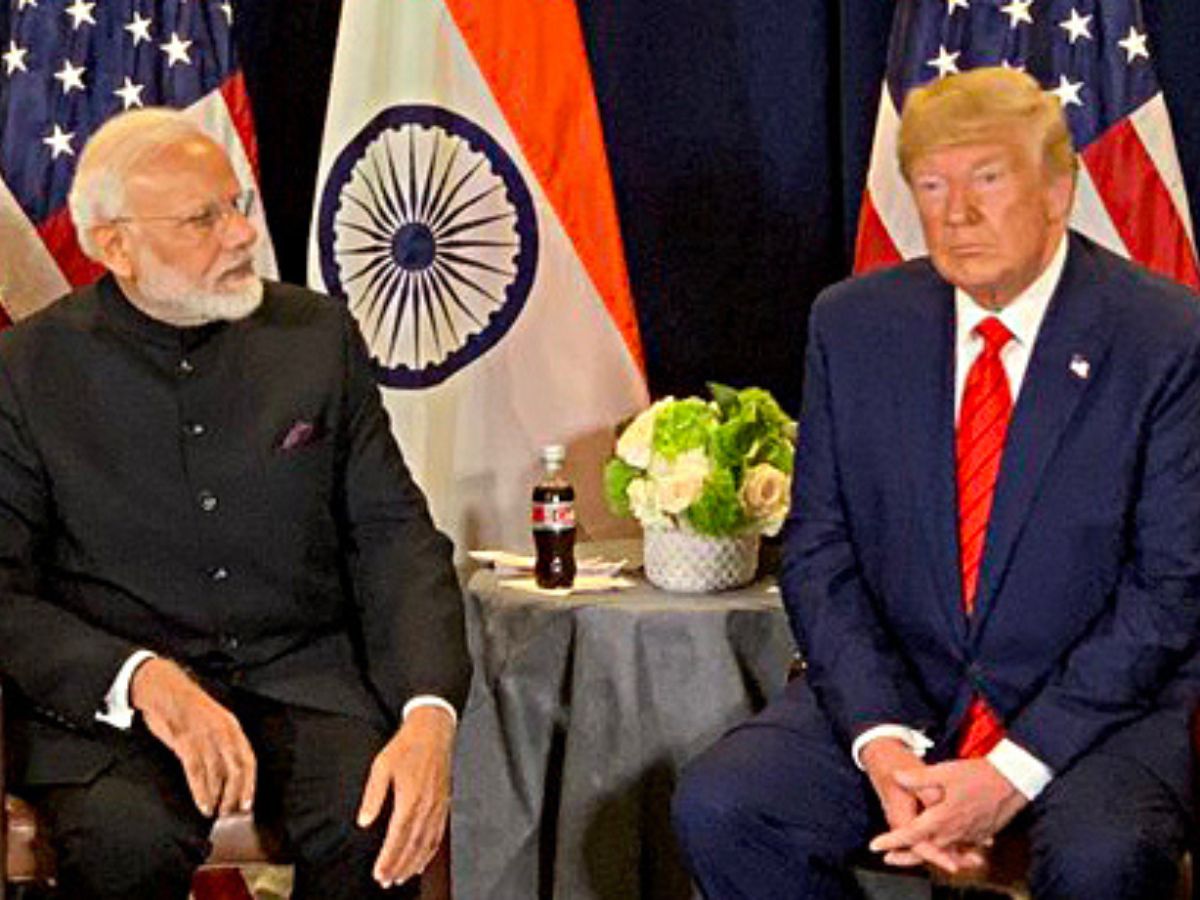
India counters Trump’s 50% tariffs with GST cuts and new trade deals to safeguard exporters. Photo/ANI.
US has imposed a 50 percent tariff on Indian exports, combining a 25 percent reciprocal duty with a 25 percent penalty linked to India’s 52.7 billion dollar Russian oil imports. The move, aimed at what Trump adminstration has said – pressuring Moscow over the war in Ukraine – impacts 60.2 billion dollars of India’s around 87 billion dollar exports to the US, striking hard at textiles, gems, jewelry, shrimp, and auto parts. Pharmaceuticals and electronics have been exempted for now, but officials warn a possible 200 percent tariff on drugs could follow.
The US Department of Homeland Security, in its official notice, said the levies were necessary in response to “threats to the United States by the Government of the Russian Federation.”
The tariffs will take effect at 9:31 pm IST on August 27, escalating trade tensions between New Delhi and Washington.
India is not alone. Other major economies are also facing higher tariffs.
China: 30 percent tariff on imports, though temporarily capped at 10 percent until August 12, 2025 during trade talks.
United Kingdom: Secured a favorable 10 percent tariff rate under a new US-UK trade deal.
Canada: Hit with 35 percent tariffs on non-USMCA goods from August 1, 2025, linked to border and fentanyl disputes.
European Union: General tariffs capped at 15 percent, but steel, aluminum, and copper face a steep 50 percent duty.
Mexico: Facing 25 percent tariffs, with a delayed increase to 30 percent after a 90-day reprieve.
Prime Minister Narendra Modi has called the move “unfair,” but vowed to protect national interests.
“India will bear the pressure,” he said, assuring exporters of government support.
Experts warn India’s GDP growth could dip between 0.3 and 0.8 percent, given the heavy reliance on exports to the US.
Also Read: How Is India Responding To Trump’s 50% Tariffs? Swadeshi Revival, Market Diversification And More
To counter the shock, New Delhi has rolled out a series of measures:
1. Historic GST Cut – The 12 percent and 28 percent GST slabs on exporters have been eliminated, making Indian textiles and leather more competitive against rivals like Bangladesh. This has already been implemented.
2. Rs 20,000 Crore Export Fund – Launching in September, this will provide working capital and trade finance for exporters hit by stalled US orders.
3. Interest Subvention Scheme – A COVID-style loan subsidy under the Interest Equalisation Scheme will help MSMEs absorb tariff costs.
4. Market Diversification – India is aggressively shifting focus to the EU, UK, UAE, and ASEAN, funding compliance support and e-commerce hubs to tap demand for textiles, chemicals, and auto parts.
India is moving to reduce dependence on the US market by diversifying its trade.
UK – The India-UK FTA, signed July 24, 2025, grants duty-free access to 99 percent of Indian exports, with trade projected to hit 120 billion dollars by 2030.
EU – A trade pact effective October 1, 2025, cuts tariffs on textiles and chemicals.
Australia – Under an economic agreement, 85 percent of Indian exports are tariff-free, with further negotiations underway.
Mercosur Nations (Brazil, Argentina, Paraguay, Uruguay) – India enjoys 10 to 100 percent tariff concessions on 450 lines.
UAE and Saudi Arabia – UAE offers zero tariffs on 99 percent of goods; Saudi Arabia remains India’s second-largest trade partner.
China – Modi’s planned visit could result in new trade agreements.
Russia – Moscow has offered India a 5 percent oil discount, and Modi is expected to meet President Vladimir Putin in Tianjin to expand trade ties, currently surging at 55 billion dollars.
India’s trade with the US in FY 2024-25 stood at 131.84 billion dollars, with 86.51 billion dollars in exports and 45.33 billion dollars in imports. Analysts estimate that the new tariffs could cause a 10 percent disruption, amounting to a 13 billion dollar immediate hit.
Industry leaders say exporters require four immediate interventions:
GST cuts (already done)
Boost to working capital
Interest subsidies for MSMEs
Expanded access to alternative markets
Also Read: Trump’s 50% Tariffs On India Could Backfire: Why US Consumers Will End Up Paying The Price
Zubair Amin is a Senior Journalist at NewsX with over seven years of experience in reporting and editorial work. He has written for leading national and international publications, including Foreign Policy Magazine, Al Jazeera, The Economic Times, The Indian Express, The Wire, Article 14, Mongabay, News9, among others. His primary focus is on international affairs, with a strong interest in US politics and policy. He also writes on West Asia, Indian polity, and constitutional issues. Zubair tweets at zubaiyr.amin
West Bengal BJP 2nd Candidate List 2026: BJP releases 2nd Bengal list with 111 names;…
Bihar DCECE 2026 Registration Open, Check Eligibility, Steps To Apply
The Bihar Combined Entrance Competitive Examination Board (BCECEB) has published the notification for Bihar DCECE…
Unidentified drones were seen flying over Fort Lesley J. McNair, a sensitive US military base…
