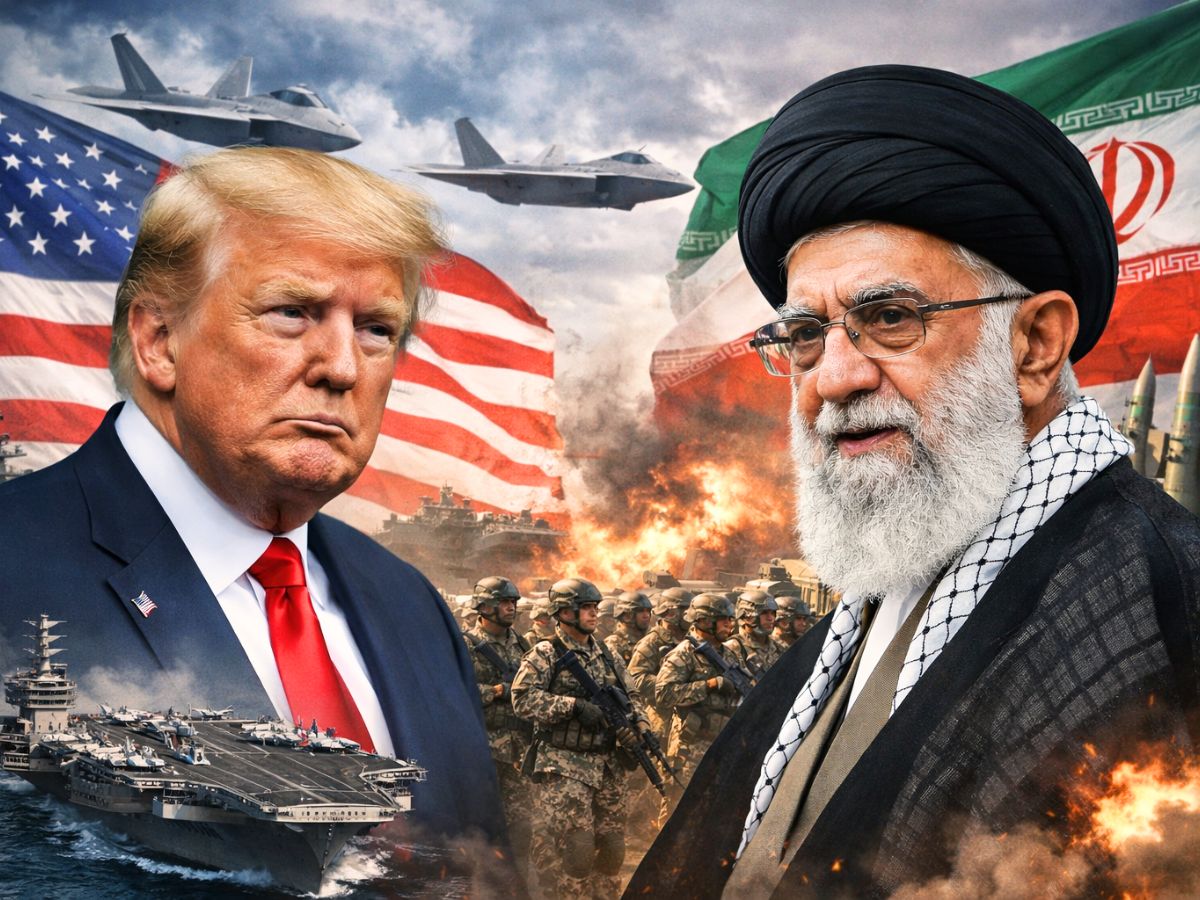
Iran vs US: United States is ranked first globally in military strength. (Photo: AI)
As tensions heat up between the United States and Iran, global attention has now turned to a crucial question: if conflict breaks out, who would dominate the war front? While no war has officially begun, sharp rhetoric from leaders on both sides and increased military posturing have revived fears of a wider confrontation in the Middle East.
In this article we made a comparison of US and Iran military powers. A comparison of their military capabilities reveals a transparent imbalance in conventional power but also highlights Iran’s ability to challenge US dominance through asymmetric warfare.
The United States is ranked first globally in military strength, backed by an enormous defence budget exceeding $895 billion. Iran, by contrast, ranks 16th, with military spending estimated at just over $15 billion giving Washington a nearly 60-to-1 financial advantage in military resources.
This funding gap translates into superior technology, logistics, training and sustained combat capability for the US armed forces.
The US military commands around 1.3 million active-duty personnel, supported by a large reserve force. Iran fields approximately 610,000 active troops, but compensates through a strong paramilitary structure.
Tehran maintains powerful forces such as the Islamic Revolutionary Guards Corps (IRGC) and the volunteer Basij militia, which significantly boost its mobilisation capacity and domestic control, particularly in regional defence strategies.
In the skies, US dominance is overwhelming. The US Air Force operates more than 13,000 military aircraft, including advanced fifth-generation stealth fighters like the F-22 Raptor and F-35 Lightning II, along with bombers, refuelling aircraft and transport fleets.
Iran’s air force is far smaller, relying on roughly 550–560 ageing aircraft, many of them decades old, leaving Tehran at a severe disadvantage in aerial warfare.
The US Navy remains the world’s most powerful maritime force, with 11 aircraft carriers, 81 destroyers, and a fleet capable of projecting power across the globe.
Iran operates a “green-water” navy focused on the Persian Gulf. Rather than competing directly with US carriers, Tehran relies on submarines, naval mines and swarms of armed speedboats designed to disrupt shipping lanes and threaten energy routes through the Strait of Hormuz, a vital chokepoint for global oil supplies.
Iran’s greatest strength lies in its missile arsenal. It possesses the largest ballistic missile stockpile in the Middle East, with over 3,000 missiles, enabling it to strike regional US bases and allies.
By comparison, the US holds an estimated 25,000 to 30,000 missiles across all categories, but Iran’s focus on missile warfare, drones and proxy militias allows it to offset conventional disadvantages through asymmetric tactics.
The United States is a recognised nuclear superpower with a vast nuclear arsenal and established delivery systems.
Iran does not possess nuclear weapons but is widely considered a “threshold state,” having enriched uranium to near weapons-grade levels a central source of diplomatic tension and sanctions over the past decade.
Another decisive factor is alliances. The US benefits from NATO and strategic partnerships across Europe, Asia and the Middle East, operating from more than 750 overseas military bases worldwide.
Iran counters this with its “Axis of Resistance,” a network of proxy forces including Hezbollah in Lebanon, militias in Iraq and Syria, the Houthis in Yemen, and armed groups in Gaza allowing Tehran to project influence without deploying large conventional forces.
Iranian President Masoud Pezeshkian recently warned of a “harsh and discouraging” response to any attack on Iranian territory, while senior leaders have said US bases and ships would be legitimate targets in case of hostilities.
US President Donald Trump has stated that Washington is considering “very strong options” regarding Iran, signalling that military action remains on the table.
In a full-scale conventional war, the United States would clearly dominate due to its unmatched air power, naval reach, technology and global alliances.
However, analysts warn that Iran’s asymmetric strategy combining missiles, proxy militias, cyber warfare and regional disruption could make any conflict prolonged, unpredictable and costly, particularly for US allies and global energy markets.
While the US holds overwhelming conventional superiority, Iran’s ability to destabilise the region through indirect warfare ensures that any conflict would not be swift or simple. For now, both sides continue to rely on deterrence, diplomacy and strategic signalling, aware that a full-scale war could reshape the Middle East and beyond.
Sofia Babu Chacko is a journalist with over five years of experience covering Indian politics, crime, human rights, gender issues, and stories about marginalized communities. She believes that every voice matters, and journalism has a vital role to play in amplifying those voices. Sofia is committed to creating impact and shedding light on stories that truly matter. Beyond her work in the newsroom, she is also a music enthusiast who enjoys singing.
The Gujarat Giants will kick off their IPL 2026 campaign against the Punjab Kings on…
Papmochani Ekadashi 2026 spans March 14–15, but devotees should fast on March 15 for maximum…
Canva Down: Popular graphic design platform Canva experienced a major global outage, leaving thousands of…
